A useful college baseball map should help you choose an area, identify real programs and find the correct ballpark for a confirmed game. This national D1 campus map supplies the first two steps. Use its numbered school key and the state directories to build a shortlist, then check the school's baseball schedule and venue before traveling.
Start with the national D1 baseball campus map
The map places 309 institutions returned by the NCAA Division I baseball directory in our October 15, 2026 snapshot. Green points show the matched campuses; 27 navy points provide numbered reference schools. The examples are geographic anchors rather than a ranking or an endorsement of the closest option for every reader.
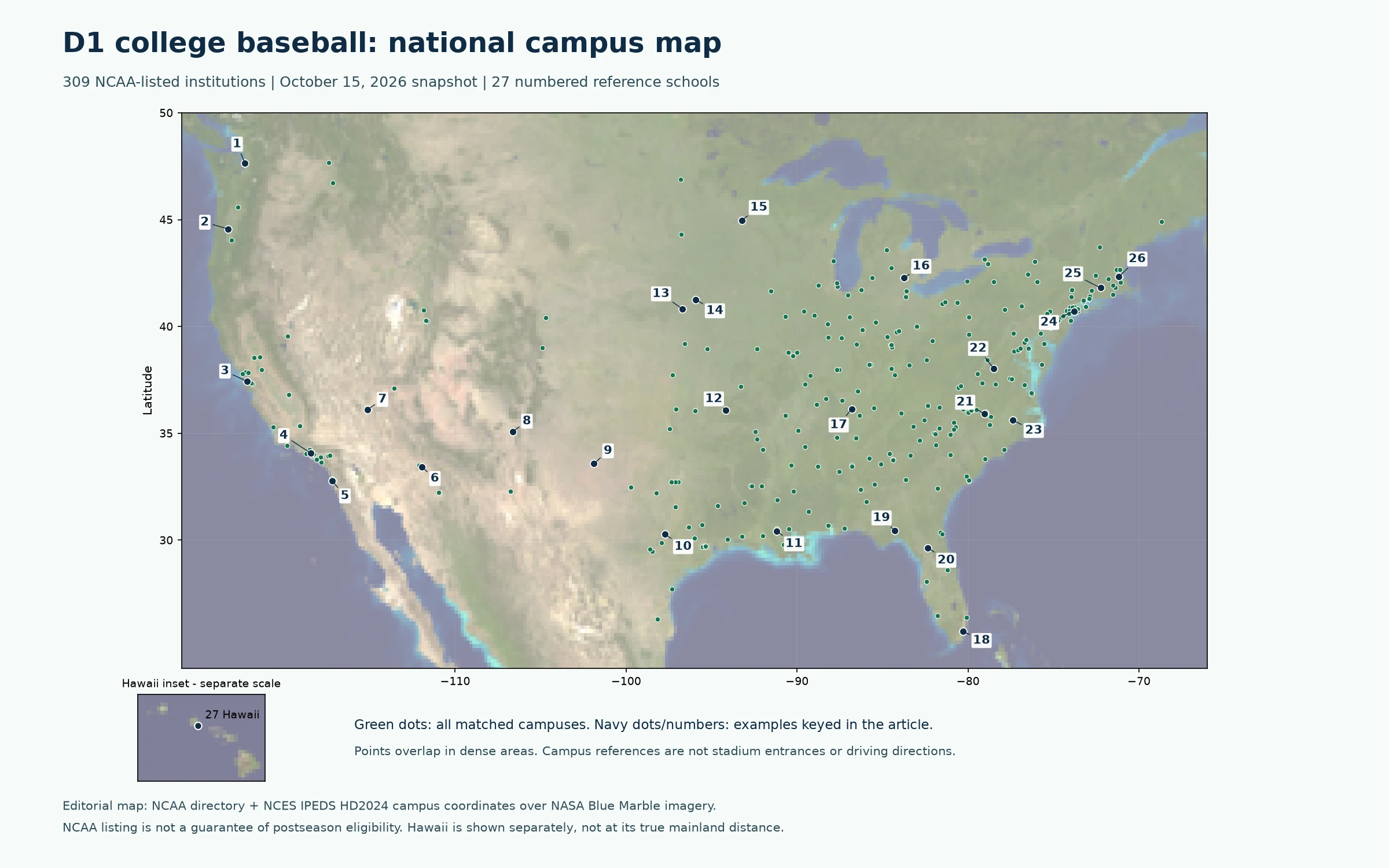
What each point represents
Coordinates come from the NCES IPEDS HD2024 institutional dataset, matched to the NCAA school's identity and state. They represent a campus reference location. They do not identify the baseball gate, parking entrance or a temporary home field. The membership snapshot is newer than the coordinate dataset, so treat this as geographic orientation rather than a live venue tracker.
Names also require care. A university can have several campuses, and an athletics label may differ from its federal reporting name. We reviewed the alternate-name matches and used the relevant campus rather than an online branch or a similarly named college. A point on this map is not a claim that every listed institution has identical championship eligibility or the same number of scheduled games.
The national scale is useful for seeing broad choices. It is less useful for deciding which of several neighboring parks is easiest to reach from a particular hotel. Open the larger image for reference, use the text key below to identify the numbered examples, and then narrow the search through the D1 schools by state directory. That directory includes schools that do not have a numbered label here.
This is a static map: it does not read your location or calculate a personalized nearest-team list. If two green points appear to touch, their campuses can still be several neighborhoods apart. The practical next question is which home schedules fit your dates, followed by where those games will actually be played.
| Map | School and official athletics site | Campus city |
|---|---|---|
| 1 | Washington | Seattle, WA |
| 2 | Oregon State | Corvallis, OR |
| 3 | Stanford | Stanford, CA |
| 4 | UCLA | Los Angeles, CA |
| 5 | San Diego | San Diego, CA |
| 6 | Arizona State | Tempe, AZ |
| 7 | UNLV | Las Vegas, NV |
| 8 | New Mexico | Albuquerque, NM |
| 9 | Texas Tech | Lubbock, TX |
| 10 | Texas | Austin, TX |
| 11 | LSU | Baton Rouge, LA |
| 12 | Arkansas | Fayetteville, AR |
| 13 | Nebraska | Lincoln, NE |
| 14 | Creighton | Omaha, NE |
| 15 | Minnesota | Minneapolis, MN |
| 16 | Michigan | Ann Arbor, MI |
| 17 | Vanderbilt | Nashville, TN |
| 18 | Miami (Florida) | Coral Gables, FL |
| 19 | Florida State | Tallahassee, FL |
| 20 | Florida | Gainesville, FL |
| 21 | North Carolina | Chapel Hill, NC |
| 22 | Virginia | Charlottesville, VA |
| 23 | East Carolina | Greenville, NC |
| 24 | St. John's (New York) | Queens, NY |
| 25 | UConn | Storrs, CT |
| 26 | Boston College | Chestnut Hill, MA |
| 27 | Hawaii | Honolulu, HI |
For example, numbers 13 and 14 mark Nebraska in Lincoln and Creighton in Omaha. They are two institutions in the same state, not two names for the same team. Number 27 places Hawaii separately so that the mainland map stays readable; the inset must not be interpreted as showing Hawaii next to California.
Find a useful baseball area before choosing a school
Start with where you will sleep or spend the day, rather than with the most famous team in a state. A visitor based near a particular airport, campus or business district faces a different set of practical choices from someone already staying beside a ballpark. The national view helps identify possible regions; the actual starting address turns those possibilities into a workable search.
Dense clusters can cross state borders
State lines organize a directory but do not necessarily organize a local trip. Cincinnati's campus is in Ohio, while Northern Kentucky's is in Highland Heights, Kentucky. A visitor considering baseball around Cincinnati should investigate both institutions' home schedules rather than stopping at the state boundary. That is a geographic search suggestion, not a claim that the two campuses have the same travel time from every hotel.
The reverse problem appears in large states. Two Texas schools can share a state label while belonging to very different travel plans. Texas Tech in Lubbock and Texas in Austin are separate destinations; a national point map helps prevent them from collapsing into one generic "Texas baseball" choice. Check the city before treating another school as an easy fallback.
Compare several plausible options before choosing. One may be away, another may have an early afternoon start, and a third may offer the matchup you most want. The most useful nearby team for a visitor can therefore change from weekend to weekend without either the campus or the hotel moving.
A conference is not a driving region
Modern conference geography can be much wider than its name suggests. The ACC's official baseball hub includes California programs alongside its Atlantic-side schools. Selecting a conference is useful for understanding opponents and standings; it is a poor substitute for checking a route between ballparks.
Read the baseball affiliation for the relevant season when you use a conference page. University-wide membership, another sport's arrangement and an older baseball season can tell different stories. A regional itinerary does not require all of its stops to share a league, and two conference rivals are not automatically suitable for a same-day doubleheader.
Use the state directories for the next level of detail
For Texas, our 22-school map and regional guide separates the Dallas-Fort Worth, Houston, central/southern and western choices. For California, the 26-school guide supplies a closer look at northern, central and southern programs. Those dated directories are better tools for reading dense groups than trying to fit every campus name onto one national image.
Elsewhere, use the national state directory to find the full set of listed institutions, then open the official athletics site. The sequence should be area, school, home game and exact venue. Reversing it by choosing a well-known name first can leave you with a long trip to a team that is not even playing at home.
Keep the scope in mind when the D1 map looks sparse. It does not show every NCAA Division II or III, NAIA or two-year program. A green-point gap means there are fewer entries in this particular map, rather than proof that no college baseball is played nearby. Our divisions guide helps widen that search.
Check the ballpark rather than navigating to the campus label
A college baseball trip can involve three different destinations: the institution's campus reference, the game venue and the approved arrival point. Saving only the school name leaves two of those questions unresolved. The distinction matters for an unfamiliar city, a shared stadium and a home game played away from the institution's central campus.
UCLA shows why the stadium needs a separate check
UCLA's campus point locates the university, while its stadium information places Jackie Robinson Stadium on Constitution Avenue west of Sepulveda Boulevard. These are different geographic references. Choosing UCLA on a national campus map should start the venue search, not finish it.
The university's official 2026 baseball schedule provides a dated example: the February UC San Diego home series was listed at Jackie Robinson Stadium, while UCLA's late-February tournament games in Arlington were at Globe Life Field. A campus dot cannot encode both locations. Those historical listings also do not constitute an announcement that every future UCLA home game will use a particular venue.
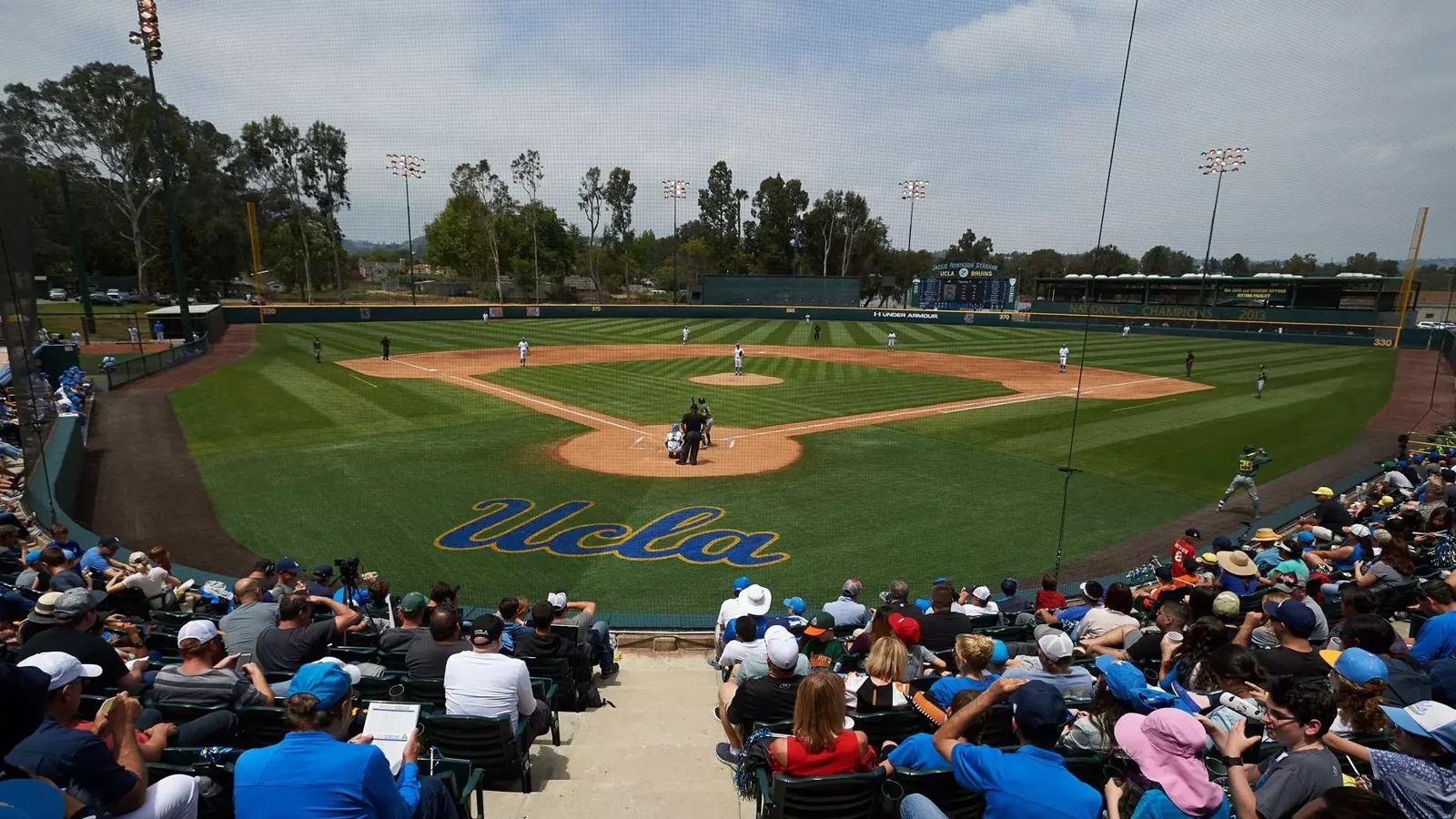
This principle applies beyond UCLA. An athletics complex may sit on a different side of town from the university's mailing address, and a special event may use a professional park. Read the location field for the specific game, then open the venue's own directions. A general map search can otherwise land on an administration building, another sport's stadium or an outdated entrance.
Save the entrance and parking information together
UCLA's game-day page, checked for this guide, directs baseball fans to off-site parking and a Lot 32 shuttle. That is a useful example of why navigating directly to a field can be the wrong arrival plan. Recheck the instructions for the game you will attend; a saved policy from an earlier season may not remain applicable.
Keep four items together on your phone: the confirmed game listing, the ballpark name, the parking or transit destination, and the walking or shuttle instructions for the last part of the journey. If you are meeting friends, agree on an arrival point that can actually be reached before ticket scanning rather than saying only "at the stadium."
For an accessible visit, investigate the route from the approved drop-off or parking area to the seating location. A campus point and a straight-line distance reveal little about that final section. Use the host's accessibility information or ticket office to resolve the details that affect your party. The national map is a way to discover candidates; the host's event instructions make one candidate usable.
Turn nearby teams into games you can actually attend
After choosing two or three plausible schools, put their schedules beside your travel dates. Keep the year visible. A search engine can return a previous season's schedule with a familiar opponent and a convincing afternoon start time. That is useful historical information, but it does not establish a game on your upcoming visit.
Check the home, away or neutral designation and read the location text as well. An opponent appearing on a school's schedule is not evidence that it will visit that campus. A neutral tournament can place a familiar team hundreds of miles from its map point, while a home series can bring a distant opponent into the area you are visiting.
Creighton's 2026 official schedule gives a concrete example of the next level of detail. Its Gonzaga series at Charles Schwab Field Omaha included two games on March 7 and another on March 8. A reader assuming that every three-game series occupies three separate dates could miss the doubleheader. This is a dated example, not a forecast of the 2027 calendar.
Separate the number of games from the number of tickets or admission sessions. A doubleheader listing tells you that two games are planned, but the host's ticket terms explain what your purchase covers. Likewise, a rivalry series or special promotion may have different availability from a less prominent midweek game. Look at the actual event offer rather than assigning every nearby college park the same price or admission policy.
Think about the baseball experience you want. Staying for a series gives you a chance to see different starting pitchers and how managers respond after the first game's result. A single midweek visit may fit a business trip more easily and provide a different matchup. Neither guarantees that a particular pitcher or position player will appear; check announced lineups and pitching plans close to the game.
Write the start time together with its time zone. A national schedule may display times in your selected zone, while an official school page may show local time or another stated convention. If you are crossing a time-zone boundary, compare those settings before deciding that two listings disagree. A start time marked TBD is an unresolved planning input, not an invitation to assume an evening game.
Our schedule and team directory can help you browse, but the official game announcement should resolve a venue change or postponement. Recheck on the travel day, especially when weather affects several games in a series. A campus stays on the map even when that afternoon's game moves or disappears from the plan.
Build a realistic multi-park baseball trip
Once you have confirmed games, decide whether you want depth at one series or variety across several parks. Three visits to the same matchup let you follow adjustments: a lineup reacting to a different starter, a bullpen responding to yesterday's workload, or a manager protecting a narrow series lead. Two parks offer contrasting settings and teams, but you give up part of that continuing baseball story.
Neither approach is automatically better. A first-time visitor may value one relaxed game with time to explore the ballpark. A fan following a particular team may prefer an entire series. Someone collecting different venues may accept a longer journey for a second park. Choose the experience first, then use geography to test whether the plan fits.
Compare routes only after confirming the games
Take Nebraska and Creighton as real geographic candidates, shown at numbers 13 and 14. Nebraska's official schedule and Creighton's schedule provide the evidence needed to investigate a particular season. Their Lincoln and Omaha campus locations alone do not establish that both will host on the dates you have available.
A hypothetical plan might put a Friday game at Park A and a Saturday game at Park B. Before booking it, confirm both events, compare the route from your actual accommodation, and work backward from the second park's arrival requirements. Do not turn the straight line between two campus points into a guaranteed driving time. Traffic, parking, shuttle arrangements and the walk to the gate are separate inputs.
A same-day plan needs more margin than two dots suggest. Extra innings, a delayed first pitch or a slow exit from the parking area can make the second start impossible even when the road distance looks manageable. If watching both opening pitches matters, consider different days. If you are comfortable arriving late, understand what you would sacrifice rather than treating a tight connection as certain.
A small trip worksheet
- School, opponent and confirmed date.
- Venue name and official game listing.
- Start time and the time zone used.
- Ticket coverage, arrival destination and final walking or shuttle route.
- Travel margin and the point at which you will abandon a second stop.
- A backup home game or a confirmed broadcast if the original plan changes.
Use a nearby alternative only after verifying its home listing. Driving to another campus because its green dot is close is not a substitute for checking whether baseball is being played there that day. If the whole area loses games to weather, the TV schedule and viewing guide can help identify another confirmed game to follow.
The useful result is a short, checked list rather than the largest possible collection of map points. Start with the national picture, choose a region, identify the actual schools and finish with the game and arrival instructions. That turns "college baseball near me" into a decision you can act on.
Join the conversation
Share a question or a thought about college baseball. Comments are reviewed before they appear. Keep it friendly and on topic.
No comments yet. Start the conversation.
Sign in with Google to leave a comment. Your email address is not displayed.