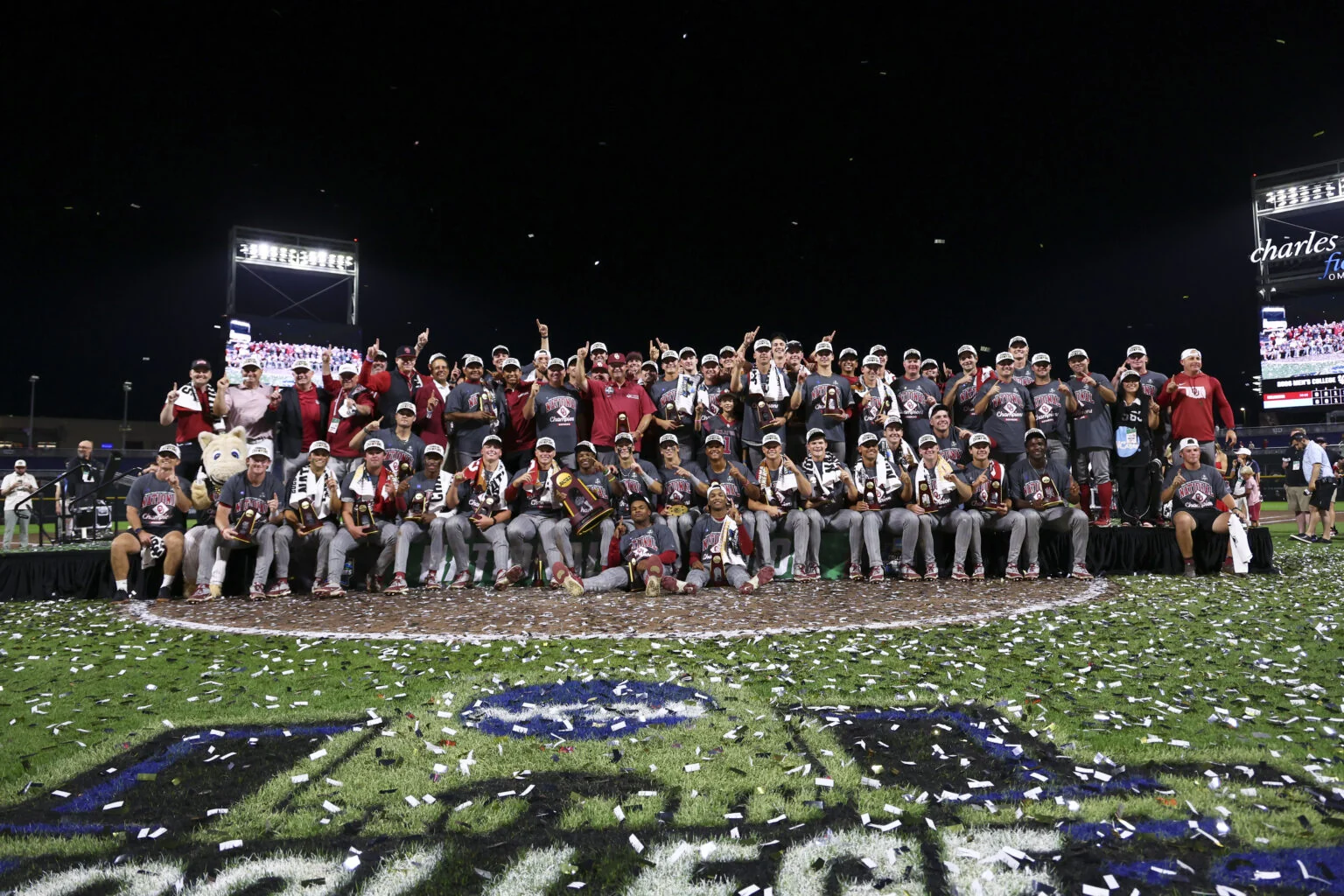
Find D1 baseball schools by state in this complete, dated NCAA directory snapshot. The list below contains 309 institutions in 45 states and Washington, D.C., using the NCAA baseball-filtered Division I records retrieved September 29, 2026 for the 2026–27 academic year.
Browse the regional tables for every listed institution, including states with no entry, then follow the official athletics links. This is a school-location directory, not a team ranking or a guarantee of championship eligibility.
How to use this state-by-state D1 baseball directory
The NCAA's baseball-filtered Division I directory contains 309 institutions across 45 states and Washington, D.C., in the September 29, 2026 snapshot used here. The records identify the 2026–27 academic year. California has the most entries with 26, followed by Texas with 22, New York with 19, North Carolina with 18 and Florida with 14.
The tables below reproduce the institutions in that snapshot, organized geographically for easier browsing. Each school appears once, under the state recorded by the NCAA. The regional headings are navigation aids; they are not NCAA tournament regions or conference groupings. Within each table, the count gives the number of institutions listed for that state, and the school names link to the athletics websites supplied by the directory.
This is a current membership-directory list, not a reconstructed list of every team that competed during the completed spring 2026 season. Directory inclusion alone also does not certify postseason eligibility for the next championship. Program launches, returns and classification transitions can create differences between a membership snapshot and a season's actual participants. Use our explanation of the national D1 baseball count when that distinction matters.
The NCAA membership directory is the primary source for the list. To repeat the search, choose Division I and baseball in the sport-filtered member list. Searching Division I without a sport filter would include universities that do not sponsor varsity baseball.
For a quick lookup, use your browser's find function with the state name or university name. Official institutional names sometimes differ from the short name on a scoreboard, so try a distinctive part of the name. The tables deliberately avoid adding an unverified conference column: the institution's primary conference can differ from its baseball affiliation, and recent realignment makes that distinction particularly important.
D1 baseball schools in the Northeast
The Northeast grouping contains 57 institutions in the snapshot. New York's 19 entries make it the largest D1 baseball state in this region. The schools range from institutions with familiar national athletic brands to programs that may be easier to discover through a local search. None is omitted because of its poll position or media profile.
New England
Massachusetts has eight entries and Connecticut has seven, while Rhode Island has three. Maine and New Hampshire each have one. Vermont has no entry in this D1 baseball snapshot. Those differences describe program availability by state; they do not measure the quality of an individual team or the strength of baseball at other college levels.
| State | Schools | Institutions and official athletics links |
|---|---|---|
| Connecticut | 7 | Central Connecticut State University; Fairfield University; Quinnipiac University; Sacred Heart University; University of Connecticut; University of New Haven; Yale University |
| Maine | 1 | University of Maine |
| Massachusetts | 8 | Boston College; College of the Holy Cross; Harvard University; Merrimack College; Northeastern University; Stonehill College; University of Massachusetts Lowell; University of Massachusetts, Amherst |
| New Hampshire | 1 | Dartmouth College |
| Rhode Island | 3 | Brown University; Bryant University; University of Rhode Island |
| Vermont | 0 | No institutions listed |
Names can make a search unnecessarily difficult. Connecticut may appear as UConn on a scoreboard, and Massachusetts Amherst and Massachusetts Lowell are separate institutions. Use the official link for the specific campus, then choose baseball in its sports menu. That small step prevents a search for one university system from taking you to another campus's team.
New York, New Jersey and Pennsylvania
These three states account for 37 entries. New York's list includes the U.S. Military Academy, whose team is commonly identified as Army. New Jersey's Rutgers entry is specifically the New Brunswick institution. Pennsylvania includes both the University of Pennsylvania and Pennsylvania State University; their similar geographic names do not make them the same baseball program.
La Salle illustrates why a dated directory is useful. Its official 2026 schedule announcement described the Explorers' first season back since 2021. It also included games against Pennsylvania opponents such as Villanova, Penn, Saint Joseph's, Bucknell and Lafayette. An older list could miss the returning program, while a state-based search helps reveal nearby opponents without assuming that all belong to one conference.
D1 baseball schools in the South
The Southern grouping contains 151 directory entries, including the two institutions listed under Washington, D.C. The tables separate the large region into three manageable groups. They do not imply that schools within a group share a league, a postseason route or a short drive between campuses.
Atlantic states and Washington, D.C.
North Carolina's 18 entries provide a particularly wide choice of programs to explore. Florida has 14 and Virginia has 13 in this snapshot. Pay attention to the campus suffix in state-university names: Maryland College Park, Maryland Baltimore County and Maryland Eastern Shore are three different programs, just as South Carolina Columbia and South Carolina Upstate are distinct entries.
Washington, D.C., is displayed separately because it is not a state. Its two entries are Georgetown and George Washington. This is an institutional-location directory, so it should not be treated as a map of where every home game is played. Check the venue named on the actual schedule before planning a visit.
Kentucky, Tennessee and the Gulf states
This group includes 46 institutions. Louisiana has 12, Alabama and Tennessee each have 10, Kentucky has eight and Mississippi has six. The University of Mississippi may be easier to recognize as Ole Miss, while the University of Southern Mississippi often appears as Southern Miss. The fuller names below preserve the source's institutional identity.
The Louisiana list also preserves the directory's current LSU New Orleans name. A school's displayed institutional name and its athletics branding may differ during an update or transition. Follow the official athletics link and check its baseball page rather than assuming that a change in wording represents an additional team.
Arkansas, Oklahoma and Texas
Texas has 22 entries, Arkansas five and Oklahoma three. The Texas list includes several separate A&M and University of Texas institutions, as well as private universities and other public systems. Searching only for a system name can hide the specific campus a fan or recruit actually wants.
Dallas Baptist provides a useful reminder that geography and baseball affiliation answer different questions. The Pac-12's official announcement named DBU as a baseball affiliate for 2026–27, alongside a league field that includes Texas State. Both remain Texas entries in a state directory. A conference name is not a reason to move a university into a different geographic list.
For a more local comparison, begin with the school's official venue information. Rice's Reckling Park page identifies the baseball facility on its Houston campus. That is the kind of specific information needed after a statewide list has narrowed the search.
D1 baseball schools in the Midwest
The Midwest grouping contains 54 institutions. Ohio has 12 entries, Illinois 10 and Indiana nine. At the other end of the count, Iowa, North Dakota, South Dakota and Wisconsin each have one institution in this specific D1 baseball directory. A small statewide total does not mean the state has only one college baseball team across all levels.
Several names deserve careful reading. Ohio University and Ohio State are separate programs. Miami University in this table is the Ohio institution, not the University of Miami in Florida. Southern Illinois at Carbondale and Southern Illinois Edwardsville are also different entries. A school system or familiar nickname should not be used to combine them.
The single Wisconsin entry is the University of Wisconsin-Milwaukee. The Dakota entries are North Dakota State and South Dakota State. These distinctions matter when a search begins with an institution best known from another sport: a prominent football or basketball program does not automatically mean the same institution sponsors D1 baseball.
Iowa offers a straightforward example of the next search step. Its official baseball hub separates the schedule, roster, game-day information and statistics. Choose the resource that answers your question instead of assuming that the most recent news item is the next regular-season game. A September fall report and a spring season's results describe different parts of the program's calendar.
For readers near a state border, expand the shortlist to neighboring states before judging how many practical options are available. State counts are convenient for organizing a directory, but a border does not establish travel time. Use the exact venue and date to decide whether a game fits an evening trip or requires a longer visit.
D1 baseball schools in the West
The Western grouping contains 47 institutions, with 26 in California alone. The Pacific-state table accounts for 34 entries and the Mountain-state table for 13. As elsewhere in this guide, these are geographic groupings for finding schools, not a list of members in a conference with a Western name.
Pacific states
California's variety makes campus identity especially important. The University of California and California State University systems include multiple distinct baseball programs, alongside private institutions. Cal is the Berkeley entry, UCLA is the Los Angeles entry, and Cal Poly is listed under its official California Polytechnic State University name. A nickname does not add another institution to the total.
The University of San Diego and San Diego State are different institutions. UC San Diego is a third, separate university. Likewise, the University of San Francisco is not San Francisco State; the latter is outside this D1 directory's scope. Read the complete name before following a schedule or contacting a staff.
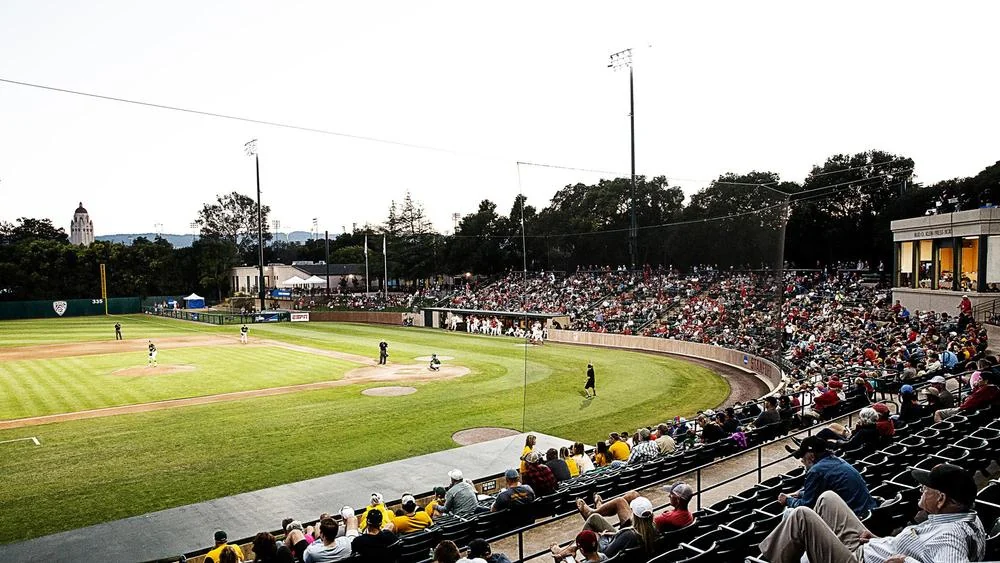
Stanford's official facility page identifies the venue pictured here. Once a state list has produced a shortlist, venue pages help turn university names into actual places to watch. They also prevent the mistaken assumption that all games take place at the institution's general mailing address.
Mountain states
Utah has four entries and Arizona has three. Colorado, Nevada and New Mexico each have two. In Colorado, the listed programs are Northern Colorado and the U.S. Air Force Academy. In Nevada, the Reno and Las Vegas entries are separate institutions, often shortened to Nevada and UNLV in baseball coverage.
| State | Schools | Institutions and official athletics links |
|---|---|---|
| Arizona | 3 | Arizona State University; Grand Canyon University; University of Arizona |
| Colorado | 2 | U.S. Air Force Academy; University of Northern Colorado |
| Idaho | 0 | No institutions listed |
| Montana | 0 | No institutions listed |
| Nevada | 2 | University of Nevada, Las Vegas; University of Nevada, Reno |
| New Mexico | 2 | New Mexico State University; University of New Mexico |
| Utah | 4 | Brigham Young University; University of Utah; Utah Tech University; Utah Valley University |
| Wyoming | 0 | No institutions listed |
Alaska, Idaho, Montana and Wyoming have no entries in the snapshot. For a nearby-game search, that means broadening the geographic area or considering another college baseball level. It does not justify adding a school merely because it sponsors other Division I sports or appears in a general college directory.
Which states have no D1 baseball schools in this snapshot?
Alaska, Idaho, Montana, Vermont and Wyoming have no institutions in the NCAA Division I baseball-filtered snapshot used for this directory. That is a precise statement about one division and one sport on the stated date. It is not a claim that these states have no baseball, no college athletes or no institutions competing in other Division I sports.
The distinction is easy to miss when looking at a university's overall athletics identity. A school can be a Division I member and still not sponsor varsity baseball. Conversely, a baseball program can offer meaningful varsity competition through another NCAA division, the NAIA or a two-year association. Those teams belong in a broader college baseball search, but adding them here would make this D1 list inaccurate.
If your first-choice state has no entry, decide which requirement matters most. A fan who wants a nearby game can investigate other college levels. A prospective student who specifically wants a D1 baseball program can expand the state search while comparing academic and financial fit. Those are different decisions, so one directory should not pretend to answer both automatically.
The NAIA's baseball hub, for example, has its own scores, polls and championship information. It illustrates why searching another association requires a new competition context rather than treating an absent D1 entry as the end of college baseball research. Our college baseball divisions guide explains those parallel systems.
Finally, a zero should be rechecked when the directory is updated. A future program announcement can change the landscape, but an announcement and an active season are not interchangeable. Confirm the start date through the institution and the governing association before adding a school to a current-season list. The same date discipline applies to states with many entries.
Turn a state shortlist into a useful baseball search
After finding a school, decide what you need from the next page. A fan looking for a game needs the current schedule and venue. Someone comparing programs needs the baseball roster and staff information. A prospective student also needs academic, admission and financial-aid information from the institution. A state directory helps you find candidates; it does not replace those separate checks.
For game planning, select the correct season first. A schedule archive can remain highly visible in search after a season ends, and a fall exhibition can appear beside news about the next spring. Confirm the date, home or away designation, start time and venue before arranging travel. When the time is displayed in a different zone, keep the venue's local time in view.
Use our team pages to connect a recognizable program name with schedule coverage, and the conference directory to explore league context. Then confirm the particular game's latest details through the host institution. The number of institutions in a state does not tell you how many will be at home on the weekend you have available.
For playing opportunities, avoid reading the table as a recruiting ranking. A large state total does not guarantee more openings at a particular position, and a school's presence does not establish scholarship funding or personal eligibility. The NCAA Eligibility Center provides the appropriate starting resources for the NCAA pathway. Direct individual questions to the school's admissions, financial-aid and athletics compliance staff as appropriate.
For postseason research, use the named championship and season rather than counting institutions from this page. The NCAA Division I baseball championship hub serves a different purpose from its membership directory. One describes the competition and its resources; the other identifies institutions within a chosen membership and sport scope.
Keep the date of your own shortlist beside the names. That makes it easier to notice a program return, a school-name change or a conference move when new information appears. A geographically organized list becomes most useful when it leads to a small set of current, specific program pages that answer your actual baseball question.
Join the conversation
Share a question or a thought about college baseball. Comments are reviewed before they appear. Keep it friendly and on topic.
No comments yet. Start the conversation.
Sign in with Google to leave a comment. Your email address is not displayed.