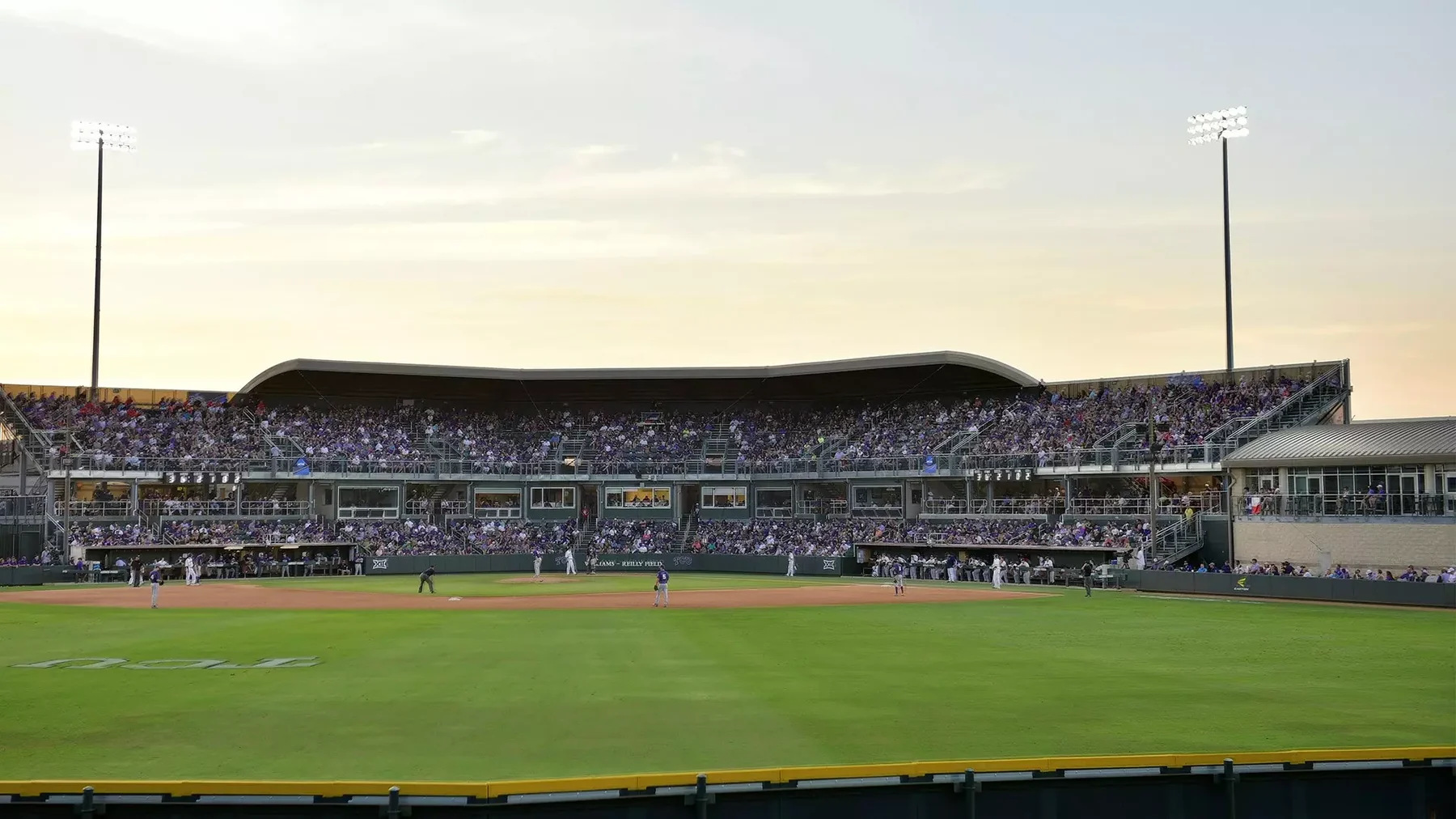
This Texas college baseball map covers all 22 institutions in the NCAA Division I baseball directory snapshot retrieved September 29, 2026. Use the statewide view and the Dallas-Fort Worth and Houston detail panels to locate programs, then browse every school in the regional tables.
The guide also connects the map to real ballparks, explains the DBU and Texas State conference change for the 2026-27 academic year, and points to selected programs outside Division I. It is a geographic directory for choosing your next school or game to explore, with official athletics links throughout.
Texas college baseball map: all 22 D1 institutions
Texas has 22 institutions in the NCAA's Division I baseball directory snapshot retrieved September 29, 2026. Every one appears on this map and in the regional tables below. The membership records cover the 2026-27 academic year; they should not be confused with a list of teams that qualified for the completed 2026 NCAA tournament.
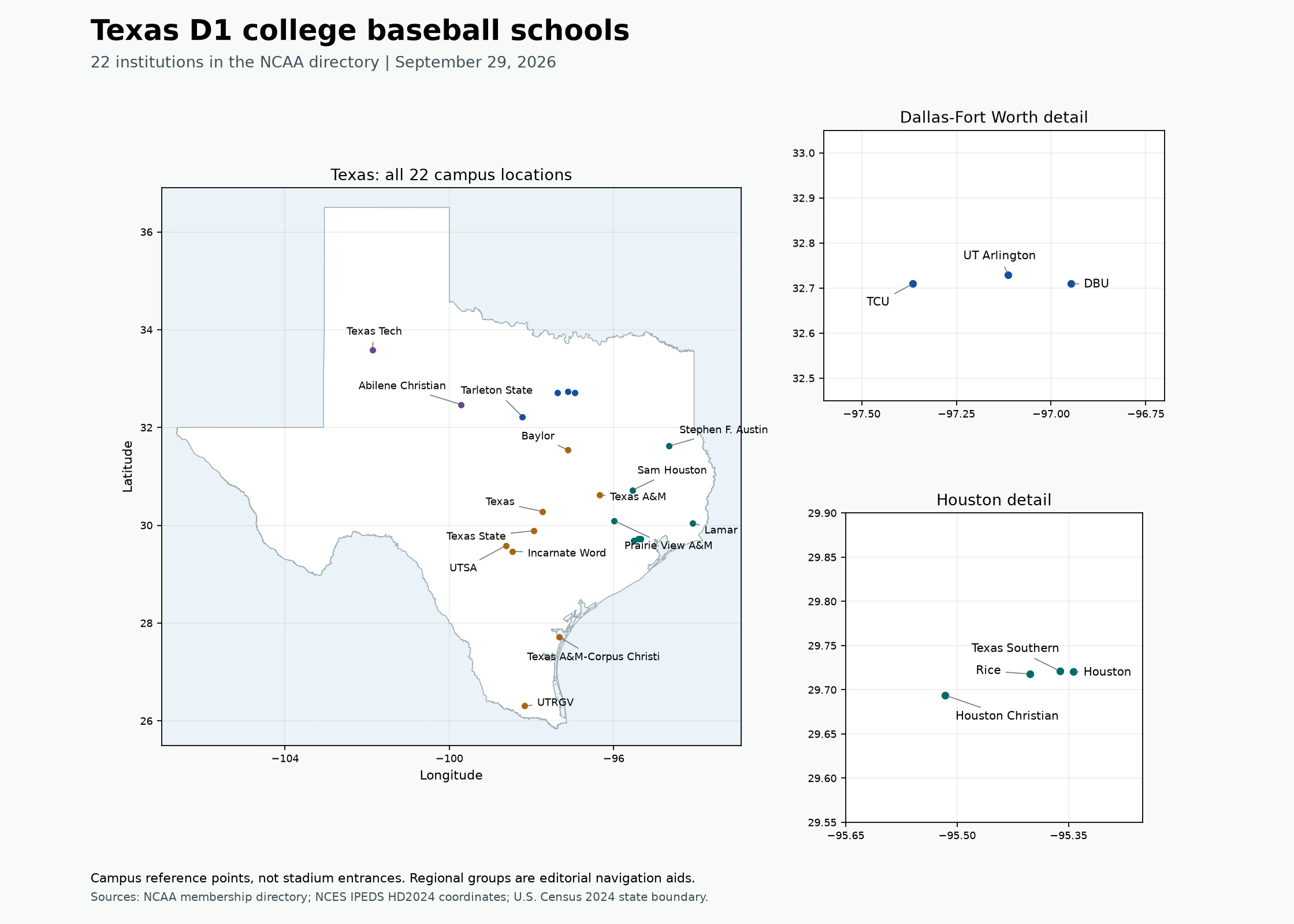
The school list comes from the NCAA's baseball-filtered Division I directory. Positions use the NCES IPEDS institutional file, with a Census cartographic boundary for Texas. The geographic file is older than the membership snapshot and serves only to locate established campuses.
For easier browsing, the article groups four schools in Dallas-Fort Worth and nearby North Texas, eight around Houston and across Southeast and East Texas, eight in Central and South Texas, and two in West Texas. These editorial groups are navigation aids. They do not define conference membership, recruiting areas or postseason regions.
Dense clusters need a closer view. The two inset panels separate the Dallas-Fort Worth institutions and the four schools inside Houston, while the statewide panel shows how those clusters relate to programs in Lubbock, Abilene, the Rio Grande Valley and other cities. A nearby point indicates another institution to explore, not an available home game or a particular driving time.
For a broader comparison, use the D1 baseball schools by state directory. Within Texas, read the school name and city together: several universities share a system name but operate separate baseball programs.
The complete D1 scope is useful when comparing regions with very different densities. Houston contains multiple institutions within the same city, while West Texas has fewer points spread across a broader area. Counting only familiar conference brands would miss part of that landscape, so the regional tables retain every directory entry.
Dallas-Fort Worth and nearby North Texas programs
Four institutions make up this northern group. Dallas Baptist, TCU and UT Arlington form the metropolitan cluster shown in the map inset. Tarleton State lies farther southwest in Stephenville. Together they offer several distinct starting points for a North Texas baseball visit, rather than a single program attached to the entire Dallas-Fort Worth area.
Three D1 choices in the Metroplex
| Institution and official athletics site | City |
|---|---|
| Dallas Baptist University | Dallas |
| Texas Christian University | Fort Worth |
| University of Texas at Arlington | Arlington |
TCU's ballpark provides a useful connection between the region's schools. According to the university's Lupton Stadium history, the venue opened on February 2, 2003 with UT Arlington as the visiting opponent. The stadium and its Williams-Reilly Field are in Fort Worth, with the athletics department listing 3700 Berry Street as the baseball address.
That history illustrates why the metropolitan map is more useful when it retains every institution. A visitor based in Dallas may consider DBU, while someone staying in Fort Worth may begin with TCU. Arlington adds a third campus between those city names. The best choice for a particular evening depends on the home schedule and the type of visit you want, not on which name occupies the largest space in national baseball coverage.
DBU belongs in this D1 baseball list because the directory is filtered by sport. Its baseball classification is the relevant one here. The conference section later in this guide explains the program's new league arrangement for the 2026-27 year.
Tarleton State in Stephenville
| Institution and official athletics site | City |
|---|---|
| Tarleton State University | Stephenville |
Tarleton State gives the northern group a separate college-town destination. Its baseball complex information places the field on the south side of Washington Street beside the baseball and softball indoor facilities. The university describes a second renovation phase completed ahead of the 2023 season that added a roof structure and a new press box.
For a trip centered on Stephenville, start with Tarleton's official athletics link in the table. For a trip centered on the Metroplex, treat Stephenville as a separate stop and assess the journey using your actual starting point. Grouping these four institutions together helps organize the state; it does not imply that every pair of campuses is equally convenient to combine in one day.
Houston, Southeast Texas and East Texas programs
Eight D1 institutions occupy this broad eastern group. The Houston inset separates four campuses within the city, while Prairie View, Beaumont, Huntsville and Nacogdoches extend the regional picture beyond Houston itself. These names are useful both for fans choosing a nearby game and for readers trying to identify an unfamiliar opponent on a schedule.
Five schools in and around Houston
| Institution and official athletics site | City |
|---|---|
| University of Houston | Houston |
| Houston Christian University | Houston |
| Rice University | Houston |
| Texas Southern University | Houston |
| Prairie View A&M University | Prairie View |
The University of Houston and Houston Christian University are separate institutions. Rice and Texas Southern add two more Houston-based programs, and Prairie View A&M is based in Prairie View rather than inside Houston. Keeping all five names visible prevents the region from collapsing into a single school or conference.
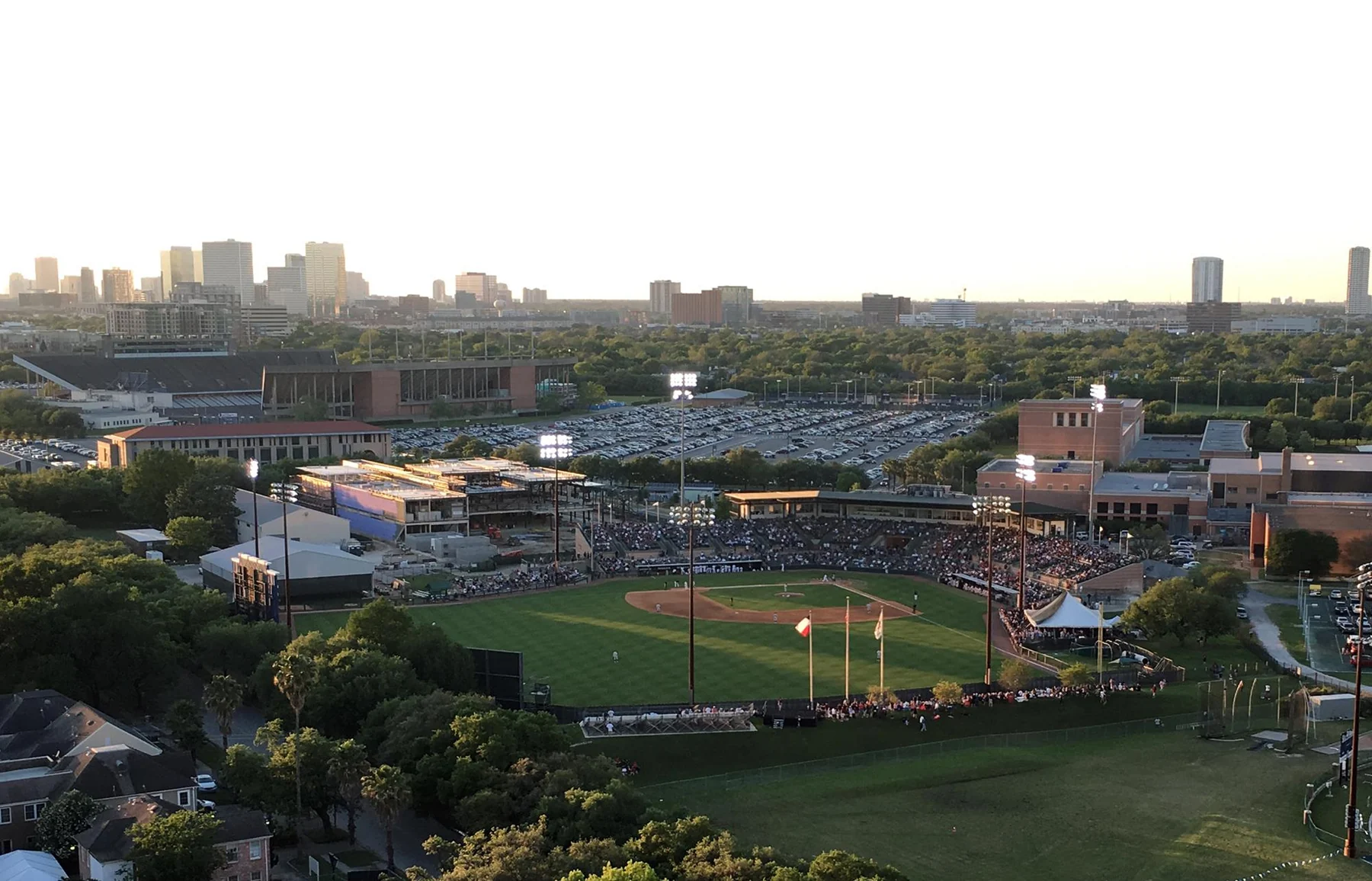
Rice's Reckling Park history gives one concrete destination: the venue opened for the 2000 season on the southwest part of campus near Tudor Fieldhouse. It replaced Cameron Field, Rice's baseball home from 1978 through 1999. Those details identify a long-established ballpark and its campus setting without treating an old season's attendance or performance figures as current.
Beaumont, Huntsville and Nacogdoches
| Institution and official athletics site | City |
|---|---|
| Lamar University | Beaumont |
| Sam Houston State University | Huntsville |
| Stephen F. Austin State University | Nacogdoches |
Lamar's Beaumont destination is Vincent-Beck Stadium, home to the program since 1969. The university added a substantial support building at that existing venue in 2026: the Teri and Glen Morgan Baseball Complex opened on May 2. Its 8,500 square feet include a locker room, coaches' offices, training and film rooms, lounge and equipment space.
Sam Houston and Stephen F. Austin belong to different cities farther north. The table's full institutional names help distinguish their official athletics links from similarly named high schools or unrelated teams. A Houston-based visitor can use these regional alternatives when the four city programs are away, but should compare the actual journey and game time before adding a stop.
For this group, the most useful first decision is whether the trip is centered on Houston or on another eastern Texas city. That decision narrows eight possibilities into a manageable selection while preserving the full regional directory for later exploration.
Central Texas and South Texas programs
Eight schools connect the central part of the state with San Antonio, the coast and the Rio Grande Valley. This group includes two different Texas A&M institutions and several University of Texas names, so matching each program to its city is particularly valuable. The statewide map shows the broader pattern without implying that these destinations form one compact local cluster.
Austin, Waco, College Station and San Marcos
| Institution and official athletics site | City |
|---|---|
| University of Texas at Austin | Austin |
| Baylor University | Waco |
| Texas A&M University, College Station | College Station |
| Texas State University | San Marcos |
Texas in this table means the University of Texas at Austin. Baylor's location is Waco, Texas A&M's is College Station, and Texas State's is San Marcos. Those four city names are a better starting point for planning than a generic search for baseball in Central Texas.
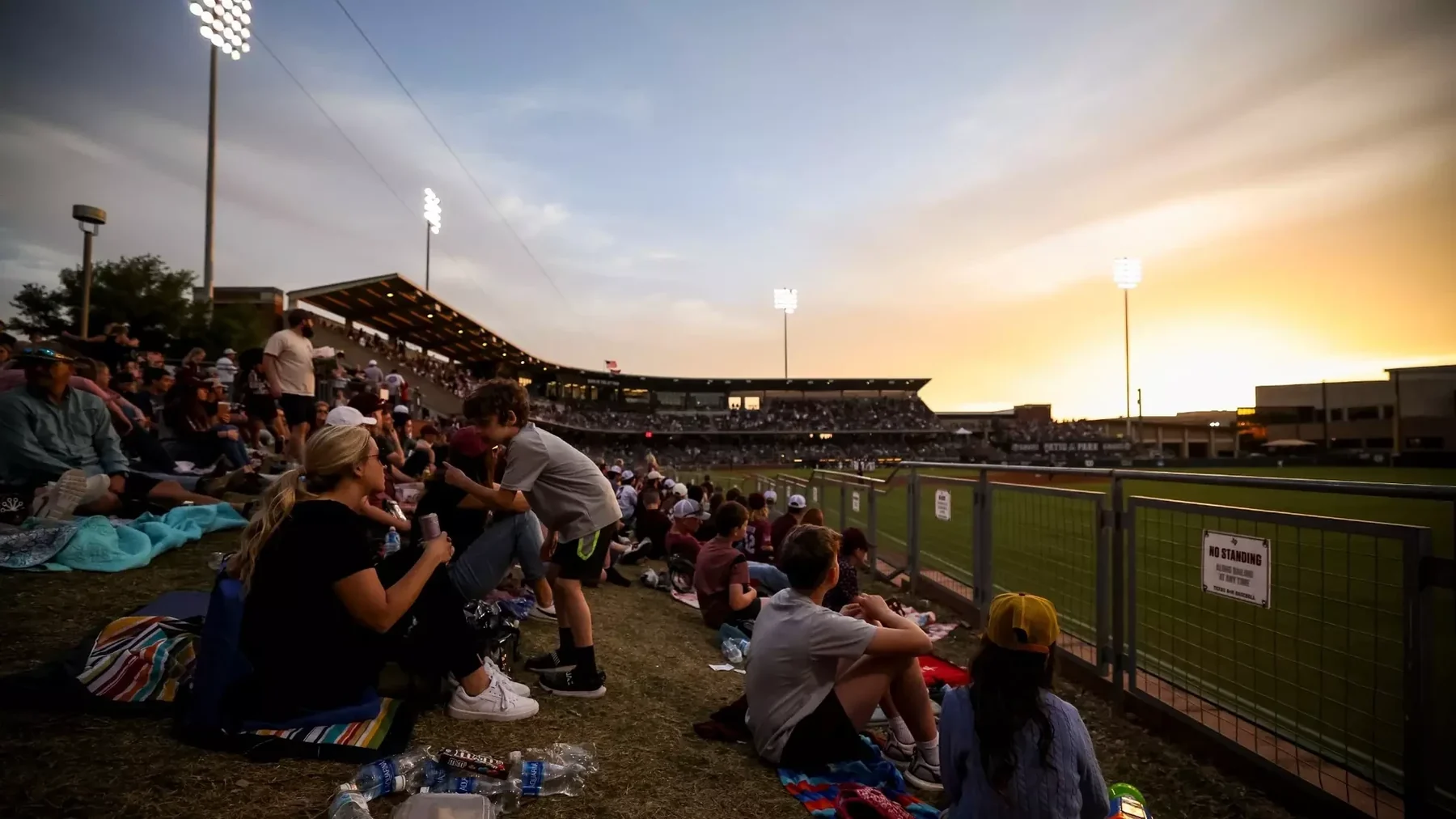
At Texas A&M, the familiar destination is Olsen Field at Blue Bell Park. The university's facility history distinguishes the original Olsen Field, opened in 1978, from the transformed ballpark that opened in February 2012. The redesign included lawn seating along both the first- and third-base sides as well as conventional seats, giving the venue several different viewing settings.
San Antonio, Corpus Christi and the Rio Grande Valley
| Institution and official athletics site | City |
|---|---|
| University of Texas at San Antonio | San Antonio |
| University of the Incarnate Word | San Antonio |
| Texas A&M University-Corpus Christi | Corpus Christi |
| The University of Texas Rio Grande Valley | Edinburg campus reference |
San Antonio has two separate entries: UTSA and the University of the Incarnate Word. Texas A&M-Corpus Christi is a different institution from Texas A&M in College Station. UTRGV is represented by its Edinburg institutional reference point, which is especially relevant to baseball because the team's stadium is in Edinburg.
The official UTRGV Baseball Stadium history places the venue at the northwest corner of campus and records its opening in 2001 as Edinburg Baseball Stadium. This southern end of the map is a distinct destination rather than an extension of a San Antonio city itinerary.
Readers comparing these eight programs can begin with a chosen city and widen the search only as needed. A visit centered on Austin, for example, raises different practical choices from a weekend in Corpus Christi or Edinburg. The official athletics links provide the next step for each institution without assuming a particular route, hotel location or schedule.
West Texas programs in Abilene and Lubbock
Abilene Christian and Texas Tech complete the 22-school D1 directory. Their points stand apart from the denser eastern clusters, making them straightforward anchors for a visit centered on Abilene or Lubbock. The small number of D1 entries in this editorial region should not be read as a count of every college baseball program in West Texas.
| Institution and official athletics site | City |
|---|---|
| Abilene Christian University | Abilene |
| Texas Tech University | Lubbock |
Abilene Christian identifies its baseball home as Crutcher Scott Field at Bullock Brothers Ballpark. Its opening date was February 23, 1991. The university's historical account records a 2-1 victory over Tarleton State in ten innings that day, with spectators watching from flatbed trailers brought in as temporary stands. It is another example of two Texas institutions sharing a ballpark-opening story.
In Lubbock, Texas Tech's home is Dan Law Field at Rip Griffin Park, listed at 2901 Drive of Champions. The university's history records a major renovation spanning August 2011 through February 2012. The first game at the renovated park was a 4-1 Texas Tech win over Missouri State on February 17, 2012.
Those venue names are useful search terms once you move from the state map to an actual game. For Abilene, pair the Wildcats' official schedule with the Bullock Brothers Ballpark destination. For Lubbock, pair the Red Raiders' schedule with Rip Griffin Park. A search using only the university name can otherwise lead to the central campus, a football venue or another athletic facility.
The two stops also make the limits of a statewide map clear. It shows relative location and program coverage, while a practical itinerary must account for where you begin and how much time you have. A trip focused on one West Texas city can be worthwhile on its own; there is no need to combine every regional point into a single weekend.
Read the map alongside current baseball conferences
A location map answers where a program is based. A baseball conference explains part of its competitive schedule. Nearby Texas institutions can play in different leagues, while a Texas program can share a conference with schools far outside the state. That distinction matters when you use a map to find conference opponents or compare two schools' schedules.
DBU and Texas State join Pac-12 baseball
The Pac-12's official baseball membership announcement includes both Dallas Baptist and Texas State in its seven-program lineup for 2026-27. The other five are Fresno State, Gonzaga, Oregon State, San Diego State and Washington State. DBU joins specifically as a baseball affiliate.
For a fan reading this guide in September 2026, that academic-year label points toward the spring 2027 baseball season. A spring 2026 schedule archive describes an earlier competitive year. The school's position on the Texas map stays the same even when its league opponents change, which is why a dated directory and a dated conference explanation serve different purposes.
DBU is also a useful reminder to select the sport before interpreting institutional membership information. A general athletics profile is not always enough to classify a baseball program. Use a baseball-specific conference announcement or the NCAA's sport-filtered directory when the two seem inconsistent.
Texas programs beyond Division I
The 22-point map intentionally excludes other levels, but those programs remain part of the state's college baseball landscape. The current NCAA Division II baseball directory includes Texas institutions such as Angelo State, Lubbock Christian and UT Tyler. The Division III list includes Trinity University in Texas, Texas Lutheran and Hardin-Simmons. These examples show why an empty part of a D1 map is not proof that no college baseball is available nearby.
Junior college baseball adds another set of destinations. In the NJCAA's 2026 Division III district championship listing, Dallas College-Eastfield appears as the South Central qualifier, with the district event based in Mesquite. NCAA Division III and NJCAA Division III are separate classifications run by different organizations, despite sharing the same division number.
These are selected examples, not a complete all-level Texas inventory. If your main aim is finding a game or exploring playing opportunities, widen the search beyond D1 and read our college baseball divisions guide. The correct level filter depends on the question you are trying to answer.
Turn the Texas map into a baseball itinerary
Begin with the city where you will be staying and choose a small group of nearby programs. For a Fort Worth visit, TCU is an obvious first schedule to inspect, with UT Arlington and DBU offering additional Metroplex options. For a Houston visit, compare the four city programs before expanding toward Prairie View or another eastern destination. This is a planning method, not a claim that any particular team will be at home on your dates.
Next, identify the host and the ballpark for each game. TCU's baseball ticket information explicitly directs fans seeking away-game tickets to the host institution. That matters when following a favorite team: its name on a schedule does not mean its campus is the destination. Record the opponent, date, first pitch and venue before purchasing admission or making travel arrangements.
Arrival details can change the shape of the visit. TCU's ticket page lists the Lupton Stadium ticket office as opening 60 minutes before first pitch. At UTRGV, the baseball game-day guide identifies Lot 33E behind the right-field wall as the designated tailgating area. These are examples of venue-specific instructions worth consulting after selecting a game; they are not statewide rules for every Texas ballpark.
For a multi-game trip, leave room between stops for the full first game, departure and the next arrival. Do not infer a reliable journey from the straight-line separation of two map points. Use the actual stadium addresses and current travel information, and revisit the official schedule shortly before departure for any changed start time or venue.
Our college baseball team directory is a starting point for continuing from this statewide list. A finished itinerary should be short and concrete: one confirmed game, one ballpark, the right ticket and an arrival plan for each stop. The map supplies the choices; those event details turn the choices into a day at the ballpark.
Join the conversation
Share a question or a thought about college baseball. Comments are reviewed before they appear. Keep it friendly and on topic.
No comments yet. Start the conversation.
Sign in with Google to leave a comment. Your email address is not displayed.