College baseball has several parallel systems: NCAA Division I, II and III; the NAIA; and two-year college associations including the NJCAA, 3C2A and NWAC. The division tells you which organizational rules and championship pathway to investigate. It does not tell you everything about an individual team, its players or the cost of attending the school.
This guide explains the differences as of September 29, 2026, using the completed 2026 season for concrete examples. Scholarship and eligibility details should always be checked for the student's own enrollment year. The aim is to help fans find the correct competition and help prospective players ask useful questions about a particular program.
College baseball is organized by association and division
D1, D2 and D3 are the NCAA's three divisions. NAIA is a separate governing association, while JUCO describes two-year college baseball played under several organizations. They are not five rungs of one national league. Understanding that distinction makes schedules, scholarships and championship brackets much easier to read.
The NCAA membership directory organizes schools into Division I, Division II and Division III. Each division has its own membership framework and baseball championship. A strong Division II season does not promote a team into the Division I tournament, and a losing Division I season does not relegate a school to Division II. Changing membership is an institutional process, not a place earned in the standings.
The National Association of Intercollegiate Athletics operates alongside the NCAA. Its baseball programs pursue their own association championship. When a school says it is an NAIA national champion, that is a title within the NAIA competition, not an earlier round on a path to Omaha.
| Label | What it identifies | What to check next |
|---|---|---|
| NCAA D1 | Division I baseball | Baseball conference, season and NCAA eligibility |
| NCAA D2 | Division II baseball | Regional championship route and program aid model |
| NCAA D3 | Division III baseball | Academic fit, team schedule and nonathletic aid |
| NAIA | A separate four-year college association | NAIA membership, eligibility and championship route |
| JUCO | Two-year college baseball | The actual association and its division, if any |
For fans, this is a map of competitions rather than a universal talent ranking. A division label can help identify the rules and postseason a program follows, but it cannot tell you how good a particular starting pitcher is or how much depth a team has this spring. Those questions require current roster and game evidence.
This guide covers the principal varsity pathways named in common college-baseball searches. It is not an inventory of every small-college association or student club. Our team schedule directory focuses on Division I; use the relevant association's official pages when exploring the other systems below.
NCAA Division I: the route to Omaha
What the D1 label tells you
Division I is the NCAA baseball competition whose national championship culminates at the Men's College World Series in Omaha. The NCAA championship page separates the regional and super regional stages from the final event. A school can make the NCAA tournament without reaching Omaha, so use those achievements accurately when comparing programs.
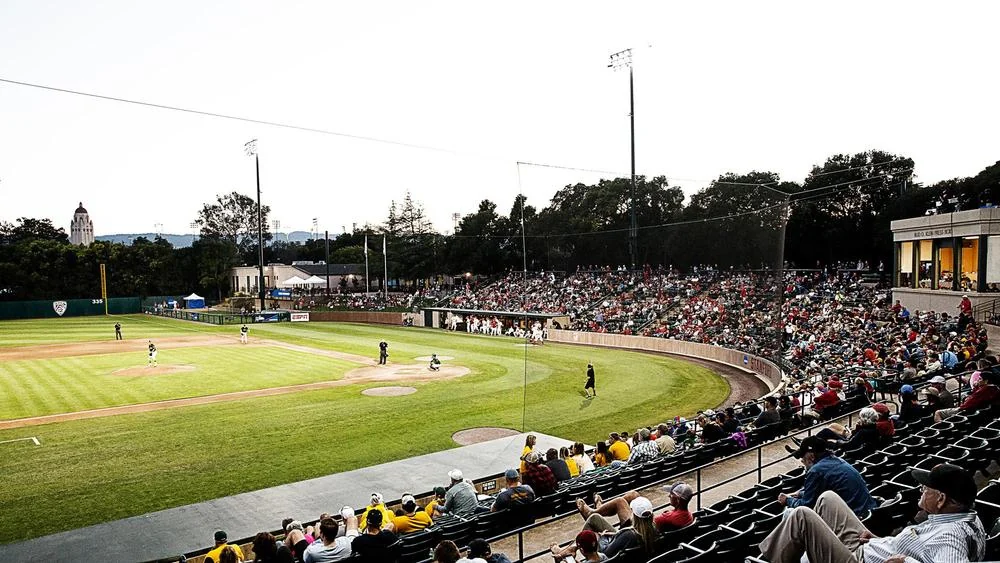
The label establishes the competition a program belongs to; it does not promise identical resources or playing conditions. A nationally televised weekend at a major stadium and a midweek game at a smaller campus field can both be Division I baseball. Stanford's Sunken Diamond, pictured on this article, is one recognizable example of a specific program's setting, not a standard facility every D1 institution is required to copy.
For a fan comparing two teams, the baseball conference schedule is more informative than the D1 label alone. Look at whom they play, where they travel and which games belong to the league race. Opponent strength and the demands of a weekend series help explain the team's task. They should not be replaced by a blanket assumption that all Division I teams are equally strong.
Scholarships after the House settlement
Older baseball guides often describe the former scholarship cap as if it still applies universally. The NCAA's June 2025 implementation announcement explains the change: schools participating in the settlement framework use roster limits in place of sport-specific scholarship limits and may offer aid to athletes on those rosters. It also describes exceptions for designated athletes affected by the transition.
Permission to fund more scholarships is not a guarantee that a particular baseball program will do so. A division-wide rule establishes what is allowed; the institution decides what it funds and offers within the applicable rules. Reading “D1” beside a school therefore does not establish the size of an individual award or the family's remaining cost.
Anyone comparing actual offers should obtain the current written terms from the institution and confirm the academic year and applicable framework. For readers following the sport, the main takeaway is structural: a pre-2025 scholarship explanation can misrepresent today's Division I landscape even when the rest of the article's baseball discussion remains useful.
NCAA Division II: a separate championship and partial-aid model
Division II baseball has its own NCAA championship and an established identity. Tampa's university reported that its baseball team won the 2026 Division II national title for a third consecutive year. That is a useful example of sustained success within a distinct national competition. It should be described on its own terms, rather than as an incomplete version of a Division I season.
The clearest financial distinction is the equivalency model. The NCAA's current Division II scholarship table lists 9.0 baseball equivalencies. This is a maximum aid measure for the team, not a nine-player roster limit and not a requirement to give nine individuals identical full scholarships.
Coaches can distribute available athletics aid among players under the applicable rules. That makes the size of an offer a school-level question. An institution may fund below the permitted maximum, and a student may have other eligible sources of assistance. Comparing two programs only by the phrase “baseball scholarship” can hide a substantial difference in what each written package actually covers.
For a family, the useful comparison is the remaining cost after confirmed aid, together with the academic and baseball opportunity. A partial award at one school cannot automatically be called cheaper than an offer from a different division. Tuition, housing, other assistance and the terms of the award all matter. Ask the financial-aid office to explain the package rather than converting a division label into a projected bill.
On the field, do not use D2 as shorthand for an easy place to play. A championship-level roster has competition for innings and plate appearances. The relevant evaluation is the actual staff, depth chart, schedule and development record. Nor should a broad description of Division II's balanced model be read as a guarantee that every program travels less or expects less commitment than every Division I team.
For spectators, Division II can add a nearby varsity option that disappears from a D1-only search. Follow its own standings and championship coverage. Watching Tampa pursue another title, for example, requires the Division II bracket; the Omaha bracket will not tell that story.
NCAA Division III: varsity baseball without athletic scholarships
No athletic scholarship does not mean no financial aid
Division III schools do not award athletics-based scholarships. The NCAA's Division III overview distinguishes that rule from financial assistance based on academic merit or need. A baseball player may receive eligible nonathletic aid, but calling it a baseball scholarship would misdescribe the basis of the award.
This distinction is particularly useful when comparing the price of attendance. The absence of an athletic scholarship does not by itself establish that a Division III option is more expensive. Equally, it does not guarantee that a student will qualify for enough other aid to make it affordable. Compare the institution's actual offer and remaining costs, using the same categories for every school.
The scholarship rule is not a statement that Division III baseball is casual or that every interested student can make a roster. These are varsity programs with coaches, selection decisions, conference races and an NCAA national championship. A player still needs a realistic assessment of the opportunity at the particular school; a fan still needs the correct schedule and postseason bracket.
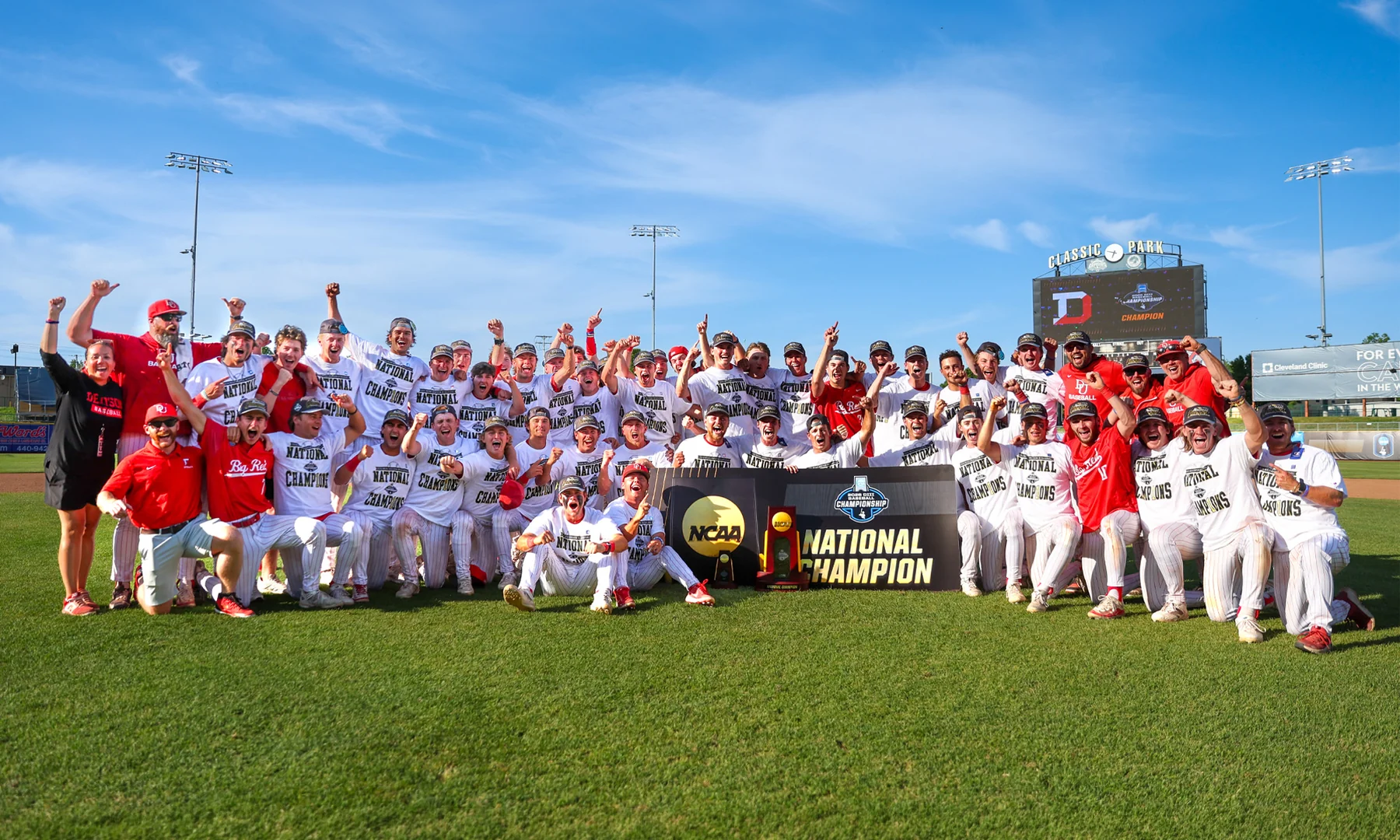
Denison gives the competition a concrete face. The university's account of its 2026 championship describes a 51–3 season capped by the program's first NCAA baseball title. The Big Red won the deciding game against Endicott 4–3 in extra innings after recovering from a three-run deficit. Those are the stakes and demands of a national baseball final, regardless of the way the students' financial aid is classified.
When watching a Division III team, evaluate its baseball directly: strike throwing, defensive execution, extra-base threats and the options available after the starter leaves. It is more informative than treating a financial-aid rule as a scouting report. Strong individual players and accomplished teams deserve analysis beyond a label.
For a prospective student, academic fit remains essential alongside the baseball conversation. Ask about the intended course of study, the actual weekly schedule and the team's expectations. Admission standards, financial-aid eligibility and a coach's interest are separate questions; confirmation of one should not be mistaken for a guarantee of the others.
NAIA baseball operates outside the NCAA divisions
NAIA baseball is a separate four-year college route with its own eligibility framework, member conferences and national championship. It is not NCAA Division IV, and an NAIA team does not need to win its way into an NCAA division. Start with that organizational distinction before comparing a particular school's academic or baseball offering.
The postseason provides a clear illustration. The NAIA's 2026 national-tournament announcement named 46 Opening Round qualifiers across ten sites, with ten survivors advancing to Harris Field in Lewiston, Idaho. That route belongs to the NAIA World Series. It is separate from the NCAA Division I regional path to Omaha.
Lewis-Clark State is a useful program to recognize in that setting. The NAIA announcement described its long championship history while identifying Lewiston as the final-site destination. A fan who searches only NCAA brackets would miss a major part of the college game's national postseason. Association-specific coverage is the right way to follow the race.
Athletics aid is permitted, but its structure should be read from NAIA sources. The association's financial-aid explanation uses baseball's limit of 12 full grant equivalencies as its example. It explains that aid can be divided among athletes while remaining within the applicable total. That is not a promise of twelve full awards at every institution.
The institution determines an individual student's package. This is why an NCAA rule announcement, even a major one, should not be copied into an NAIA comparison as though both organizations changed together. They are separate governing systems. Confirm the current association policy and the school's actual terms before making a financial or eligibility decision.
From a baseball perspective, look past shorthand such as “below D2.” Different programs have different roster experience, pitching depth and development priorities. A serious comparison needs the actual team, season and opponents. An NAIA option can be evaluated on its own program evidence without either exaggerating its level or dismissing it because its games sit outside the NCAA television schedule.
For a fan, the actionable distinction is simple: use NAIA conference results, Opening Round brackets and the NAIA championship page together. That keeps the same competitive system in view from the league race through the final out.
JUCO baseball includes more than one organization
JUCO is a useful everyday description of two-year college baseball, but it is not the name of one national governing body. Before interpreting a ranking, scholarship offer or World Series appearance, identify the association and the baseball division. Otherwise, two accurate descriptions of different competitions can appear to contradict one another.
NJCAA Division I, II and III
The National Junior College Athletic Association has its own Division I, II and III classifications. An NJCAA Division I team is not an NCAA Division I team. The repeated Roman numerals describe different organizational systems, with different members and national championships.
Jefferson College's 2025–26 student-athlete handbook provides a practical explanation of the NJCAA financial-aid distinctions. Division I permits athletic aid that includes room and board; Division II permits categories such as tuition, fees and course-related books, but not room and board within its athletic grant. Division III does not award aid based on athletic ability. These are permitted categories, not a statement that every player receives the maximum.
The handbook also identifies division by sport. That detail matters when a college's athletics website includes teams in different classifications. Use the baseball program's current information, then ask the institution to confirm the terms that apply to the relevant enrollment year. A general institutional label is a starting point rather than a substitute for that check.
California and the Northwest follow their own systems
California community-college baseball supplies an important example outside the NJCAA structure. Santa Ana College's 2026 championship report identifies its title as the 3C2A State Championship. The Dons beat Palomar 7–4 in the season finale to claim the program's fifth state crown. Calling that an NJCAA title would place the achievement in the wrong competition.
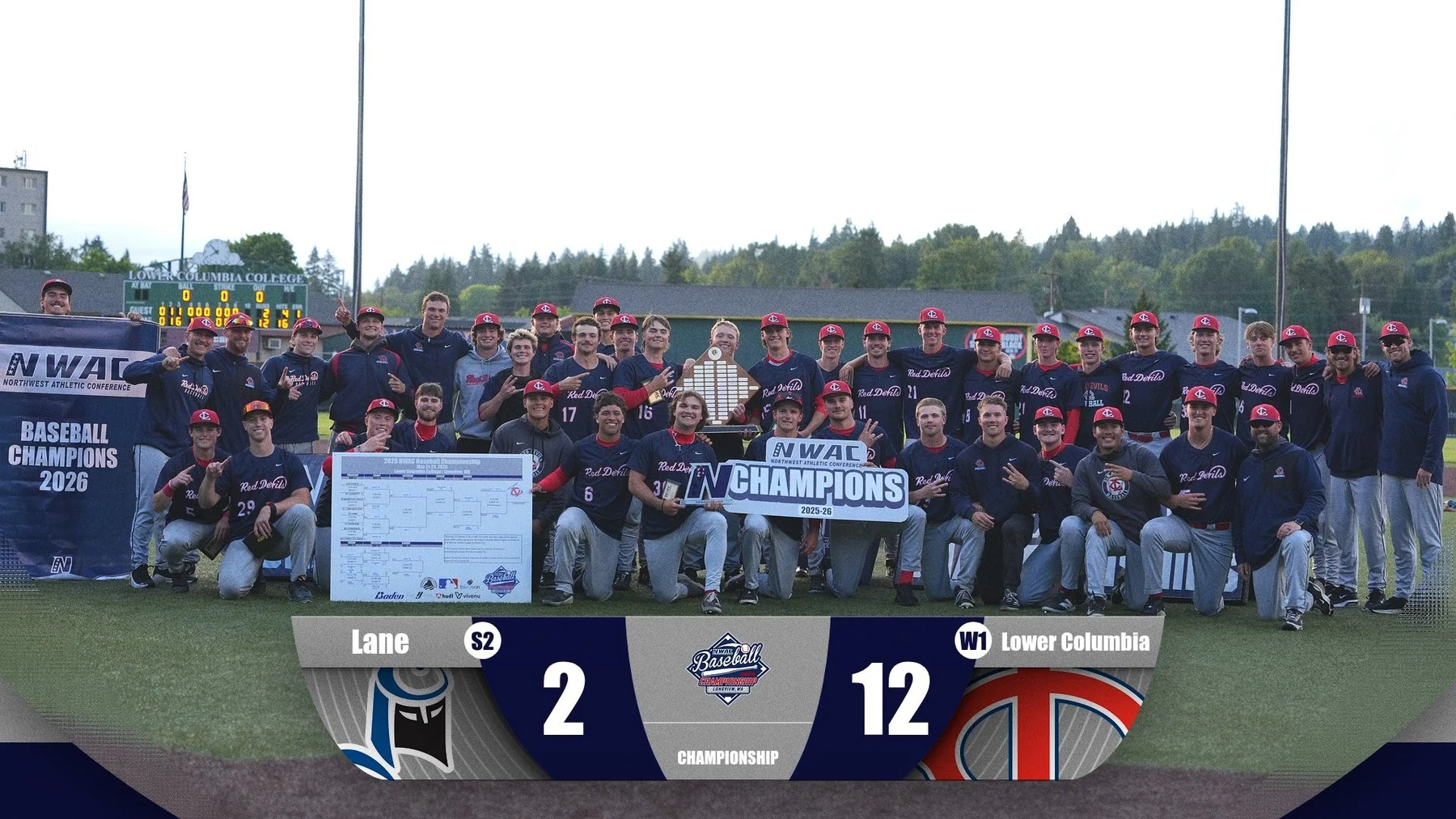
The Northwest Athletic Conference is another distinct route. Lower Columbia College won the 2026 NWAC championship, beating Lane 12–2 in the final game. Its official account describes the title as the college's sixteenth in that competition. The name of the championship is essential context; the broad phrase junior-college champion is not specific enough to identify the bracket.
Two-year baseball and transfer planning
A two-year program can be part of a student's plan to continue at another institution, but that next step should be planned academically as well as athletically. A coach's interest, admission to the destination school, the transfer of course credits and permission to compete are different decisions. None should be assumed from the others.
The NCAA transfer resource hub separates two-year transfer guidance from four-year guidance and supplies division-specific resources. Use the pathway that matches the student's history, then ask the destination's compliance office about the individual record. This is especially important before choosing courses on the assumption that all credits will satisfy the next institution's requirements.
For fans, a player's previous college helps explain a roster without reducing the player to that former classification. Follow the athlete's current role and performance. For families, the useful question is whether the present program offers suitable teaching, academic progress and an attainable next step, rather than whether a generic label sounds more prestigious.
Compare individual baseball programs before choosing a label
A useful shortlist starts with schools and questions, rather than a decision that only one label can provide worthwhile baseball. First identify the association, baseball division and relevant season. Then look at the individual program's roster, schedule and academic setting. This keeps a broad organizational comparison connected to choices a fan or prospective student can actually make.
For someone who wants to attend games, begin with location and the published home schedule. Check the named venue, ticket arrangements and any game-day changes through the host institution. Stanford's Sunken Diamond facility page, for example, answers a venue question; a division label cannot replace it. Nor does that label tell you whether a particular game will be televised.
For a prospective player, compare the intended academic program, total remaining cost, roster opportunity and expectations during the season. Ask how the staff sees the player's position and development, but distinguish that conversation from a guaranteed starting role. Study the roster thoughtfully: a list of current players provides context, while future decisions still belong to the program.
Keep eligibility questions separate from ordinary admission questions. The NCAA Eligibility Center explains that requirements and account types differ across divisions and student circumstances. Use its current resources for an NCAA pathway, and the relevant association's resources for other pathways. A summary article is useful for orientation; the institution must confirm how the rules apply to the individual student.
Finally, compare like with like. Record the same cost categories for each offer, the same season when looking at schedules and the same competition when interpreting rankings. A strong Division III season, an NAIA national-tournament run and an NJCAA championship each have their own context. They do not become less meaningful because another system uses a similar division name.
Our college baseball team directory and conference pages can help you move from a familiar program name to its schedule context. From there, use the school's official information to confirm the details that determine the next step: where to watch, which championship to follow, or whom to contact about playing and studying there.
Join the conversation
Share a question or a thought about college baseball. Comments are reviewed before they appear. Keep it friendly and on topic.
No comments yet. Start the conversation.
Sign in with Google to leave a comment. Your email address is not displayed.