California offers 26 D1 college baseball programs in the September 29, 2026 NCAA directory snapshot. This guide puts every listed school on a geographic campus map and organizes the full list into Northern, Central and Southern California. It also explains the baseball conference changes relevant to the 2026-27 academic year and highlights several programs outside Division I.
Use the map and regional tables to find a school, then read the venue examples and official athletics links to plan a visit. The directory is about where programs are based; the conference discussion explains who they play in their league.
California's 26 D1 baseball schools on a campus map
California has 26 institutions in the NCAA's current Division I baseball directory snapshot. This guide uses the records retrieved September 29, 2026 for the 2026–27 academic year. It covers all 26 listed institutions, while the later discussion of other divisions provides selected examples rather than a complete all-level inventory.
The map places each institution using its campus reference coordinates from the National Center for Education Statistics' IPEDS institutional file. California's outline comes from the U.S. Census Bureau's cartographic boundaries. These are campus locations, not stadium gates, parking entrances or suggested driving routes.
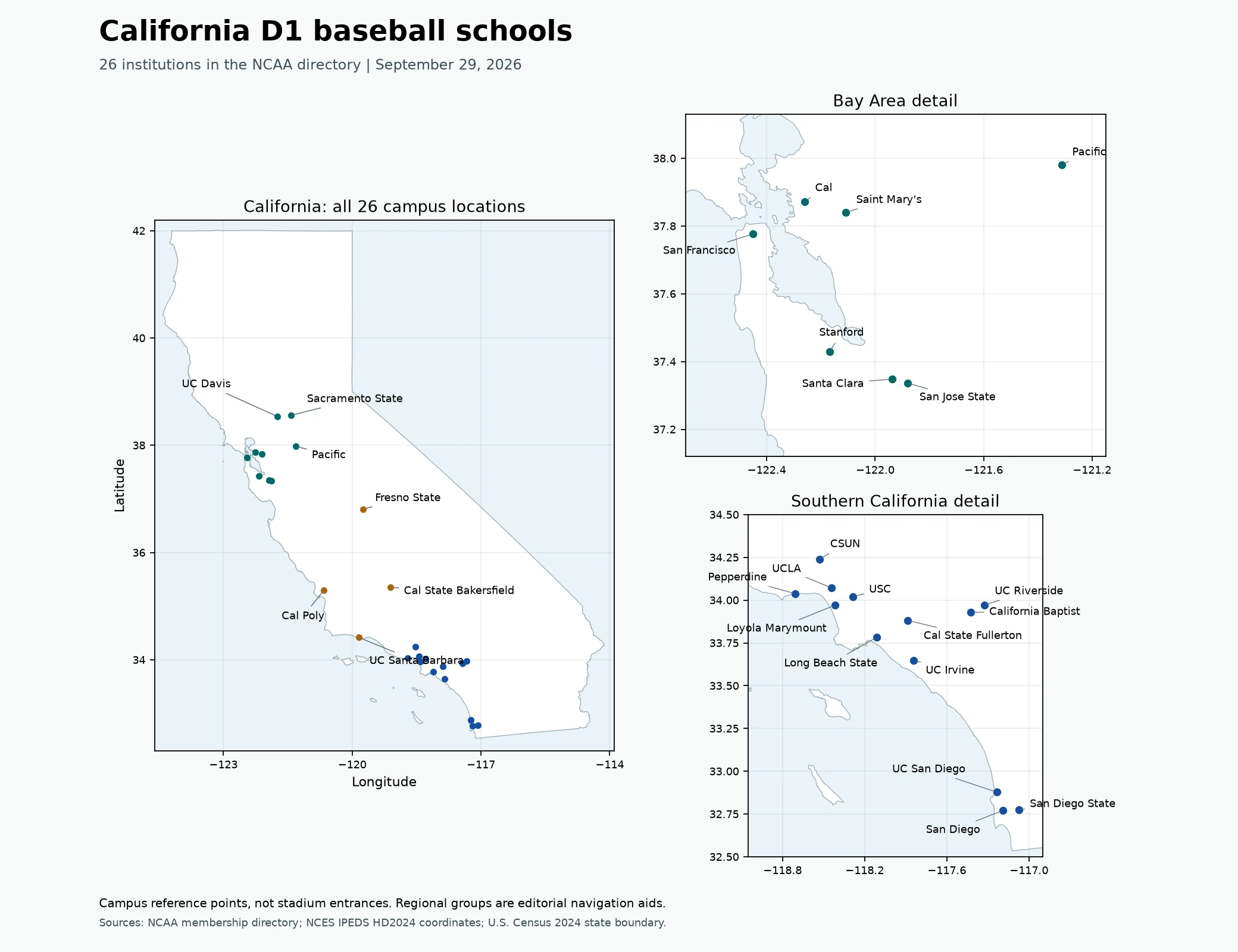
For navigation, this article groups nine schools in Northern California, four along the Central Coast and Central Valley, and thirteen in Southern California. Those are editorial geographic groups. They do not represent conferences, recruiting territories or NCAA tournament regions. The detail panels make the Bay Area and Southern California clusters easier to distinguish.
The NCAA's sport-filtered membership directory establishes which institutions belong in this snapshot. The older geographic file is used only to position established campuses. Neither source should be treated as proof that a specific game is scheduled, that a student has a roster place or that a team is eligible for the next postseason.
Use the regional lists below to match a familiar baseball name to the right institution. For a nationwide comparison, the D1 baseball schools by state directory uses the same membership scope. California's 26 entries make it the largest state group in that dated snapshot, but a larger count does not establish that every school is a suitable match for every fan or prospective player.
Northern California baseball programs
Northern California contributes nine of the state's D1 directory entries. Six are grouped here around the Bay Area, with three more in Sacramento, Davis and Stockton. The table uses the location associated with the institution in the federal campus file. A campus city is useful for orientation, but the baseball schedule remains the authority for the actual playing venue.
Bay Area schools
| Baseball name | Institution | Campus location |
|---|---|---|
| Cal | University of California, Berkeley | Berkeley |
| Stanford | Stanford University | Stanford |
| San Francisco | University of San Francisco | San Francisco |
| Santa Clara | Santa Clara University | Santa Clara |
| Saint Mary's | Saint Mary's College of California | Moraga |
| San Jose State | San Jose State University | San Jose |
Cal means the Berkeley institution, while Saint Mary's is the school in Moraga. Those labels are worth resolving before comparing rosters or searching for tickets. San Francisco means the University of San Francisco in this D1 list, not every university located in the city. The official institutional name prevents a familiar geographic word from becoming an ambiguous search.
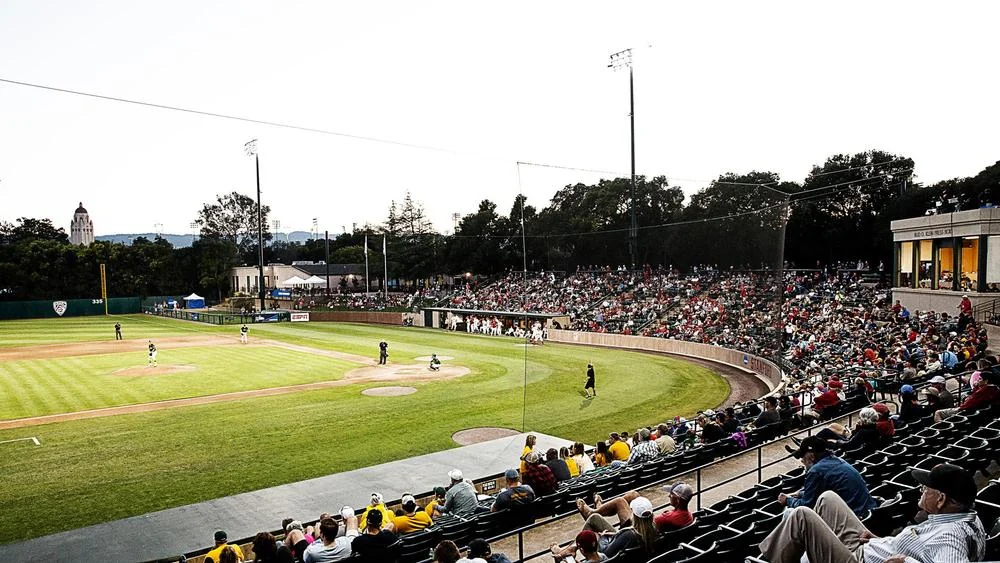
Stanford's Klein Field at Sunken Diamond supplies a concrete venue reference for one of these programs. The cover photograph shows that baseball setting. The other nearby dots represent their own institutions and game-day arrangements; the map does not imply a common ticket system or an easy same-day itinerary.
Sacramento, Davis and Stockton
| Baseball name | Institution | Campus location |
|---|---|---|
| Sacramento State | California State University, Sacramento | Sacramento |
| UC Davis | University of California, Davis | Davis |
| Pacific | University of the Pacific | Stockton |
These three entries extend the search beyond the Bay Area cluster. Pacific's official baseball page belongs to the University of the Pacific in Stockton. It should not be confused with a conference name or another institution containing Pacific in its title.
For a fan building a regional shortlist, record the program, intended date and named ballpark together. That creates a more useful comparison than choosing by the nearest-looking dot alone. For a prospective student, the same table is an introduction to distinct institutions, each requiring its own academic and baseball research.
Central Coast and Central Valley baseball programs
Four D1 institutions form the Central Coast and Central Valley group used in this guide: Cal Poly, Fresno State, Cal State Bakersfield and UC Santa Barbara. The grouping is intended to make the statewide list easier to browse. It does not suggest that these campuses form one metropolitan area or that a trip between them can be planned without checking the route.
| Baseball name | Institution | Campus location |
|---|---|---|
| Cal Poly | California Polytechnic State University | San Luis Obispo |
| Fresno State | California State University, Fresno | Fresno |
| Cal State Bakersfield | California State University, Bakersfield | Bakersfield |
| UC Santa Barbara | University of California, Santa Barbara | Santa Barbara |
Cal Poly in this list is the San Luis Obispo university. Do not treat every institution using Cal Poly in its name as the same campus or automatically assign it to this D1 list. The exact institution is essential when looking up a roster, buying a ticket or evaluating an academic program.
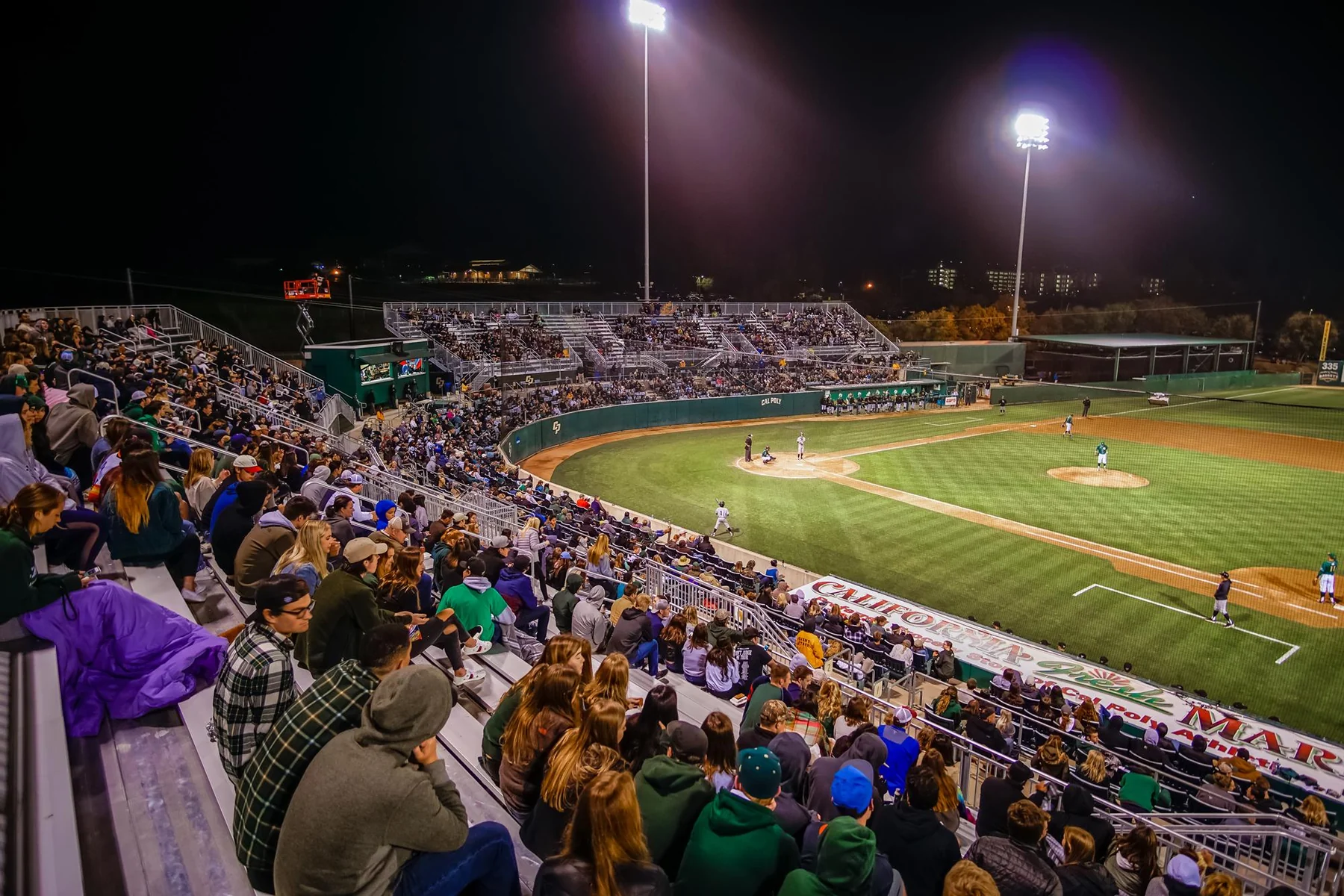
Cal Poly's official Baggett Stadium page places its baseball home on the north side of campus. It records the first game there on January 21, 2001, when Cal Poly beat Stanford 6–5 in twelve innings. That specific venue history adds useful context to a dot that would otherwise tell you only where the university sits.
UC Santa Barbara identifies Caesar Uyesaka Stadium as its baseball home in its official announcement about baseball facilities. A facilities announcement can describe planned work as well as the existing venue, so check the latest game-day information before assuming that an announced improvement has opened.
The practical next step is the same for all four programs: choose the baseball schedule, select the intended season and confirm the home field for the specific date. A regional list helps identify options; the program's current schedule tells you which option is actually available when you want to watch.
Southern California baseball programs
Thirteen of the state's D1 directory entries are grouped here in Southern California. The concentration is visible in the map's detail panel, but nearby campus points can still represent very different trips. Use the school name to find the correct baseball schedule before deciding which game is practical to attend.
Los Angeles and Orange County
| Baseball name | Institution | Campus location |
|---|---|---|
| UCLA | University of California, Los Angeles | Los Angeles |
| USC | University of Southern California | Los Angeles |
| Loyola Marymount | Loyola Marymount University | Los Angeles |
| Pepperdine | Pepperdine University | Malibu |
| CSUN | California State University, Northridge | Northridge |
| Long Beach State | Long Beach State University | Long Beach |
| Cal State Fullerton | California State University, Fullerton | Fullerton |
| UC Irvine | University of California, Irvine | Irvine |
These eight institutions are not interchangeable versions of a Los Angeles baseball team. UCLA and USC have separate campuses and programs; Loyola Marymount is another distinct institution. Pepperdine's campus location is Malibu, and CSUN identifies the Northridge campus. Those details are more useful for a local search than a broad Southern California label.
Cal State Fullerton's university site identifies Goodwin Field as the Titans' baseball home. A stadium page or campus camera can help recognize the venue, but it does not confirm that a game is taking place at the moment you want to visit. Use the baseball schedule for that decision.
Riverside's two D1 programs
| Baseball name | Institution | Campus location |
|---|---|---|
| California Baptist | California Baptist University | Riverside |
| UC Riverside | University of California, Riverside | Riverside |
California Baptist and UC Riverside are two separate universities in Riverside. A search that uses only the city name can return either program. Record the institution as well as the opponent and date when comparing games, especially when a search result abbreviates California Baptist to CBU or UC Riverside to UCR.
The three San Diego institutions
| Baseball name | Institution | Campus location |
|---|---|---|
| San Diego State | San Diego State University | San Diego |
| San Diego | University of San Diego | San Diego |
| UC San Diego | University of California, San Diego | La Jolla |
San Diego State, the University of San Diego and UC San Diego are three different institutions. The federal campus file uses La Jolla for UC San Diego. That location label explains the northernmost point in the San Diego cluster without changing the university's identity or adding a fourth program.
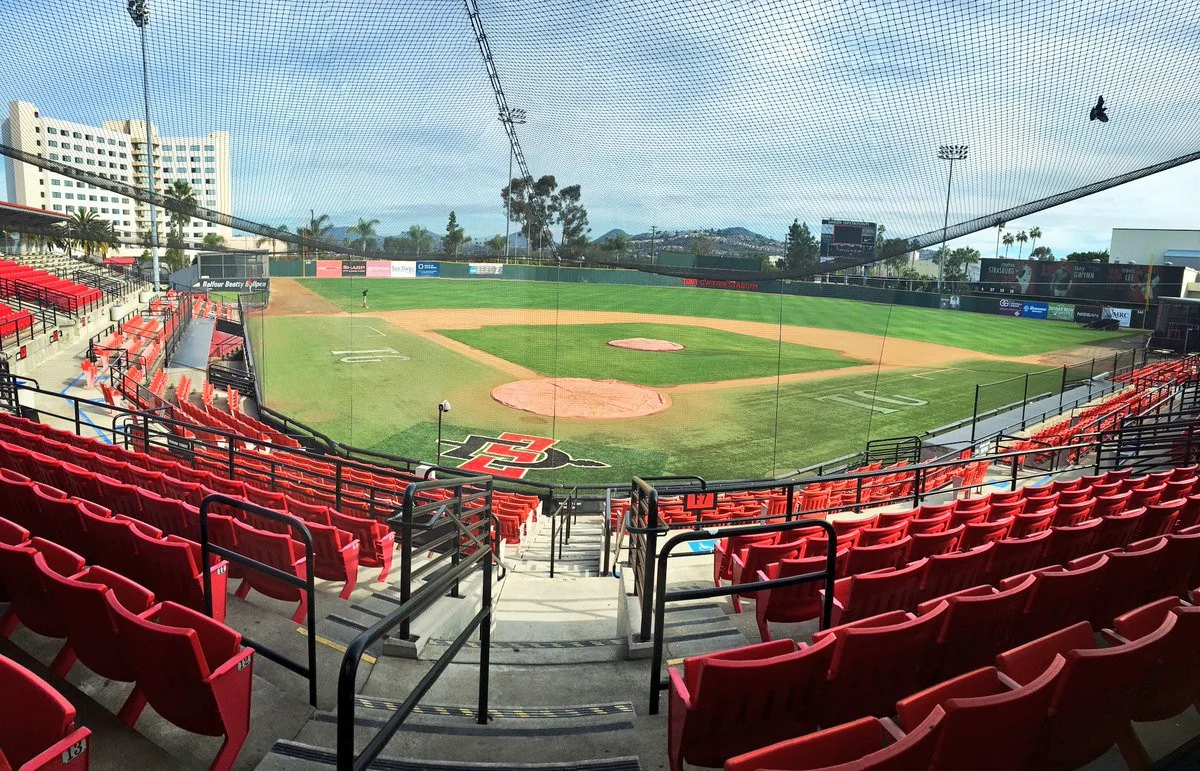
San Diego State's official Tony Gwynn Stadium page identifies the venue and links driving directions. Use that program-specific information rather than navigating to a generic San Diego campus pin. The same approach applies to the other two schools: the name, schedule and venue should all match.
Check the baseball conference for the 2026–27 year
California's campus geography is much more stable than its conference membership. The 2026–27 academic year contains the spring 2027 baseball season, so a league change taking effect in July 2026 affects the next spring. A list describing the completed 2026 season can therefore be accurate historically and still give the wrong affiliation for a 2027 preview.
Big West membership changes
The Big West's July 2026 membership announcement welcomed California Baptist, Sacramento State and Utah Valley. It explicitly included baseball among the sports in which the new members would compete. For California readers, the first two additions connect Riverside and Sacramento programs to the same league.
The announcement lists eleven California full members for 2026–27: California Baptist, Sacramento State, Cal Poly, Cal State Bakersfield, Cal State Fullerton, CSUN, Long Beach State, UC Irvine, UC Riverside, UC San Diego and UC Santa Barbara. Utah Valley makes twelve full members overall. Its inclusion is a useful reminder that the Big West's membership is not identical to a list of California schools.
UC Davis moves in the other direction. The Aggies' baseball-specific season report identified 2026 as the program's final Big West year and the Mountain West as its 2026–27 destination. Its May 2026 home series against Hawai'i belonged to the previous league chapter, even though both schools' names may remain familiar from older Big West schedules.
Other California conference routes
Fresno State and San Diego State are part of the announced seven-team Pac-12 baseball membership for 2026–27. The other five are Dallas Baptist, Gonzaga, Oregon State, Texas State and Washington State. That is a baseball-specific membership list, making it more informative for this sport than assuming that every school's football arrangement supplies the answer.
A further date distinction concerns UC Santa Barbara. The Big West's April 2026 transition statement described the Gauchos' intended West Coast Conference move as effective July 1, 2027. That future date should not be moved forward into the 2026–27 Big West membership list above. An announcement date and an effective date serve different purposes.
These changes affect which games belong to a conference race and which standings a fan should follow. They do not relocate a campus or automatically make a nearby opponent a league rival. For a particular matchup, use the season's baseball schedule and its conference designation; the conference directory provides a starting point for following the relevant league.
California college baseball extends beyond Division I
The 26-school D1 map covers only one part of California's college baseball landscape. NCAA Division II and III programs, NAIA teams and community colleges have their own competition structures. The examples here are selected to show that variety; they are not a complete list of every California program outside Division I.
Cal Poly Pomona, Chico State and Point Loma appear in the NCAA's Division II baseball directory. Cal Poly Pomona is particularly helpful as a naming example: its absence from the D1 map does not mean it lacks varsity baseball. It is a different institution and classification from Cal Poly in San Luis Obispo.
Chapman supplies a concrete Division III example. The university's current baseball coaching biography records its 2019 NCAA Division III national championship. That team won 44 games and set a Division III record with 524 strikeouts. A classification outside D1 clearly does not prevent a program from having a substantial championship history.
Hope International represents another route. The NAIA's 2026 national-tournament announcement lists the California institution as a conference tournament champion and Opening Round qualifier. Its championship pathway belongs to the NAIA, so looking for Hope International in the NCAA D1 bracket would be the wrong search.
At the community-college level, Santa Ana won the 2026 3C2A State Championship. The Dons defeated Palomar 7–4 in the deciding game, securing their fifth state title and second in four seasons. The result identifies both a strong local baseball story and the correct governing competition; calling it an NCAA or NJCAA title would change its meaning.
For fans, these separate systems broaden the possible games and postseason races to follow. For students, they broaden the institutions worth investigating without making the options equivalent in admissions, aid or roster opportunity. Start with the program itself and learn its actual requirements. Our college baseball divisions guide explains how the associations and divisions fit together.
Use the map to plan a game, then check the venue
Start with a region, pick two or three programs, and compare their home dates. A Central Coast trip could pair a Cal Poly game in San Luis Obispo with a UCSB game in Santa Barbara on different days. A Bay Area visitor has several nearby institutional choices, but the useful comparison is between actual first-pitch times, available tickets and travel between ballparks. The map helps build that shortlist; a school appearing nearby does not establish that its team is playing at home.
Once you choose Cal Poly, the destination becomes Baggett Stadium. The university's athletics parking guide lists H-15, H-14, H-16 and H-12 for Baggett Stadium and Bob Janssen Field. That is substantially more useful for arrival than navigating to the university's central address. Follow the current baseball parking instructions and signs when you arrive, including the designated accessible options if needed. Confirm the parking charge through the current ticket or parking information rather than assuming that every campus lot follows the same event arrangement.
At UCSB, planning also includes the entry process. Its visitor guide references AXS mobile tickets and ParkMobile parking and identifies concessions inside Caesar Uyesaka Stadium. Load the relevant ticket before approaching the gate and read the baseball-specific arrival instructions attached to your event. A campus parking permit and a game admission ticket serve different purposes, so buying one should not be treated as confirmation that the other is covered.
Use our college baseball team directory to continue from the regional list, then open the selected program's official schedule and ticket page. For a weekend with multiple games, record the date, opponent, first pitch and ballpark for each stop. That small itinerary turns California's broad choice of programs into a realistic baseball trip.
Join the conversation
Share a question or a thought about college baseball. Comments are reviewed before they appear. Keep it friendly and on topic.
No comments yet. Start the conversation.
Sign in with Google to leave a comment. Your email address is not displayed.