How many D1 baseball teams are listed for 2026–27?
The NCAA's current Division I baseball directory lists 309 institutions for the 2026–27 academic year, checked September 29, 2026. That is the number obtained by counting the unique school records behind the NCAA's Division I Baseball Institutions directory. It is a current directory count, with the scope and date attached, rather than an estimate drawn from the number of teams on television.
The timing matters. September sits between completed spring competition and the following spring's schedule. A school directory for academic year 2026–27 is useful when looking ahead to 2027 baseball, but it does not tell you how many teams actually completed the 2026 season. It also does not certify that every listed institution will be eligible for the next NCAA tournament. Sponsorship, competition and championship eligibility are related questions with separate evidence.
For comparison, the NCAA's published sponsorship table gives 308 projected Division I baseball teams for 2025–26, using information from September 2025. The page explicitly calls that figure a projection. Quoting it as a finalized 2027 team total would change both its date and meaning.
Our current count uses one record per NCAA organization ID. It does not count a university again because it has a shorter sports name, a different campus nickname or a separate schedule listing. California, Cal and the University of California, Berkeley represent one institution in this count. A schedule site's record total can differ because its coverage and maintenance rules are different from the NCAA directory's.
For a fan, the practical next step is to find a particular school in the team directory and open its season schedule. The national number tells you the scale of Division I baseball. The school page tells you which opponent is coming to town, whether a weekend is at home and whether the date you want has a confirmed game.
Why different websites give different team totals
A directory count is different from a season total
Before deciding that two totals contradict each other, check what each page is counting. A live membership directory answers which institutions its filters currently return. A completed-season statistical table answers which teams appear in that particular statistical dataset. A projection describes plans collected before the season. Those three lists can overlap almost entirely while still producing different totals.
The NCAA's sponsorship and participation research is built from annual school reporting. That makes its year labels essential. An archived report remains useful for comparing growth over time, but its historical value does not make it a current-season directory. If you need a number for a school project, retain the reporting year in the sentence rather than dropping it from the citation.
School naming creates another practical problem when assembling your own list. One page may use California Baptist and another the abbreviation CBU. Searching both names is sensible; counting both as separate programs is not. A stable institutional identifier is a better way to deduplicate than guessing whether two sports brands belong to different campuses. Conversely, separate university campuses should not be merged simply because their names share a university system.
Baseball sponsorship is different from Division I membership
Division I is an institutional athletics classification, not a promise that a school fields every sport. The NCAA's September 2026 membership breakdown reports 361 active Division I institutions across sports. That broader universe cannot be substituted for the baseball list. A familiar basketball brand might have no varsity baseball schedule to follow; a school with a much smaller television footprint might have a well-established baseball program.
The same caution applies when a search result says “D1 colleges” without mentioning baseball. It might be useful for admissions research but fail the question asked here. For a baseball-specific list, start with the sport filter, then check school identity, season and current sponsorship. Do not combine a current institutional total with an old baseball percentage to manufacture a new team count.
This is also why a directory disagreement should lead to a definition check before an accusation of error. Without inspecting another site's underlying list, the exact reason for its total remains unproven. A dated, reproducible count is more useful than an unexplained number presented as permanent.
How program changes affect the next season
Returning programs and effective dates
Program counts change when institutions add, restore or discontinue baseball, and when schools move between divisions. A conference move alone is different: it can alter the league table without changing the national number of baseball programs. To understand the total, follow the effective season of each change instead of treating every realignment headline as an additional team.
La Salle offers a clear example of why old lists need refreshing. Its 2026 schedule announcement described the Explorers' first season back in competition since 2021. The school had reinstated the program in 2024, but the relevant playing season was 2026. A directory frozen during the gap would miss a Philadelphia option that a current fan should be able to find.
The restoration also had a local baseball consequence beyond the national arithmetic. The announced schedule included Philadelphia opponents Villanova, Penn and Saint Joseph's, alongside Atlantic 10 play. For someone following college baseball around the city, an additional program means more possible weekday games and local matchups. A national total cannot convey that improvement in access on its own.
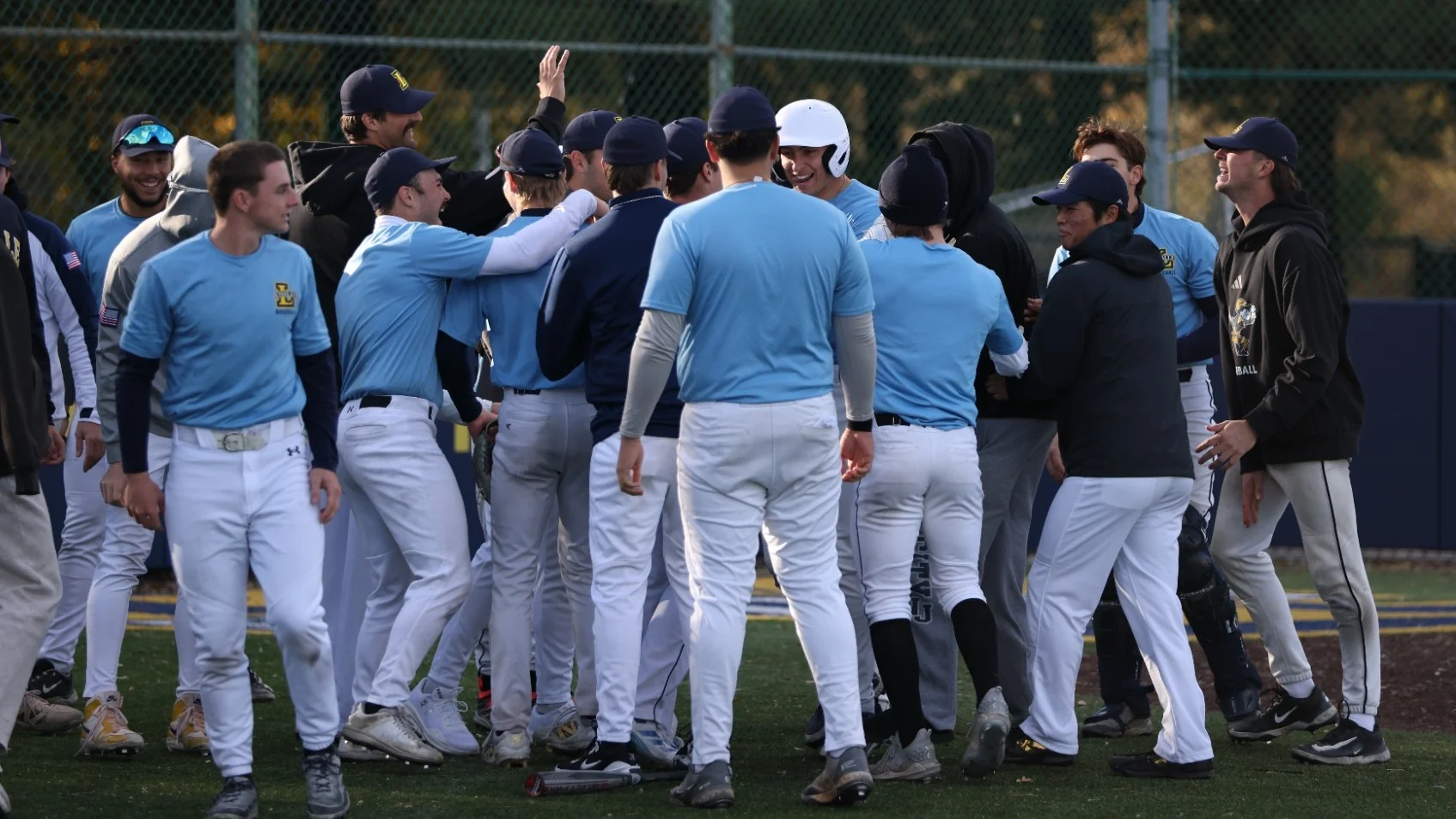
Eligibility can change without a school suddenly becoming a new baseball name. In its 2026 tournament announcement, the NCAA identified Tarleton State as a first-time Division I tournament participant in its second season of eligibility after reclassification from Division II. The school's first regional appearance and its first Division I schedule were therefore different milestones.
Read those timelines separately when assessing a newly eligible team. A club can already be familiar to its conference opponents before a postseason opportunity changes the stakes of its spring. Do not infer eligibility from a generic directory field or from the presence of a team on a schedule. Check the NCAA championship information and the school's specific announcement.
These examples explain how totals can evolve; they do not establish that one particular restoration accounts for the entire difference between two national datasets. A proper year-to-year reconciliation needs both full lists, the same definition and a record of every addition and removal.
How many Division I baseball conferences are there?
Use the baseball affiliation, not the football label
For the most recently completed NCAA tournament, 29 conferences supplied automatic qualifiers in 2026, according to the NCAA's automatic-bid tracker. Keep that season attached to the answer. It is more precise than taking every Division I conference in every sport and assuming each sponsors baseball.
A baseball affiliation also need not match the conference name you associate with a school's other teams. The Pac-12 announced Dallas Baptist as a baseball affiliate for 2026–27. Its baseball group consists of Dallas Baptist, Fresno State, Gonzaga, Oregon State, San Diego State, Texas State and Washington State. That seven-school list is a baseball-specific statement from the league itself.
This matters when you are trying to understand a weekend series. A list built from football affiliations can send you to the wrong standings, invent a rivalry's conference status or omit an affiliate that belongs in the title race. Follow the sport named in the announcement and the season when membership begins. Our conference directory is a starting point for finding those schedules.
Conference totals and automatic bids are different questions
Counting leagues that organize baseball competition and counting leagues certified for an automatic NCAA berth are not interchangeable exercises. The NCAA publishes automatic-qualification resources separately because the postseason route has its own requirements. A renamed league, new alignment or affiliate announcement should not be converted into a promised tournament bid without that additional evidence.
For 2027 planning, use the announced new affiliations to understand opponents, but check that season's championship documents before describing the precise bid allocation. The 2026 figure of 29 is a verified historical answer; it is not a shortcut for certifying the next field. The distinction is especially relevant in an offseason when the same familiar school can appear under a new league heading.
When comparing schedules, start with the conference's actual baseball members and then ask how its champion is determined. That gives a fan something useful: the series that affect the league race and the postseason event that matters. A bare national conference total cannot explain either on its own.
Where the Division I baseball teams are located
The 309 institutions in the current NCAA baseball directory are distributed across 45 states and the District of Columbia. Grouping that same snapshot by the NCAA's institutional state field gives California 26 entries, Texas 22, New York 19 and North Carolina 18. These are counts of listed institutions, calculated from one consistent dataset, rather than a mixture of numbers copied from different seasons.
That distribution is useful for discovering a local team, but it should not become a ranking of baseball quality. Twenty-two programs spread across Texas do not create the same travel choices as several campuses around one metropolitan area. Nor does a smaller state total make its individual program less competitive. State membership, geographic proximity and strength on the field measure different things.
Start with a state list if you want to add college baseball to a trip. Then move to the actual stadium address. The NCAA field used here describes an institution, not necessarily the venue for every home game. A school can play away from its main campus, stage a neutral-site game or temporarily use another facility. A familiar university name is not enough information to put into a navigation app on game day.
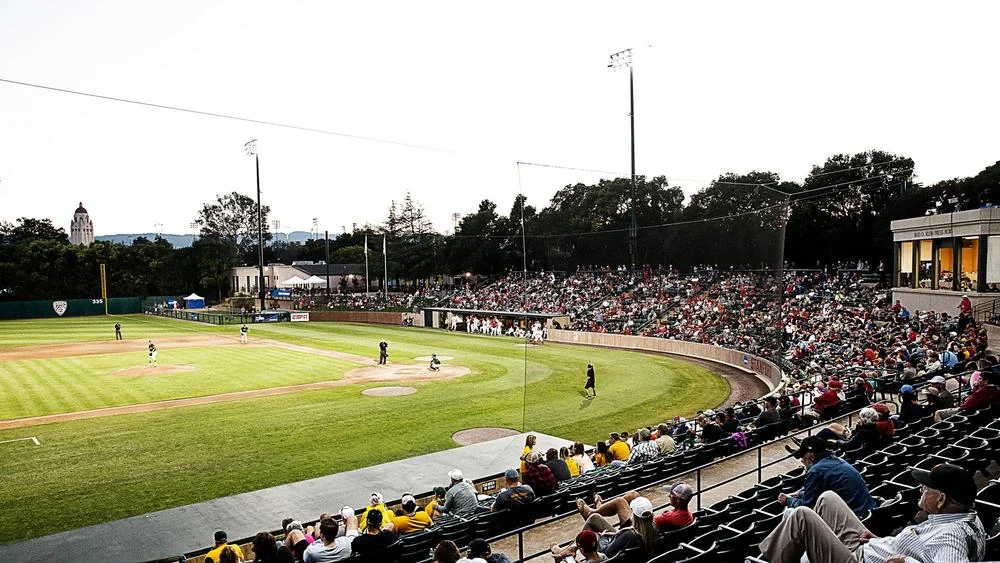
Stanford illustrates how much more useful the next layer of information can be. The university's Klein Field at Sunken Diamond guide identifies the baseball facility and places it south of Stanford Stadium. That is practical venue information. Counting Stanford as one California program tells you none of the details needed to find an entrance or plan a visit.
The states absent from this particular Division I baseball snapshot are Alaska, Idaho, Montana, Vermont and Wyoming. This does not mean those states have no college baseball. Other NCAA divisions, separate college associations and club programs fall outside the filter used for the national figure. A fan seeking any nearby college game should broaden the search instead of reading a Division I absence as the absence of the sport.
Use the school directory to turn a geographic shortlist into actual dates. Comparing two home schedules is often more helpful than choosing the school with the largest name recognition, especially when your available evening falls between weekend series.
How the national total connects to the NCAA tournament
From a national schedule to 64 tournament places
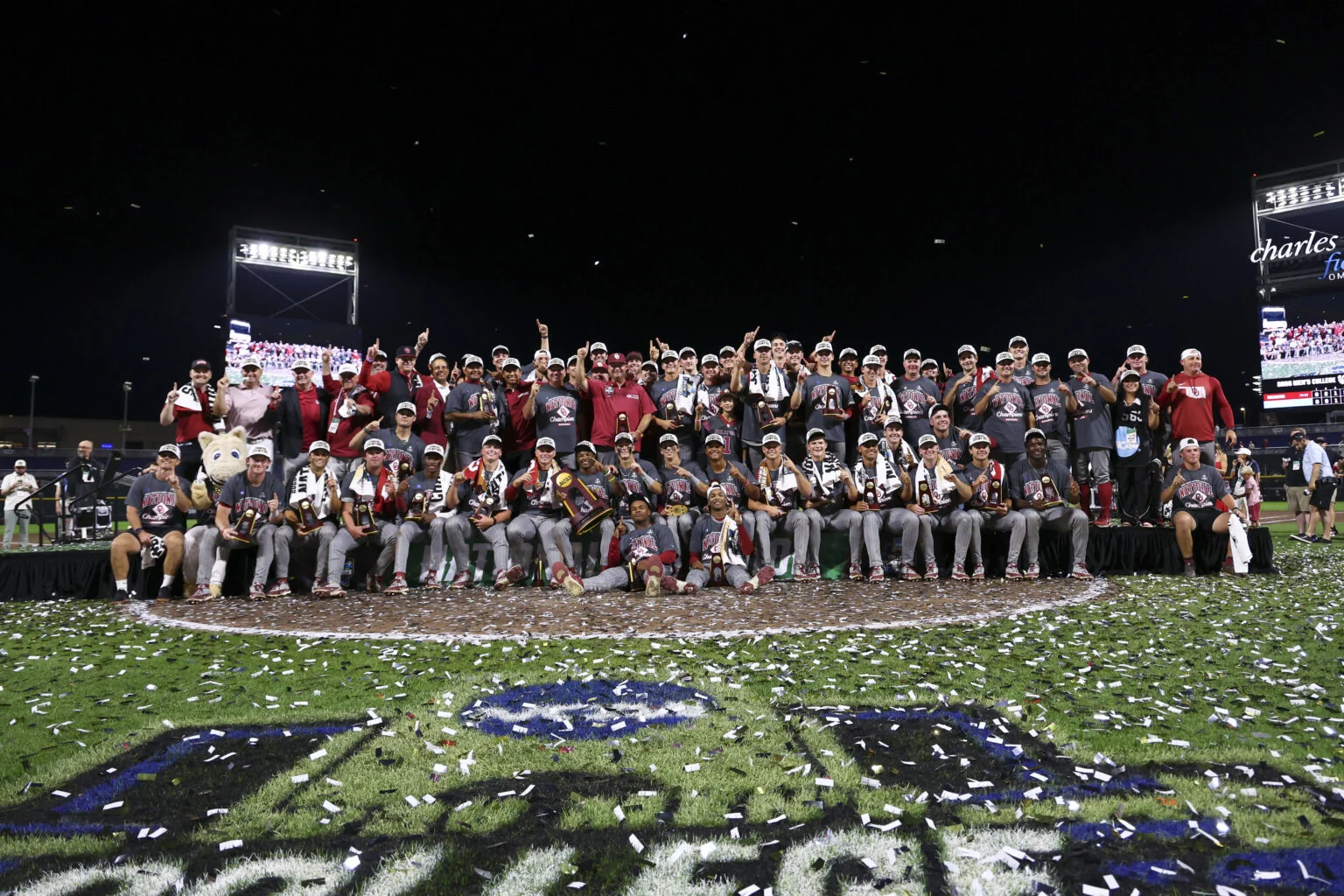
The Division I team total is much larger than the postseason field. In 2026, the NCAA championship selected 64 teams: 29 automatic qualifiers and 35 at-large selections. A school appearing in the national directory therefore has not already earned a place in the tournament. The regular season and conference postseason determine the evidence and opportunities that lead to selection.
The NCAA's tournament format guide describes the stages: 16 four-team regionals reduce the field to 16, eight super regionals reduce it to eight, and those survivors reach the Men's College World Series in Omaha. “NCAA tournament team” and “College World Series team” are consequently different levels of achievement.
A regional puts a particular kind of pressure on a roster. Games accumulate over a short stretch, so a club needs more than the starter who looks best on Friday night. As an editorial way to evaluate a postseason contender, examine the quality of its additional starters, the workload of its main relievers and its ability to avoid giving away outs. Those baseball questions tell you more about surviving a regional than the national membership number does.
Why the number of teams does not describe competitive balance
The NCAA's 2026 selection announcement placed 12 SEC teams and nine ACC teams in the field. Those figures show why dividing tournament places evenly among conferences would misdescribe what actually happened. Automatic qualification provides one route; at-large selection makes the overall field different from a simple gathering of league champions.
Do not divide 64 by the current directory total and present the result as a team's chance of making the tournament. That calculation would combine different season scopes and ignore eligibility, opponent quality and performance. It would also turn a population ratio into an unsupported probability for a particular school.
For fans, the more useful distinction is between a program's existence, its route to selection and its ability to win after selection. A small conference label does not make a team irrelevant to a regional. A major conference name does not relieve a club of the need to pitch, defend and win. Count the schools to understand the sport's scale, then assess each team through its actual baseball.
How to check a school before following its season
A national count is most useful when it leads to a reliable school-level answer. Start by confirming the institution in the NCAA's baseball-specific directory. Check the full name when a sports abbreviation is ambiguous, and make sure you are looking at varsity baseball rather than a student club. Save the season alongside the school so that an old schedule does not quietly become your plan for next spring.
Next, confirm the baseball conference for the season you intend to follow. Use a league announcement or the school's baseball page when a move has recently taken effect. A football subdivision or an institution's main conference label is not enough. Dallas Baptist's sport-specific Pac-12 membership is a good example of why that extra check can change the answer.
Then open the actual schedule and look at the venue field, not just the opponent. A home designation, a neutral-site event and a road game can place the same team in very different cities. Check whether the page is showing the completed season or the upcoming one. An empty future schedule is not evidence that the program has disappeared; it can simply mean dates have not been posted there.
For an attendance decision, finish with the host school's current ticket and game-day information. Stanford's baseball game-day page, for example, points readers toward weather updates and its rainout policy. These operational details belong to the host, and a national school list cannot replace them. Recheck them close to the game, especially after a postponement or a change to a doubleheader.
If you simply want baseball to watch now, use the today schedule and select the relevant time zone before comparing first-pitch times. A list of 309 institutions does not mean 309 teams play on the same day. Nor does a listed game automatically include a free video broadcast. Follow the individual game's confirmed viewing information when it is available.
The number to carry forward is therefore specific: 309 institutions in the NCAA Division I baseball directory for academic year 2026–27, as checked on September 29, 2026. Preserve that definition whenever you reuse the figure. For historical participation, postseason eligibility or the number of teams playing tonight, use the dataset built to answer that separate question.
Join the conversation
Share a question or a thought about college baseball. Comments are reviewed before they appear. Keep it friendly and on topic.
No comments yet. Start the conversation.
Sign in with Google to leave a comment. Your email address is not displayed.