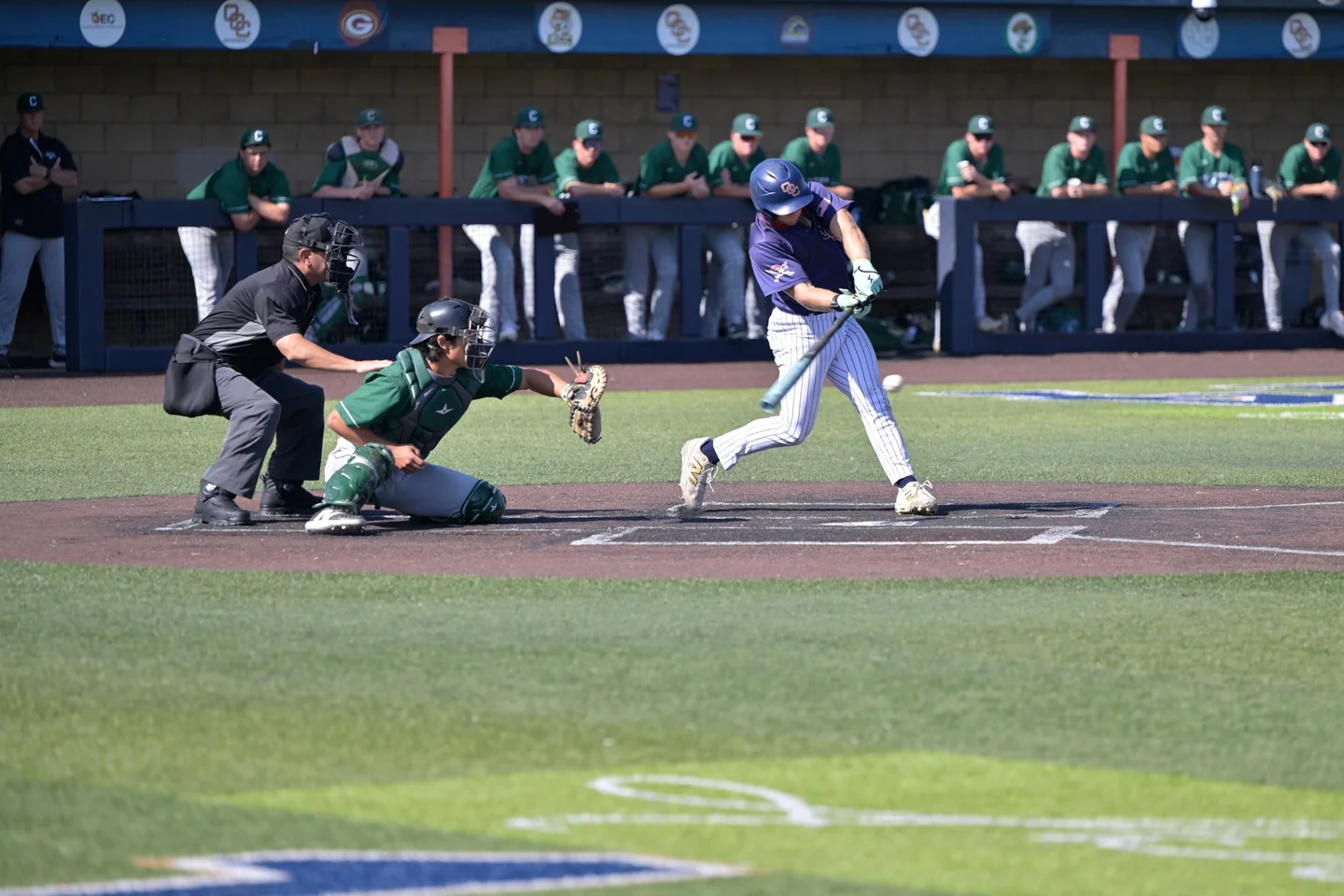
To find JUCO baseball near you, begin with your location and the correct two-year college association. NJCAA, California's 3C2A and the Northwest Athletic Conference have separate program and competition resources. A search covering only one of them can miss an appropriate nearby school.
This guide provides a selected regional map, school-and-state reference table and official baseball links, checked in October 2026. It is designed to help you find a real program and then a real game. It is not an exhaustive national directory, an automatic distance search or a ranking of recruiting opportunities.
Start with the association that covers your area
JUCO is a convenient expression for junior-college baseball, but it does not identify a single governing body. Before comparing teams, establish which association organizes the program you are investigating. That determines where to look for membership, regional competition and championship information.
NJCAA is a national starting point
The National Junior College Athletic Association's baseball resources are an appropriate starting point for its member programs. Search the school and state, then confirm the baseball team through the college's official athletics site. Do not treat an NJCAA-only list as a complete inventory of every two-year baseball program in the United States.
A practical search should retain both the college's name and the association name. A program may be easy to find through its nickname while its academic institution uses a longer name. Saving those two labels together makes it easier to move between a team schedule, an association listing and the college's admissions information without accidentally switching schools.
California has its own two-year college system
The California Community College Athletic Association, branded 3C2A, has its own baseball pages, schedule resources and standings. For a California community-college search, use those resources alongside the individual school's site. The fact that a school is absent from an NJCAA search does not establish that it lacks baseball.
Keep this search separate from California's four-year programs. A state can contain NCAA, NAIA and community-college baseball at the same time. If your purpose is specifically to find a two-year opportunity or a nearby JUCO game, retain that filter rather than collecting every college team returned by a broad California baseball query.
The Northwest needs a separate search
The NWAC's official association overview describes its current membership footprint in Oregon, Washington and British Columbia, Canada. It also identifies NWAC, 3C2A and NJCAA as distinct community-college athletics systems. Use the NWAC's own baseball and member-school resources when searching that area.
An association's geographical footprint does not guarantee that every member offers baseball. Start with the baseball list, then check the actual school. If your search extends across the US-Canada border, also distinguish a nearby location on a map from a practical travel option. The association connection identifies the competition system; it does not remove the need to plan the journey.
For the wider organizational comparison, our college baseball divisions guide explains how two-year associations sit alongside NCAA and NAIA competition. The next step here is more specific: connect an association to a named campus and its official baseball page.
Use a regional shortlist to find nearby programs
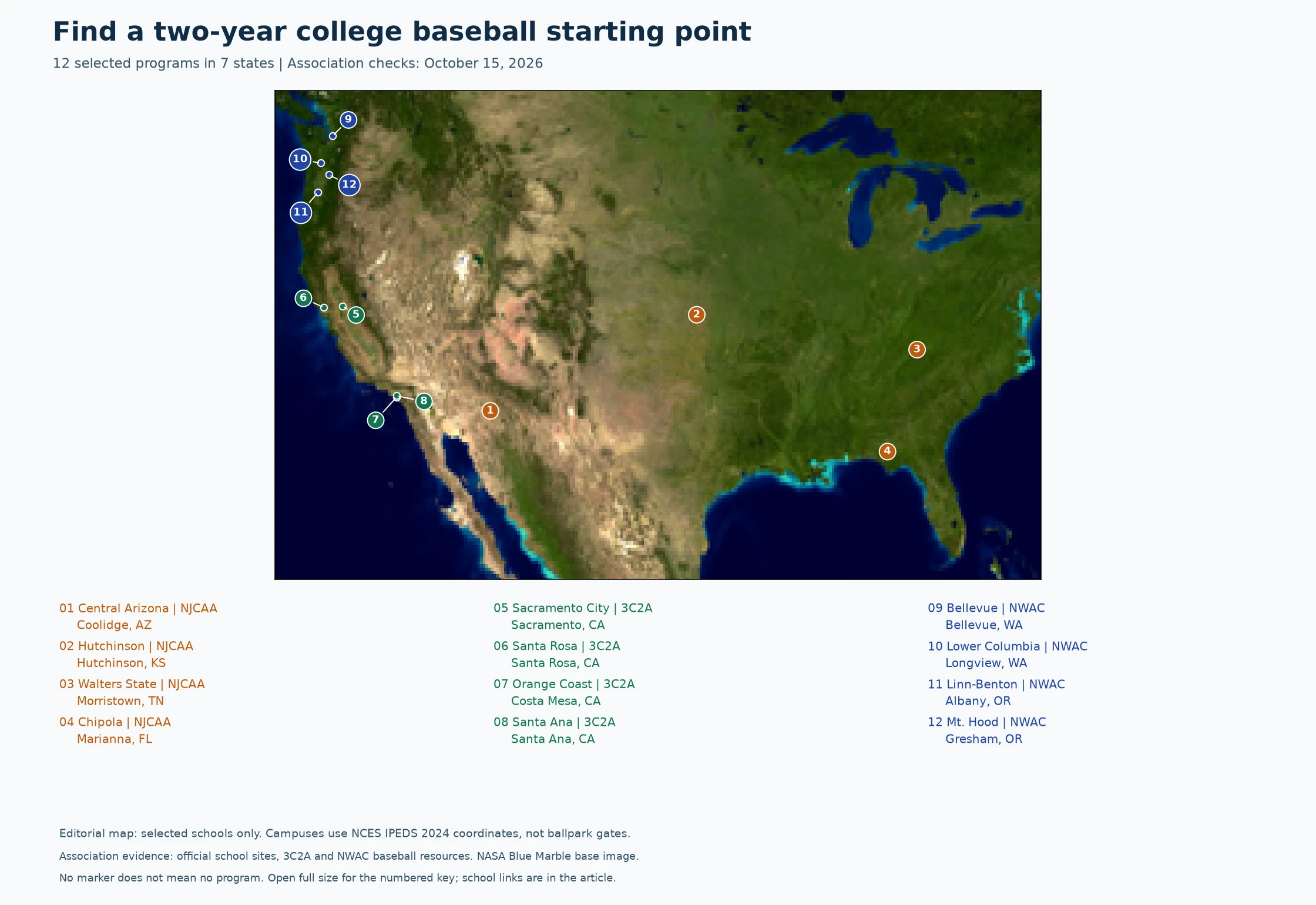
These twelve examples span seven states and three association systems. The numbered map uses NCES IPEDS 2024 campus coordinates; school and association resources establish the baseball identities. Markers show institutional locations rather than stadium entrances, and the table links to official baseball or athletics entry points.
| State | Map and college | Campus city | Association |
|---|---|---|---|
| Arizona | 1. Central Arizona College | Coolidge | NJCAA |
| California | 5. Sacramento City College | Sacramento | 3C2A |
| California | 6. Santa Rosa Junior College | Santa Rosa | 3C2A |
| California | 7. Orange Coast College | Costa Mesa | 3C2A |
| California | 8. Santa Ana College | Santa Ana | 3C2A |
| Florida | 4. Chipola College | Marianna | NJCAA |
| Kansas | 2. Hutchinson Community College | Hutchinson | NJCAA |
| Oregon | 11. Linn-Benton Community College | Albany | NWAC |
| Oregon | 12. Mt. Hood Community College athletics | Gresham | NWAC |
| Tennessee | 3. Walters State Community College | Morristown | NJCAA |
| Washington | 9. Bellevue College | Bellevue | NWAC |
| Washington | 10. Lower Columbia College | Longview | NWAC |
For California, begin with the part of the state you can realistically reach. Sacramento City and Santa Rosa are northern examples; Orange Coast and Santa Ana provide two distinct southern programs. Their markers are close at national-map scale, so open the full-size key and use the named city rather than interpreting overlapping geography as a single campus.
For the Northwest, Bellevue and Lower Columbia give Washington starting points, while Linn-Benton and Mt. Hood give Oregon examples. The NWAC member-school directory helps extend that search. Its baseball standings confirm that a college fields a baseball team; a general association membership badge alone is not the same evidence.
The four NJCAA examples deliberately cover different areas: Central Arizona in Coolidge, Hutchinson in Kansas, Walters State in eastern Tennessee and Chipola in the Florida Panhandle. They are separate starting points for regional searches, not an itinerary suggesting that a fan should combine them in a single weekend.
To expand beyond these examples, add schools through the relevant association and check their official baseball pages. An unmarked state can have programs worth investigating. The useful comparison is between verified schools and real home dates within your own travel area, rather than between the arbitrary number of dots appearing on a national illustration.
Read the schedule before planning a visit
Once you have a regional shortlist, compare the actual games available on the day you want to go. Record the school, opponent, season, venue and latest status together. A college's location is useful for finding nearby baseball, but its team can be playing elsewhere that afternoon.
Orange Coast's 2026 schedule supplies a clear historical example. Its Santa Ana series alternated locations: March 10 was listed versus Santa Ana, March 12 at Santa Ana, and March 13 versus Santa Ana. Two nearby colleges and one opponent pairing did not mean three consecutive games at one park. Read each entry individually rather than assuming a familiar series pattern.
That same completed-season schedule recorded a rain postponement against Palomar and a Riverside game moved to Friday. These examples explain what to look for when reading a current schedule; they do not announce 2027 dates. When a team's page opens an archived season by default, change the season before treating an entry as an upcoming opportunity.
For an actual visit, move from the college marker to the stated baseball venue. Read the school's visitor information for the entrance, parking and accessibility details that apply to that event. A campus may have multiple athletic facilities, and the academic address in a directory is not always the best arrival point for a baseball spectator.
A doubleheader can change the whole day
Lower Columbia's official 2026 schedule listed two February 14 games against Clackamas as a doubleheader at David Story Field in Longview. It also listed a February 26 doubleheader away at Lane in Eugene. The DH label therefore needs to be read together with the venue and home/away designation.
Two games can make a trip more rewarding for a fan who wants a full day of baseball, but they also change meal, travel and return-time planning. Inspect both game entries and the organizer's description of the second start. A listed second time does not establish a guaranteed finishing time, particularly if the opening game runs long or play is interrupted.
Do not infer the innings format, break length or admission arrangement from the abbreviation alone. Those are details to verify in the team's current game information. The same caution applies to historical ticket prices appearing in archived schedules: they describe the listed event, rather than establishing a permanent JUCO baseball price.
When comparing two nearby options, a single evening game and an afternoon doubleheader are different choices even if the campuses are similarly close. Choose the event that fits your available time, then recheck its status before departure. That turns a broad near-me search into a specific plan.
Keep divisions and championship routes within their associations
A division label needs an association name beside it. NJCAA baseball has Division I, II and III championship competition; those labels do not place a program inside the NCAA's similarly numbered divisions. California's 3C2A championship and the NWAC championship are separate routes again, rather than extra rounds of one nationwide JUCO bracket.
| Search context | What to establish | What follows |
|---|---|---|
| NJCAA baseball | The school's baseball division, region and current competition | The applicable NJCAA regional, district and championship information |
| 3C2A baseball | The California school and its conference | 3C2A baseball postseason brackets and state championship resources |
| NWAC baseball | The program's NWAC baseball identity and region | NWAC baseball qualification and championship information |
The distinctions are visible in actual primary records. The 2026 Division I host's World Series bracket includes Walters State. Madison College published separate 2026 NJCAA Division II World Series information for Enid. SUNY Niagara's official May 2026 championship report identifies its victory in the NJCAA Division III World Series. These are distinct competitions, not three names for the same event.
For California, the 3C2A baseball championship resource contains its own regional, super-regional and state-championship material. In the Northwest, Lower Columbia's official 2026 title report describes the NWAC championship at David Story Field. Neither should be relabeled as an NJCAA World Series result.
This matters when reading a school's claim to a championship, a player's postseason statistics or a recruiting message. Preserve the association, division where applicable, season and event name. A regional title and an association championship describe different achievements; a region's number is an organizational label rather than a national power ranking.
For an upcoming season, follow the applicable association's current qualification and bracket announcements. The historical examples here establish the separate pathways; they do not settle a 2027 field, venue, game format or ticket arrangement. They also do not guarantee that a particular team or player is eligible for a postseason opportunity. Once you know the correct system, the relevant rules and event information become much easier to locate.
Investigate the school as well as the baseball opportunity
If the search is about playing rather than watching, use the map to identify possible colleges and then build a different comparison. Proximity helps with visits and family travel, but the baseball role and academic plan determine whether an opportunity is suitable. A program's association label cannot answer those questions on its own.
Ask how the baseball development plan fits you
Make the questions specific to your position. A pitcher can ask how the staff evaluates starting and relief roles, how workload is managed and what development priorities it would identify. A catcher can ask about receiving, throwing work and opportunities to handle different pitchers. A position player can ask how defensive versatility and offensive development fit the roster.
Those are questions for a real conversation, not claims that this guide has interviewed the coaches or verified an available place. Compare the current roster and schedule before contacting the staff, then ask what information or video would make an evaluation useful. A generic promise of exposure says less than a clear explanation of how the program would help a particular player improve.
Keep the practical conditions beside the baseball discussion: the actual cost, housing or commuting plan, class availability and any proposed aid. Ask the college to explain its own terms rather than inferring a scholarship or roster guarantee from NJCAA, 3C2A or NWAC membership.
Check the academic transfer path separately
A successful baseball season does not automatically make every course transferable or secure admission to another institution. Santa Rosa Junior College's Transfer Center provides counseling and university connections, while its transfer checklist emphasizes an educational plan, researching destination universities and meeting their representatives. Those are useful academic tasks alongside athletic development.
Discuss the intended major early. Ask which courses contribute to the degree you want, how the destination institution evaluates them and which academic staff should review the plan. If later athletic participation is part of the goal, have the relevant compliance staff review that question separately. Academic admission, accepted credit and competition eligibility should not be collapsed into one informal assurance.
Also avoid assuming that JUCO baseball means every institution offers only two-year degrees. Chipola, one of the selected NJCAA examples here, lists baccalaureate degree programs in its official catalog. The baseball competition pathway and the college's complete academic offerings are different pieces of information.
A useful two-school comparison therefore records the association, location, proposed baseball role, academic program, verified cost and the staff member answering each question. That gives the nearby-program search a practical purpose without turning a map marker or a team reputation into a promise about a student's future.
Join the conversation
Share a question or a thought about college baseball. Comments are reviewed before they appear. Keep it friendly and on topic.
No comments yet. Start the conversation.
Sign in with Google to leave a comment. Your email address is not displayed.