To find D2 baseball schools, match three things: NCAA Division II baseball membership, the school's location and its baseball conference. This guide supplies a selected-program map and a state-organized table with official team links, then explains how to expand the search and find an actual game.
The selections are a starting set checked in October 2026, not a complete national membership list or a ranking. A state without a marker is not evidence that it has no D2 baseball. Use the official directory to investigate additional schools, and treat each program's own schedule as the source for dates and venues.
Start with NCAA Division II baseball membership
Division II is an NCAA classification, while a baseball conference identifies the league in which a program competes. Neither is simply another name for a state. Schools in the same state can play in different conferences, and a conference can connect schools across several states. A useful directory therefore needs both geographical and sporting information.
Start with the NCAA's official school directory. It offers division, state and sport filters, along with separate membership lists. Those controls help distinguish a search for all Division II institutions from a search for schools actually sponsoring baseball. The distinction matters when turning a general college list into a baseball itinerary or a program shortlist.
Use the sport filter before counting schools
Select Division II and baseball, then add a state when narrowing the search. Do not count a university merely because it appears in a general Division II athletics list. The NCAA directory itself separately identifies Division II institutions that sponsor Division I men's sports, demonstrating why the division needs to be checked at the sport level.
Next, open the school's official baseball page and its baseball conference's current material. The team page establishes an active program and its schedule; the league page helps confirm the competition context. Keep the season visible in your notes. A 2026 results page is useful historical evidence but cannot, by itself, announce every affiliation or opponent for spring 2027.
Also retain the association name. NCAA Division II and an NJCAA division are different classifications in different organizations. A two-year program labeled Division II in an NJCAA directory does not belong in an NCAA D2 list merely because the Roman numeral matches. Our college baseball divisions explainer provides the broader organizational comparison.
The map below deliberately uses a manageable selected set instead of presenting an unsupported national total. Its value is that each marker connects to a named school, a state, a baseball league and an official team page. You can repeat the same verification process for another school without assuming that proximity, a familiar nickname or a university's football affiliation answers the baseball question.
Read the selected-program map as a travel starting point
The map locates sixteen selected programs across fourteen states. Numbers match the directory tables below. The membership check uses the NCAA directory's 2026-27 academic-year baseball records; the markers use NCES IPEDS 2024 institutional coordinates. These are campus reference points, so use a ballpark address before starting a drive.
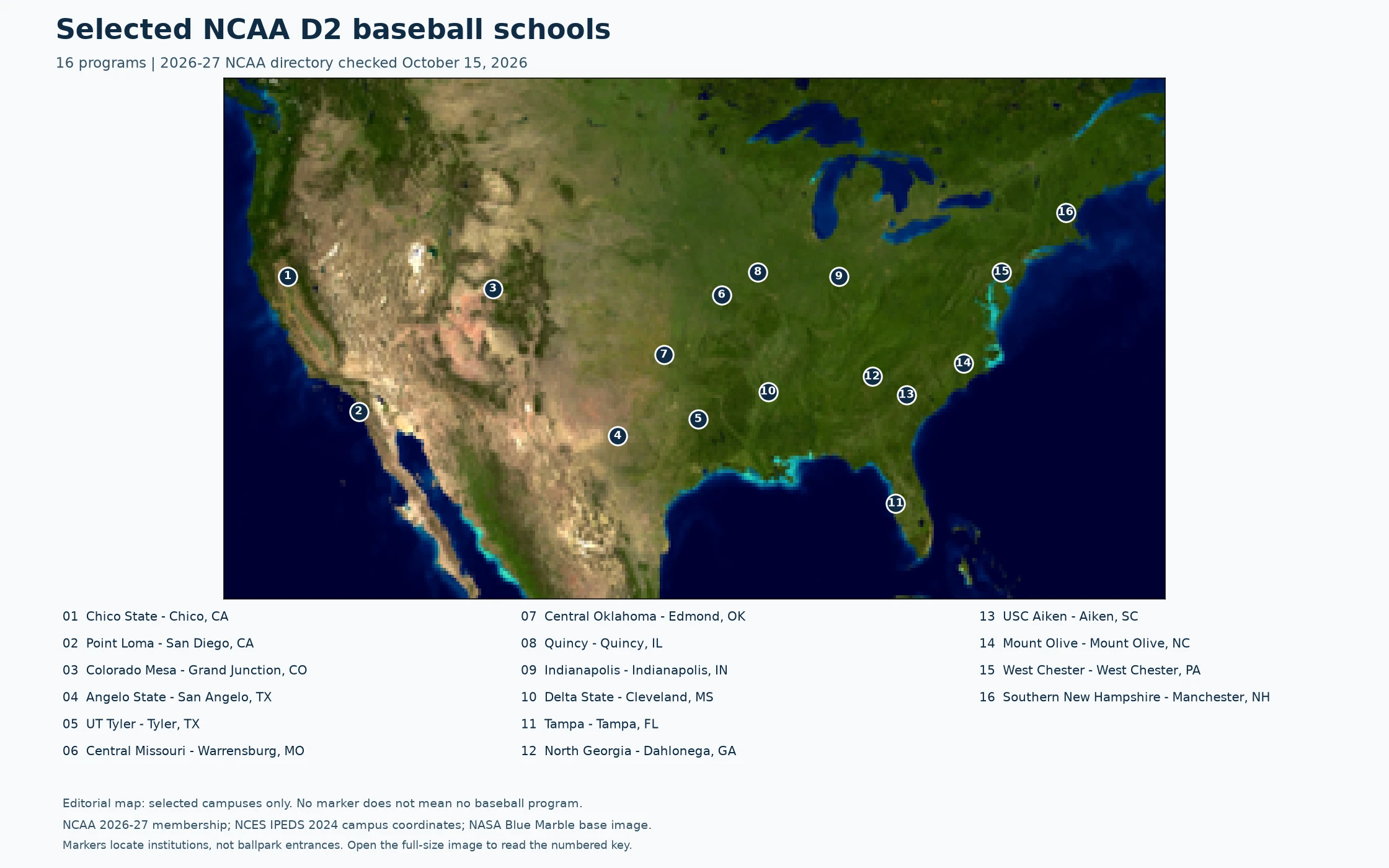
Read the geography at two scales. At the national scale, Chico and Point Loma show how far apart two California programs can be, while Colorado Mesa places a western program well inland. At a regional scale, the Central Missouri, Quincy and Indianapolis markers suggest different possible starting points through the central states. Their relative positions help you investigate a route; they do not promise that those teams are home on the same weekend.
The eastern markers likewise offer several separate searches: Southern New Hampshire in Manchester, West Chester in Pennsylvania, and the Mount Olive, USC Aiken and North Georgia programs farther south. Choose a geographical cluster first, then compare actual home dates. A nearby program playing away may be less useful for a Saturday outing than a slightly farther program hosting a scheduled game.
Selection is editorial rather than statistical. The empty areas on this particular image are not a census of states without baseball. There are other D2 programs outside these sixteen, including schools in states already represented. Use the NCAA directory to extend the map's starting set instead of interpreting an unmarked area as a gap in the sport.
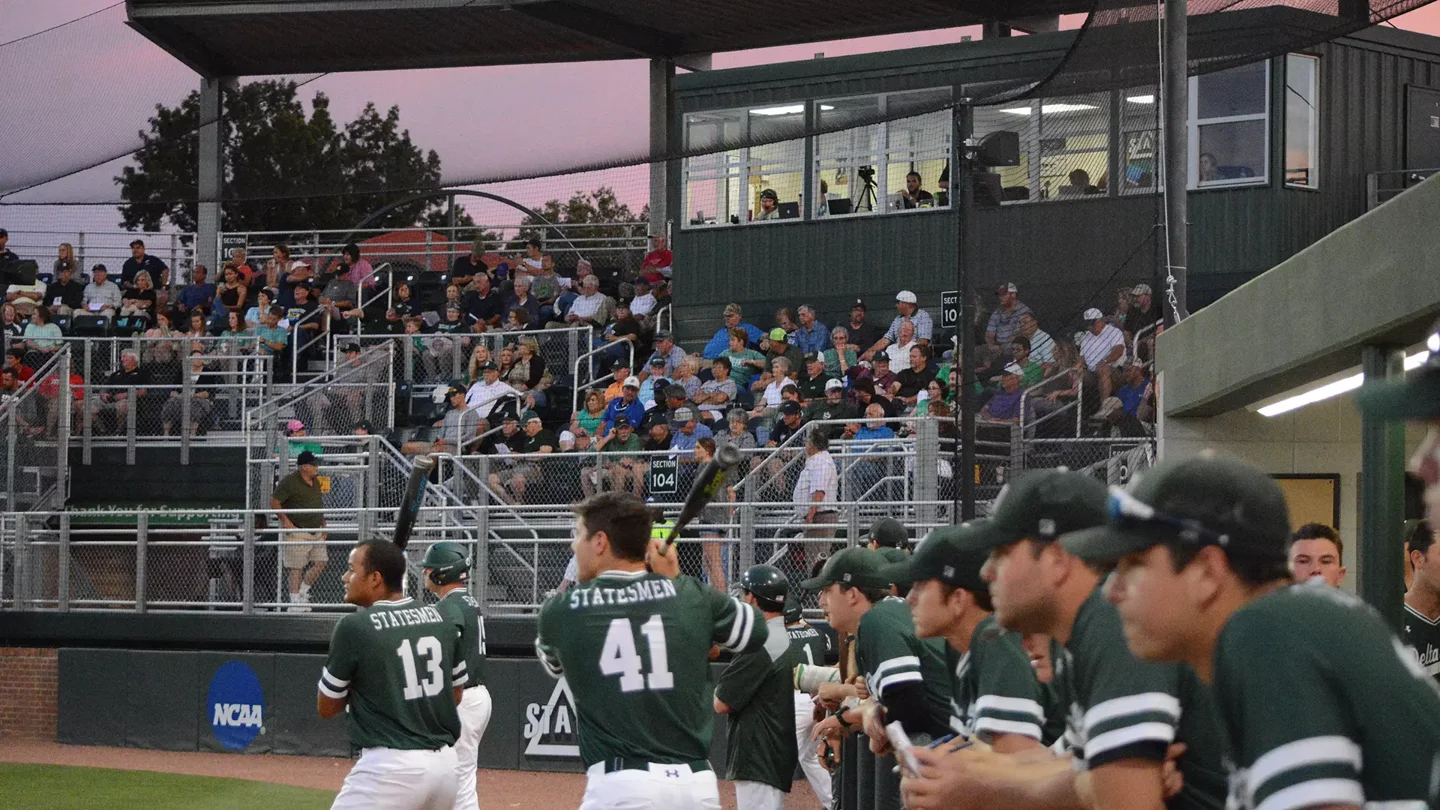
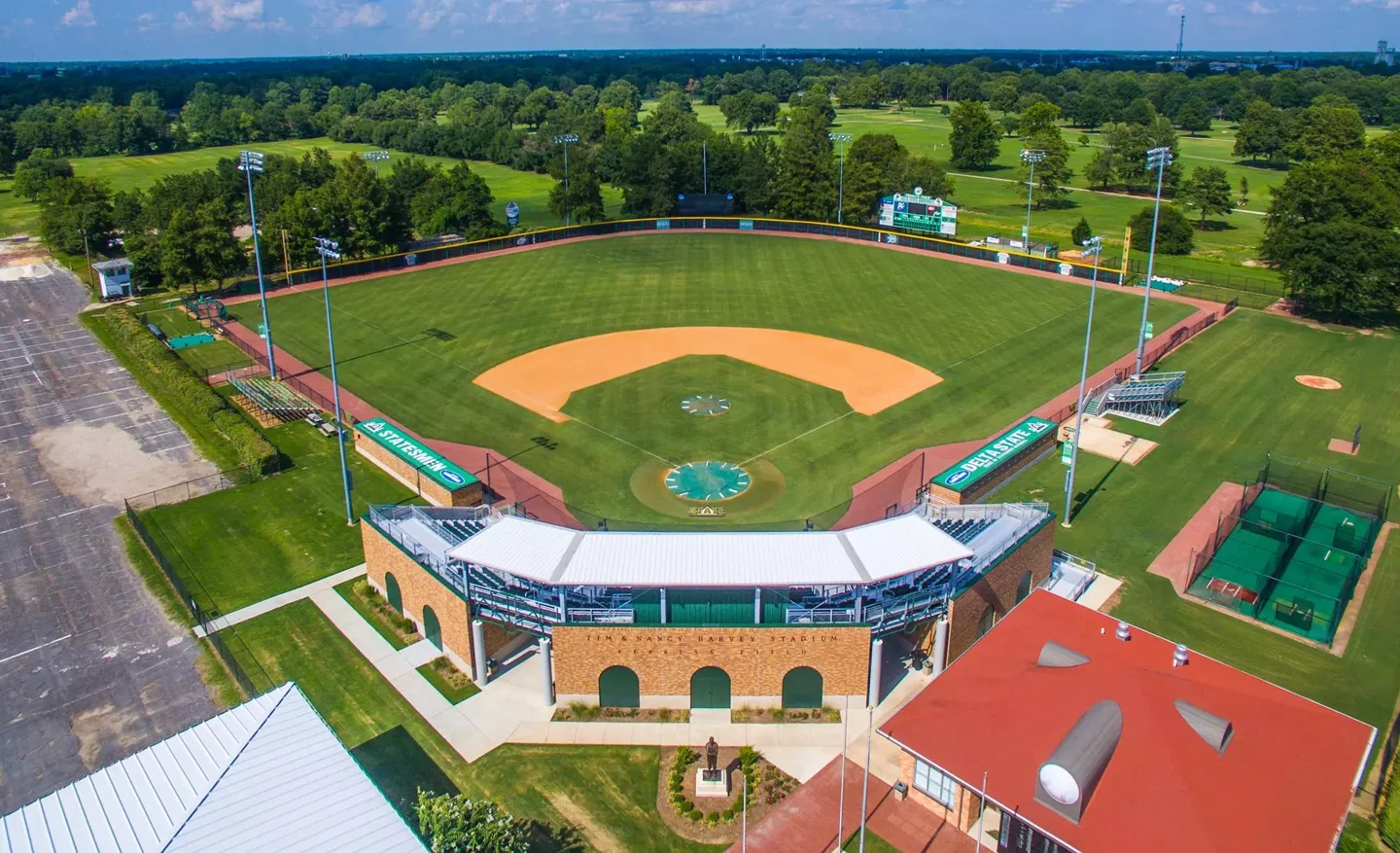
Delta State, marker 10, provides a concrete connection between the geographical view and a real venue: its official Ferriss Field facility page supplies the photographs used here. The gallery shows the baseball setting; it is not evidence that a game will take place on any date you choose. Current schedules complete that part of the search.
Browse the schools by state and baseball conference
Each row links to the school's official baseball page, where you can select its schedule. The conference labels follow the NCAA directory's baseball-filtered 2026-27 records checked on October 15, 2026. Numbers refer to the map; the order is geographical navigation rather than a competitive ranking.
Western schools
| State | Map and school | City | Baseball conference |
|---|---|---|---|
| California | 1. California State University, Chico | Chico | California Collegiate Athletic Association (CCAA) |
| California | 2. Point Loma Nazarene University | San Diego | Pacific West Conference |
| Colorado | 3. Colorado Mesa University | Grand Junction | Rocky Mountain Athletic Conference |
California alone shows why a state filter is only the first step. Chico State and Point Loma are in different parts of the state and different baseball conferences. Someone staying in San Diego should not treat Chico as another local option simply because both rows say California. Colorado Mesa adds a different western starting point in Grand Junction, rather than a school on Colorado's eastern urban corridor.
Central and Southern schools
| State | Map and school | City | Baseball conference |
|---|---|---|---|
| Florida | 11. University of Tampa | Tampa | Sunshine State Conference |
| Illinois | 8. Quincy University | Quincy | Great Lakes Valley Conference |
| Indiana | 9. University of Indianapolis | Indianapolis | Great Lakes Valley Conference |
| Mississippi | 10. Delta State University | Cleveland | Gulf South Conference |
| Missouri | 6. University of Central Missouri | Warrensburg | Mid-America Intercollegiate Athletics Association |
| Oklahoma | 7. University of Central Oklahoma | Edmond | Mid-America Intercollegiate Athletics Association |
| Texas | 4. Angelo State University | San Angelo | Lone Star Conference |
| Texas | 5. The University of Texas at Tyler | Tyler | Lone Star Conference |
Texas has two selected examples here, not a complete Texas D2 list. Angelo State and UT Tyler share a league, but the map places them in separate parts of the state. Central Missouri and Central Oklahoma show another cross-state conference connection. When comparing potential weekends, use the league relationship to understand the opponent and the location to plan the journey; neither replaces a dated home schedule.
Delta State's Cleveland is in Mississippi, so preserve the state when searching directions. Likewise, Quincy University in this table is the Illinois institution. Full school names prevent a broad place-name search from leading to a similarly named town or an unrelated campus.
Eastern schools
| State | Map and school | City | Baseball conference |
|---|---|---|---|
| Georgia | 12. University of North Georgia | Dahlonega | Peach Belt Conference |
| New Hampshire | 16. Southern New Hampshire University | Manchester | Northeast 10 Conference |
| North Carolina | 14. University of Mount Olive | Mount Olive | Conference Carolinas |
| Pennsylvania | 15. West Chester University of Pennsylvania | West Chester | Pennsylvania State Athletic Conference |
| South Carolina | 13. University of South Carolina Aiken | Aiken | Peach Belt Conference |
North Georgia and USC Aiken are a useful pair for understanding school identity: one is in Georgia, the other in South Carolina, and both appear in the Peach Belt baseball records. USC Aiken is a separate baseball program from South Carolina's Gamecocks in Columbia. West Chester also needs its full Pennsylvania identity; substituting a similarly spelled place name can send a search in the wrong direction.
To add a school, repeat the same fields rather than simply adding a logo: official name, baseball membership, state, city, league and an official baseball or schedule link. That preserves the connection between the map and a program a reader can actually investigate.
Check the conference as well as the campus
A conference label tells you more than which schools are geographically close. It provides the right place to investigate league standings, recurring opponents and the conference tournament. The CCAA baseball hub, PacWest baseball hub and Peach Belt baseball hub are examples of sport-specific starting points. Select the appropriate season before interpreting their results.
Look back at California's two entries: sharing a state does not put Chico State and Point Loma in one conference race. Conversely, the Peach Belt connection joins North Georgia and USC Aiken across a state boundary. Those distinctions help a fan understand the context of a series and help a prospective player identify the league schedule they would actually encounter.
A school's general athletics label is not enough
Membership can change between one spring and the next. West Florida is a concrete recent example: the ASUN's April 2026 announcement set out its move to Division I competition beginning in fall 2026. A historical D2 baseball page mentioning the Argonauts can be correct for its own season while being the wrong basis for a 2026-27 D2 directory.
The announcement also distinguishes competing in a conference from NCAA postseason eligibility during reclassification. Those are separate questions. A school can have a new league schedule without immediately having every championship entitlement of a fully eligible member. Do not turn a conference logo into a claim about NCAA tournament access.
For any borderline entry, record the effective date, baseball league and membership status. Then compare the school's announcement with the NCAA's current sport-filtered record. This is especially useful when an older list is highly visible in search or a cached page still shows a previous conference badge.
For the sixteen selections here, the NCAA's 2026-27 baseball-filtered records provide the membership snapshot. They do not supply a completed 2027 standings table, an announced championship field or a prediction of which program will win its league. Use them to establish who belongs in the directory, then move to current league and team material for the season's competition.
Find an actual game and the right ballpark
After choosing a school, save four fields together: opponent, date, game status and venue. An institutional map point answers where the school is; those four fields establish whether there is a baseball game you can attend. Keeping the venue in the same note also prevents a neutral-site event or an away series from turning into a wasted campus visit.
Delta State's 2026 schedule offers a historical example. Its February 7 doubleheader against Spring Hill was listed in Mobile, Alabama; its February 10 Southern Arkansas game was listed at Harvey Stadium at Ferriss Field in Cleveland, Mississippi. One team's schedule therefore pointed to different cities within a few days. These completed-season entries illustrate how to read a schedule; they are not announced games for 2027.
The same page includes postponed entries with dates still marked TBD. That illustrates why a scheduled opponent and original date are not enough. Read the latest status and accompanying team notice before leaving, especially if travel depends on a single game. A saved screenshot can preserve the original plan while missing a subsequent change.
When a listing says DH, inspect both game entries. It indicates a doubleheader, but the second game's start may depend on the first game's finish or a separate published time. Do not infer the length of the break, innings format or whether one ticket admits you to both games without the organizer's stated arrangements.
Finally, switch from the campus marker to the facility's visitor information. Delta State identifies the Robert L. Crawford Center as the entrance and exit for Ferriss Field. That kind of venue-specific detail is more useful at the end of a journey than an administrative campus address. Check current parking, gate and accessibility instructions separately; an older stadium history does not establish today's event procedures.
For a weekend with several possible schools, keep a second option rather than assuming a single date cannot change. Compare actual venues and start times before attempting two parks in one day. The national map helps create the shortlist, while the official schedules and facility pages supply the detail needed to make it workable.
Choose a D2 program for the question you are asking
A baseball fan looking for Saturday entertainment and a player considering enrollment can begin with the same directory and reach different shortlists. Location and membership are shared starting facts, but the final decision depends on the purpose of the search. Do not confuse a nearby campus, a successful season and a suitable college education as if they were one measure.
For fans, compare access and the baseball calendar
Begin with a travel area, then compare the home calendars of the schools in it. For example, a Texas search might start with Angelo State or UT Tyler depending on where you are staying; a South Carolina search can begin with USC Aiken. The map gives the relative geography, while the official schedule determines whether the program is actually available for your visit.
Next, investigate the experience that matters to your group: the ballpark entrance, accessible seating arrangements, time available and any current ticket requirements. A family with two hours to spare has a different plan from a fan deliberately following a full doubleheader. An evening start, a midday first pitch and a game awaiting a time announcement are materially different travel choices.
For remote viewing, follow the specific team's official game listing to its provider. This site's main schedule tools focus on Division I coverage, so they should not be treated as a complete D2 broadcast directory. The D2 table is most useful as a set of official-team entry points, rather than a promise that every selected game appears in one shared feed.
For players, investigate the whole school
For a prospective student, add the academic program, total cost, development environment and a realistic baseball role to the geographical shortlist. A school's state and conference can narrow your search; they cannot tell you whether its courses suit your interests or whether the coaching staff has a need at your position.
The NCAA describes Division II's partial-scholarship model, under which athletics assistance can be combined with other forms of aid. That is a framework, not a scholarship offer to every baseball player. Ask each school's financial-aid and athletics staff about the actual package, conditions and cost for your enrollment year.
Useful baseball questions are specific: how are players developed at your position, what does the current roster show, which training resources are available, and what would the staff want to evaluate before discussing an opportunity? Keep those answers separate from general marketing claims about being a top program.
Use the sixteen selected examples to begin a documented search, then add schools through the NCAA directory as needed. Keeping the school, division, baseball conference, campus location and official schedule together makes the next decision more informed, whether that decision is buying a game ticket or investigating a possible place to study and play.
Join the conversation
Share a question or a thought about college baseball. Comments are reviewed before they appear. Keep it friendly and on topic.
No comments yet. Start the conversation.
Sign in with Google to leave a comment. Your email address is not displayed.