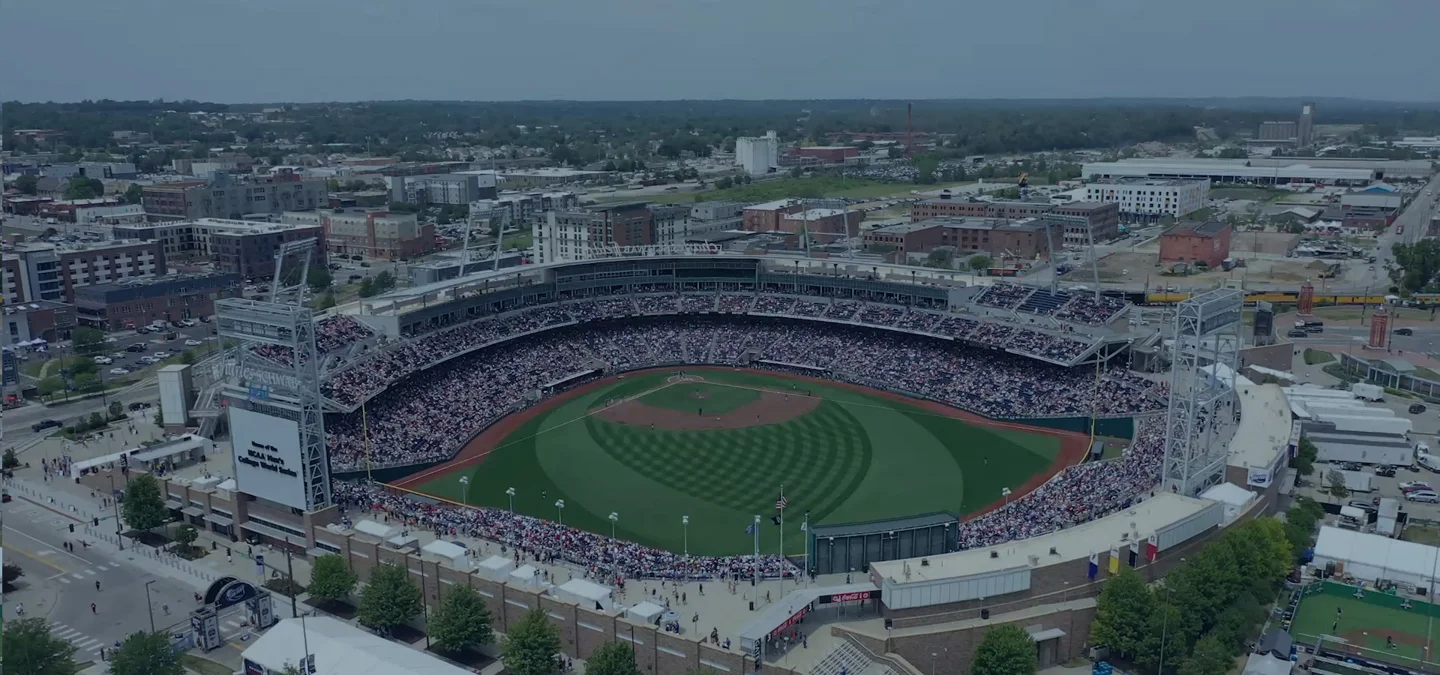
The first permissible contest date for the 2027 NCAA Division I baseball championship segment is February 19. The Men's College World Series is scheduled for June 18 through June 27 or 28 in Omaha. Between those anchors, schools and event organizers publish their own opponents, venues, times and viewing details.
This guide is a planning snapshot checked on October 15, 2026. It combines official calendar dates with selected 2027 schedule announcements and explains what each announcement lets a fan decide. Use the 2027 college baseball schedule for available fixture listings; the site's current collection is not a declaration that every national matchup has been announced or entered.
Separate confirmed dates from the schedule still taking shape
The NCAA's Division I first-contest calendar, Figure 17-2, identifies February 19, 2027 for baseball's championship segment. That is a national regulatory starting point, rather than a promise that every team plays that day. It also does not describe all college divisions or imply that fall baseball activity is absent.
| Planning item | Verified date or status | What it establishes |
|---|---|---|
| Division I championship-segment first contest | February 19, 2027 | First permissible contest date, not every school's confirmed opener |
| Men's College World Series | June 18-June 27/28, 2027 | Omaha event window at Charles Schwab Field |
| Individual opening series and neutral-site events | Check the particular 2027 announcement | A school or event commitment within its stated scope |
| Selection, regional and super-regional dates | Exact 2027 dates not established by this guide | Use the dated NCAA schedule when planning those stages |
| Tournament field, hosts and game times | Require their own announcements | Cannot be inferred from last year's bracket |
The NCAA's official Division I championship page lists the 2027 Omaha event window. Preserve the June 27/28 notation when making an initial plan instead of silently choosing the shorter ending. A possible final day matters to a return flight even before specific teams and game assignments are known.
Think of a schedule release as several layers of certainty. An opponent and date can be official while first pitch remains unassigned; the ballpark can be known while ticket sales have not opened. A broadcaster can be named for one event without carrying a school's whole season. Those distinctions let you act on verified information without filling the gaps with last year's arrangements.
For a personal calendar, keep the source announcement and the details still needed beside each entry. A planning note saying opponent confirmed, time pending is more useful than an invented 7 p.m. start. As later releases arrive, update the missing fields rather than treating the earliest schedule graphic as a finished itinerary.
Choose an opening-weekend experience
Opening weekend offers two different ways to learn about the season: stay with one home program or choose a neutral-site event featuring several schools. The choice affects how many teams you see, how closely you follow one roster and how you plan the day. Two official 2027 announcements already provide concrete examples.
A campus series gives you one program in depth
LSU's published 2027 release opens with a February 19 doubleheader against Long Island at Alex Box Stadium, Skip Bertman Field. The important detail is the doubleheader: this particular opener is not a generic assumption of one game each Friday, Saturday and Sunday. Plan around the announced games rather than imposing a familiar weekend pattern.
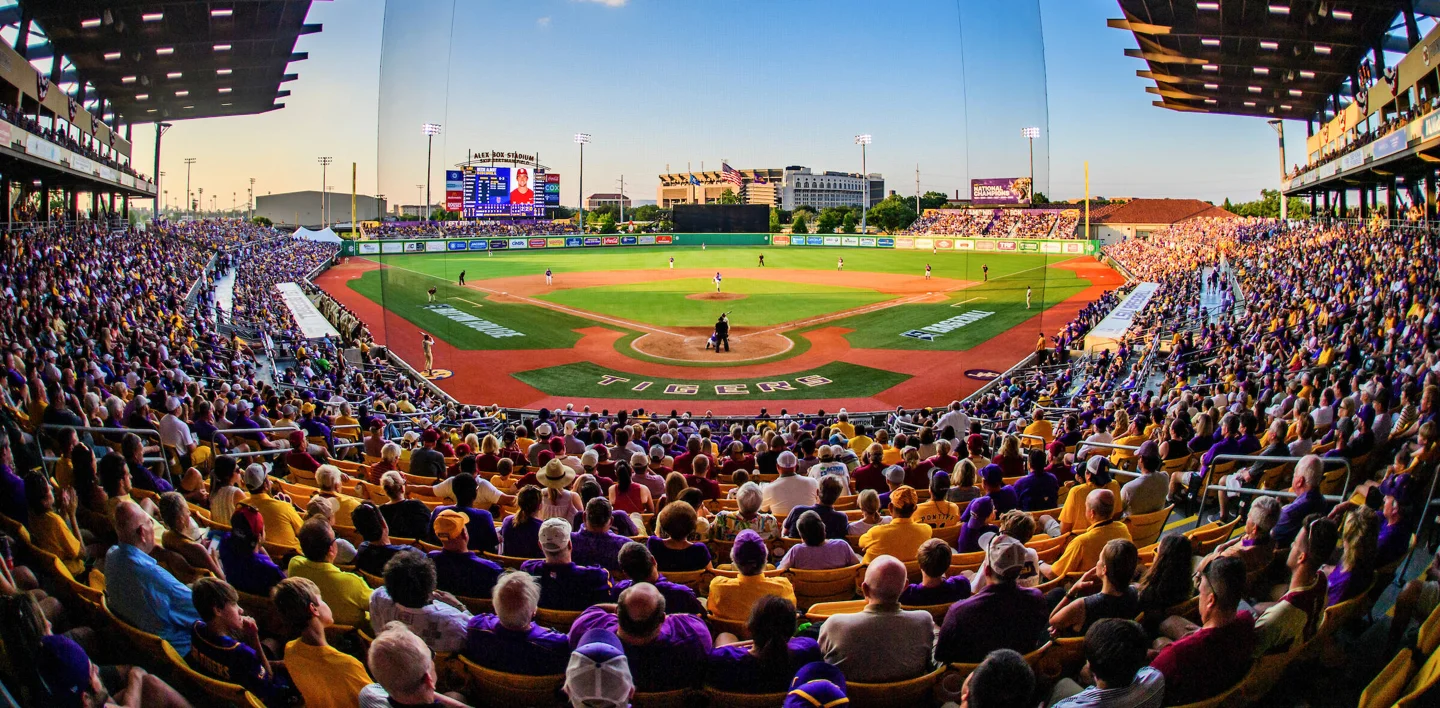
Following one home team over multiple games lets you watch how the coaching staff distributes innings and defensive opportunities. Notice which players occupy different positions, how the lineup changes against a different pitcher and which relievers are used after the starter exits. Those observations are more informative than assuming the opening lineup already defines the entire season.
Keep early judgments proportionate. A strong first outing is a useful observation, but a single opponent and a small number of plate appearances cannot settle the team's offensive quality or bullpen depth. A campus visit offers detail and continuity; it does not remove the uncertainty that makes February baseball interesting.
A neutral-site event lets you compare several teams
The organizer's 2027 Shriners Children's College Showdown announcement and Globe Life Field's event page identify February 19-21 in Arlington, with Arizona, Clemson, Oklahoma, TCU, Texas and Virginia. That gives a fan a different planning opportunity: several programs in one venue during the same event window.
A multi-team event helps you compare teams under a shared setting while following different opponents. It can be especially useful if your interest is national rather than tied to one campus. Read the event's actual daily matchups and ticket options before deciding how much of the weekend to attend; the six-team field alone does not tell you that every team plays every other team.
| Official example | 2027 date and place | Best planning question |
|---|---|---|
| LSU versus Long Island opener | February 19, Baton Rouge; doubleheader | How much time can you devote to following one home program? |
| Shriners Children's College Showdown | February 19-21, Globe Life Field, Arlington | Which daily matchups let you see the programs you want? |
Both choices start with real announcements. The useful distinction is the kind of baseball experience you want, then the actual game and admission details needed to make that choice workable.
Read conference weekends as a season-long test
A conference schedule becomes more informative when you read it in stretches rather than as a list of isolated opponents. Look for the league opener, consecutive home weekends, road series and the games between them. Those patterns help a fan follow how a team responds to different pitching staffs and repeated weekend demands.
Nebraska's official 2027 announcement provides a concrete example. The Huskers host Kansas State on March 9, open Big Ten play at home against Illinois on March 12-14, host Wichita State on March 16-17 and then visit Indiana on March 19-21. That compact stretch combines two conference series, midweek baseball and a change of location.
For a fan choosing a Lincoln visit, the Illinois series offers a sustained look at one league opponent. The following Wichita State dates provide another viewing option before Nebraska leaves for Indiana. Neither choice should be described as the beginning of Nebraska's entire season simply because it appears early in the home or conference calendar.
Put the weekend series beside the midweek workload
The stretch also creates useful baseball questions. Watch how many innings the weekend starters provide, which relievers are called on repeatedly and whether midweek games reveal additional pitching options. A bullpen that covers an unusually large share of one series may give a different picture the following week. The schedule identifies the workload sequence; it does not reveal the coach's planned rotation.
Read offensive performance with the opponent and sample in mind, too. A productive Tuesday does not prove that a lineup will handle every weekend staff, while one difficult Friday should not erase a longer body of work. As the season develops, compare several series and the quality of opposition rather than treating the order of opponents as a prediction of wins.
Conference and nonconference games also answer different questions. League results directly shape that conference race; midweek games still contribute to the team's broader season. Calling them practice games would miss their competitive value. Following both gives a fuller account of a roster than watching only its most publicized weekends.
For your own team's 2027 calendar, mark one home league series, one road series and the surrounding midweeks. That creates a manageable stretch to follow closely without requiring a copy of the entire national fixture list.
Plan the visit around the ballpark and the calendar
A matchup is only part of a travel plan. Match the ticket to the date and the admission it actually provides, then work backward from the venue to parking, arrival and accommodation. This is particularly useful for an event with several games in a day: seeing your preferred school may occupy only part of the available baseball.
The 2027 Globe Life Field event page separates daily general-admission links from its Home Plate Reserved offering. Its parking information also distinguishes advance tournament-package parking from single-day purchases at the lots and identifies the lots as cashless. Those details affect what to arrange before arrival; a team list alone would not supply them.
Read the terms of the exact option you select. Determine which day or days it covers, whether a reserved seat is included and how the event treats any additional experience. Do not assume that a ticket to one college event includes a different weekend, a stadium tour or a major-league game simply because the venue is the same.
For the Arlington example, use the venue's ballpark map and accessibility information to identify the arrangements relevant to your group. Consult the current bag policy before packing. These are venue-specific planning steps; another college ballpark can have different access arrangements.
A campus visit has a different rhythm. If you are following LSU's announced opening doubleheader, leave enough time for two games and investigate the actual admission and parking details. If you are choosing Nebraska's Illinois weekend, coordinate the individual game times with the rest of the visit rather than assuming three identical evening starts.
For an Omaha trip, retain flexibility around the official final-day notation and the sessions you intend to attend. For a regular-season trip, a changeable travel plan can be useful while start times are still pending. The goal is to make the commitments supported by current information, while clearly recording which remaining details could change the itinerary.
Treat television announcements as another release cycle
Team schedules and broadcast schedules answer different questions. The first identifies an opponent, date and location; the second tells a viewer when and where the game is available. A complete-looking list of opponents can still need further information before it becomes a useful watch calendar.
An announced matchup can still have a TBA first pitch
LSU's September 8 schedule release explicitly left SEC starting times to be determined after television schedules and travel arrangements were finalized. That is a dated example of a release with confirmed opponents and remaining timing decisions, rather than evidence that every listed game must still be TBA today. Look for the later game-level update before arranging an evening around it.
Keep the displayed timezone with the time. A school announcement may state local time while a schedule tool displays the viewer's selected timezone. For a trip, use the venue's local date and time; for watching from another country, confirm the date after conversion as well as the hour.
In a saved calendar, leave an unannounced first pitch blank or explicitly pending. If an updated time appears later, attach the source rather than copying a familiar start from a previous season. That makes changes visible and avoids confusing a planning placeholder with an official announcement.
Match the listed network to the access you need
There is already a specific 2027 viewing commitment for the Arlington events: REV's Globe Life Field schedule announcement states that every weekend game of the Shriners Children's College Showdown and Amegy Bank College Baseball Series will stream on FloCollege. That scope concerns those events, rather than every game played by their participating schools throughout the season.
Once a provider is listed, open the official event or service page to verify the actual access needed. A streaming listing is not by itself a statement that a game is free or included in an unrelated television package. Likewise, one provider's coverage of an opening event does not determine the broadcaster for a later conference series.
Use the college baseball TV schedule for available game listings, the watching guide for service distinctions and the existing FloSports and FloCollege guide for that platform's context. For a particular game, the latest official listing supplies the decision that matters: matchup, time, provider and the access required.
Follow the road to Omaha without inventing the bracket
The official 2027 Omaha window gives fans a destination and dates, while the season determines which teams earn the trip. Keep those two ideas separate. A February event field, a preseason poll or a strong opening series cannot supply the eventual national tournament bracket.
For context, the NCAA's 2025-26 championship manual describes the established progression: a 64-team field in sixteen four-team regionals, followed by eight two-team super regionals, with eight winners reaching Omaha. Regionals use double elimination; super regionals are best-of-three series. At Omaha, two four-team double-elimination brackets produce the participants in a best-of-three championship series.
That explains the broad route to follow, but the manual is a dated source. Do not copy its season-specific berth allocation, selection calendar or game dates into a 2027 itinerary. Read the 2027 NCAA announcements for those details when planning the preliminary rounds and for the actual field and host assignments.
The format also gives regular-season observations a purpose. Through the spring, watch whether a team has enough reliable pitching beyond its first starter, how it responds after a loss and whether its offense can adapt over a series. Those are useful questions for following tournament baseball, not a formula that guarantees a berth or a championship.
Keep rankings in context as well. The NCAA manual describes RPI as one evaluation tool rather than an automatic selection result. Our rankings guide explains why a poll position and an RPI figure can communicate different things. Neither should be treated as a confirmed postseason game assignment.
For Omaha itself, use the official June 18-June 27/28, 2027 event window as the starting point. Then decide whether the trip is about attending the event generally or following a particular school. A fan committed to the venue can investigate sessions before knowing the field; a fan following one team needs its qualification and game assignments before knowing the precise path.
As the season approaches, keep three calendar entries distinct: the games you plan to watch, the trips supported by confirmed event details and the postseason possibilities still awaiting a bracket. That preserves the value of the dates already announced while leaving the competition to determine the rest.
Join the conversation
Share a question or a thought about college baseball. Comments are reviewed before they appear. Keep it friendly and on topic.
No comments yet. Start the conversation.
Sign in with Google to leave a comment. Your email address is not displayed.