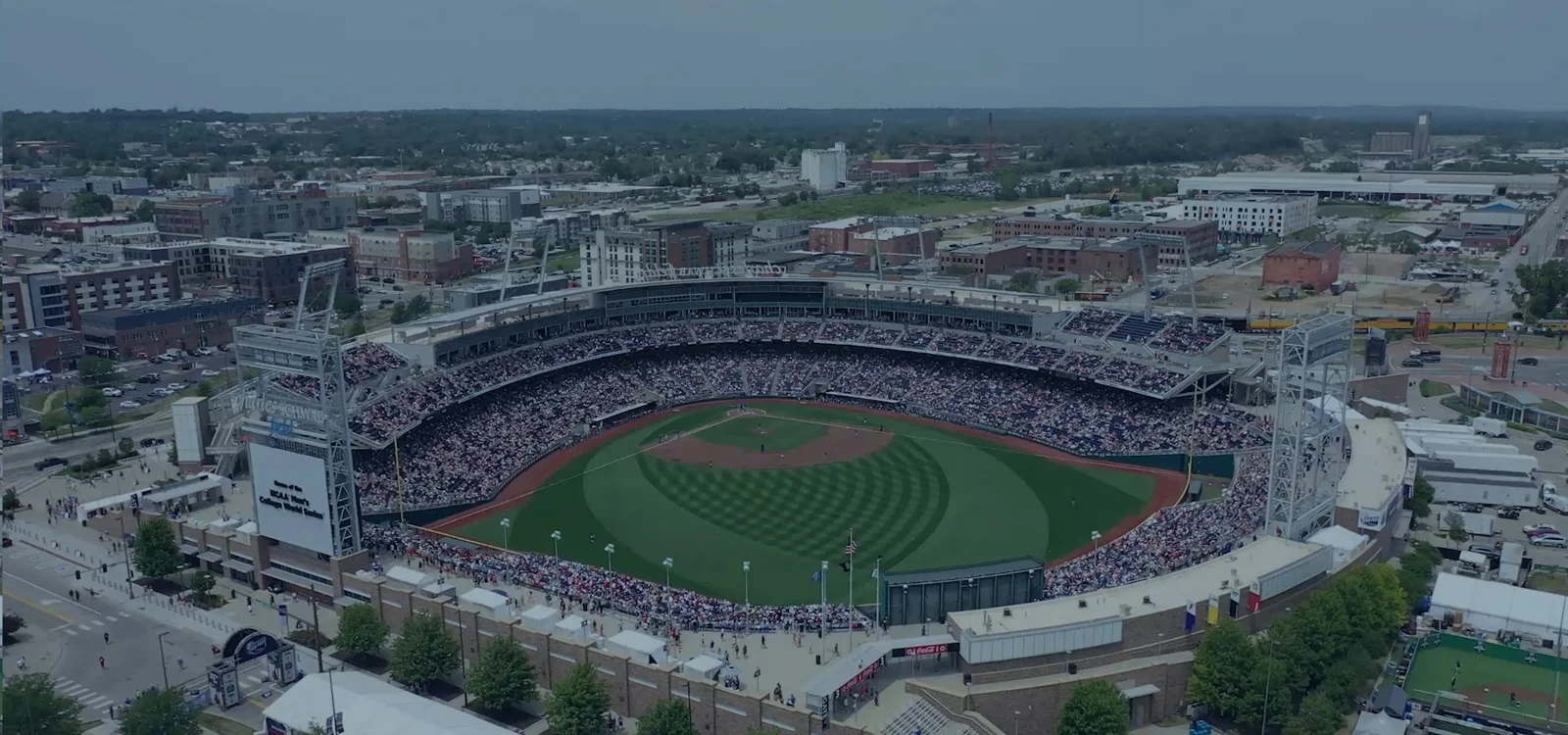
The Division I college baseball bracket starts with 64 teams, sends eight to Omaha and finishes with a best-of-three championship series. The confusing part is the route between those numbers: a regional is double elimination, a super regional is a short series, and Omaha contains another bracket stage before the finals. Read each stage separately and the lines become much easier to follow.
This guide explains the format using the NCAA's latest accessible championship materials, checked in October 2026. It is not a released 2027 bracket. Follow the official bracket and announcements for the eventual field, hosts and game assignments.
Read the college baseball bracket as four different competitions
A complete bracket is a route map rather than a promise that the two teams printed nearest each other will meet. Start with the stage heading, then identify the teams still alive in that particular competition. The NCAA championship hub connects the preliminary rounds to the Men's College World Series in Omaha. "College World Series" refers to the final eight-team event, rather than all 64 entrants.
Sixteen sites each produce one advancing team.
Eight series decide the Omaha participants.
Two separate brackets produce the finalists.
Two series wins secure the national title.
The most useful question beside any matchup is therefore not simply "Who wins?" Ask what happens to the loser. In one part of the event, a loss leaves a recovery route. In another, it puts a team one defeat away from going home. When the competition changes stages, put a mental line through the previous round and read the new format on its own terms.
A team's season record is a different layer of information. A school can arrive with many regular-season losses, win its regional and keep advancing; the bracket does not add those earlier defeats to its elimination count. Likewise, a regional winner does not bring a one-game series lead into the next weekend. Keep season statistics, bracket losses and series scores in separate columns if you are following several teams.
Check the year before saving a bracket image. An old completed bracket is excellent for learning how a path unfolded, but its hosts, pairings and dates are historical. A preseason projection is an opinion about who might qualify. The official selection release is the source for the actual field. Those documents can look almost identical on a phone, so the date and publisher deserve attention before the team names.
For readers coming from basketball's tournament, the key adjustment is patience: an opening defeat can transform the route without ending it. That recovery possibility creates extra games and tactical decisions, which is why a college baseball bracket needs more explanation than a conventional single-elimination tree.
How teams enter the field and receive their seeds
Selection, seeding and hosting answer three different questions: which teams enter, where those teams sit in the draw, and which ballparks stage the games. A strong seed helps describe a team's position, but it does not turn a regional into a walkover. A fan should separate those decisions before trying to forecast a route to Omaha.
Automatic bids and at-large selections
The 2025-26 NCAA prechampionship manual allocated 29 places to automatic qualifiers and the remaining 35 to at-large selections. Those are the documented 2026 numbers; consult the next season's selection material for its allocation. Automatic qualification follows a conference's designated championship process. An at-large place comes through the national committee's evaluation.
This distinction explains the tension during conference tournaments. Imagine a league with one team that looks safely within the at-large field and another that needs the automatic bid. If the second team earns that bid, both may enter the national field, leaving one fewer at-large opening for everyone else. That is the logic behind a "bid stealer." It is a description of a possible selection consequence, not an accusation that a champion took an undeserved place.
Do not use a single poll position as an admission ticket. The committee's evaluation includes record, schedule and other evidence; RPI is an additional tool rather than a self-executing selection list. A team's reputation and the number beside its name on a television graphic cannot replace its actual selection status. Our rankings guide explains why a poll and RPI can tell different stories.
When a school celebrates a conference regular-season title, check the league's automatic-qualification arrangement before marking that team into the national bracket. The regular-season race and the postseason tournament may award different things. Until the official field appears, keep "qualified," "projected" and "on the bubble" as separate descriptions.
A national seed is different from a regional seed
A concrete example makes the two scales clear. In its 2025 regional announcement, LSU was the No. 6 national seed and the No. 1 seed in Baton Rouge. Dallas Baptist, Rhode Island and Little Rock occupied regional seeds 2, 3 and 4. Little Rock's 4 did not mean fourth-best team in America; it described a position in that four-team regional.
Read a bracket's legend before interpreting an isolated number. National seeds describe the larger draw, while regional seed labels organize the local opening matchups. A broadcaster may also show a poll rank. Three numbers associated with one school can therefore all be correct while measuring different things.
Hosting is valuable because familiar surroundings and a home crowd can change the experience. It is still an administrative award with venue requirements, not a win credited before first pitch. Never write the host directly into the next round, and do not infer the designated home team for every individual game merely from the name of the stadium.
Regionals: four teams, double elimination and an if-necessary game
In a regional, one loss changes the route; the second eliminates the team. The opening pairings are regional seed 1 against 4 and 2 against 3. The official regional schedule then separates the opening winners from the opening losers. This is why an ordinary four-team single-elimination drawing leaves out most of the weekend's story.
Follow one team through the winners' and losers' paths
Use this hypothetical regional to read the lines. A beats D in the opening game, and B beats C in the other. A and B next meet while both are unbeaten. C and D play an elimination game because each has already lost once. Assume A beats B and C eliminates D. C must then beat B to reach the regional final against A.
| Point in the example | Still unbeaten | One loss | Eliminated |
|---|---|---|---|
| After opening games | A, B | C, D | Nobody |
| After A beats B and C beats D | A | B, C | D |
| After C beats B | A | C | B, D |
At that point A needs one win to advance, while C needs two. If A wins their first meeting, C has its second loss and the regional ends. If C wins, A has only its first loss. Both must play again because neither has yet been eliminated. That rematch is the if-necessary game, usually labeled Game 7 in a standard regional schedule.
The label does not mean the organizer can casually choose whether to stage an extra exhibition. It means the earlier result determines whether that contest is required. A saved schedule showing a possible Monday game is therefore conditional until the final matchup's first result is known. Check the actual host's game numbering rather than assuming every generic bracket image uses the same layout.
Notice the difference between C's and B's paths. In this example C lost immediately and needed four consecutive wins to advance: D, B, A and A again. B opened with a win, so its problem began later. Saying both teams are "in the losers' bracket" hides the innings already played and the number of wins still required.
Why pitching depth changes a regional weekend
A clean regional can be three games for the winner. The opening-loss route in our example requires five games. Even before discussing individual pitchers, that is a substantial difference in innings that a staff must cover. A spectacular ace cannot automatically supply every important out, especially when the schedule compresses several elimination situations into the same weekend.
As an analytical example, consider two teams with similarly strong Friday starters. One also has dependable second and third starters plus several relievers who can bridge an early exit; the other relies on two late-inning arms. An extra game need not affect them equally. That is a reason to inspect recent pitching usage, rather than treating the opening score as a complete measure of the survivors' strength.
A long elimination game can also make the next pitching decision awkward. Using a trusted reliever today might secure survival while reducing tomorrow's options. Saving that arm makes no sense if there is no tomorrow, but spending every option early carries its own cost. These are baseball judgments, not a universal instruction to start or rest a particular pitcher. Watch who has thrown, how much they have worked and what the next confirmed matchup requires.
Super regionals: two teams and a best-of-three series
Sixteen regional winners become eight super regional matchups. Each is a best-of-three series: win twice and go to Omaha. A sweep ends the series after two games; a split requires a deciding third game. The regional's four-team traffic has disappeared, so the immediate task becomes beating one opponent rather than navigating several possible opponents.
The route is fixed by the original bracket. If a regional is paired with another regional, their winners meet even when a favorite loses. In a hypothetical pairing of the No. 1 and No. 16 national seeds' regionals, an upset does not trigger a new draw that sends the surviving favorite elsewhere. The upset winner takes its regional's place in that route. Trace the connecting line rather than rearranging teams by their remaining national ranks.
That makes the neighboring regional worth following before your own regional ends. You are learning who might be next, not checking a new selection contest. A bracket can establish a potential matchup while the venue remains subject to an official hosting decision. Keep the opponent path and the host announcement separate until both are settled.
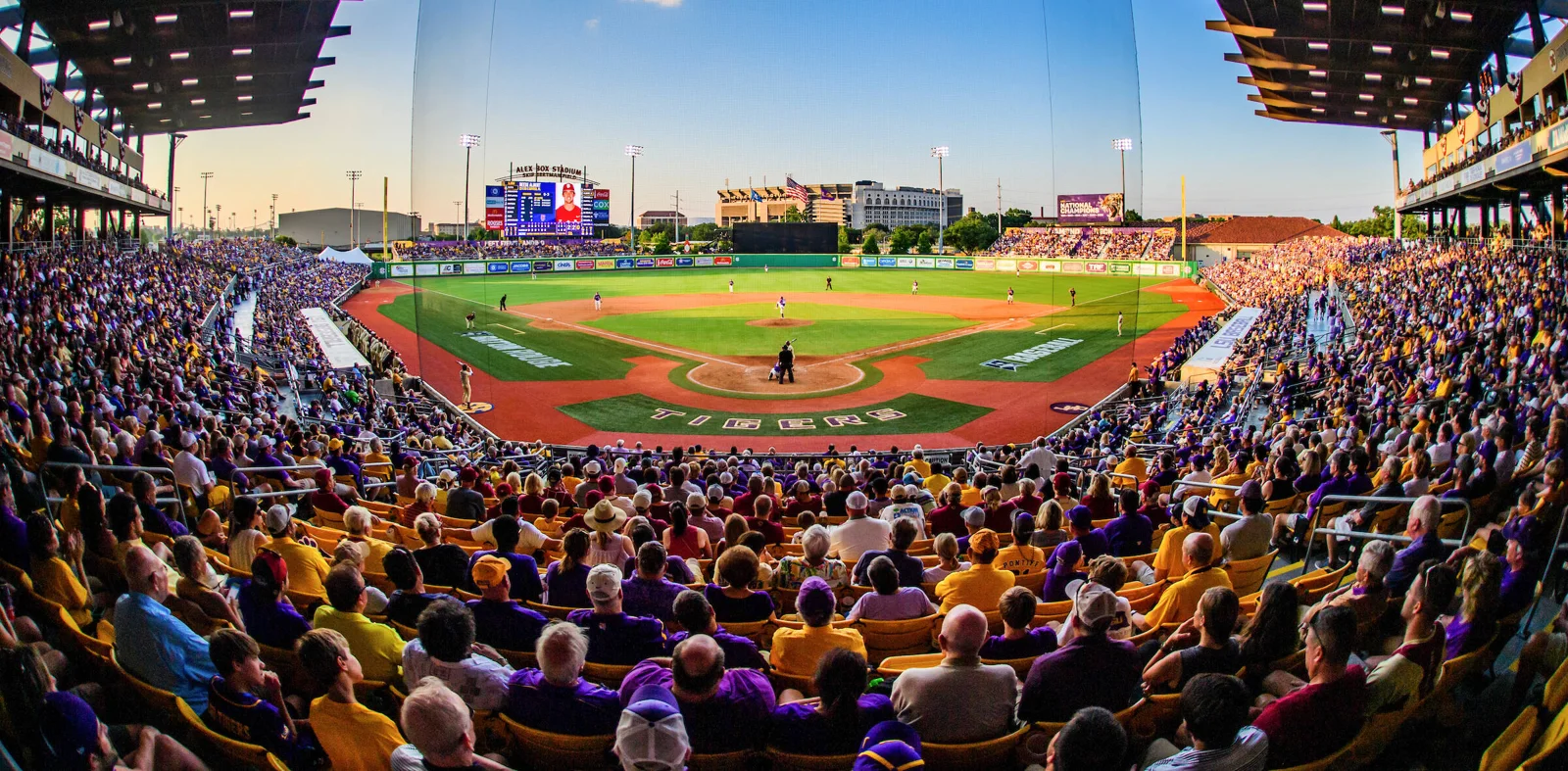
Even at the same ballpark, designated home-team assignments are a distinct detail. LSU's official 2025 super regional information sets out game-specific home-team arrangements. The relevant year's event information tells you which club bats last; a stadium bearing one school's name does not answer every game-day question by itself.
From a baseball perspective, the short series changes the value of depth without making it irrelevant. Two excellent starts can decide a sweep, but a split exposes the third starting decision. A club that survived a long regional may arrive with different recovery options from a club that used only three games. Neither circumstance supplies a guaranteed result: the opponent's lineup, available pitchers and timing of the series all matter.
When comparing teams, look past the regional final score to the distribution of work. Did a starter finish deep into the game? Did the same reliever handle several difficult situations? Was the last game a comfortable win or a long contest with little margin? Those questions help explain what each manager can reasonably ask of the staff next. They are more informative than assuming that a regional winner is automatically rested because the previous bracket has ended.
For a viewer, Game 2 has a simple fork: one club can clinch, or the series can be extended. For a traveler, that same fork determines whether the third game's ticket, hotel night and return journey will be needed. Treat the third date as a real possibility, then update the plan when the series score makes it certain or removes it.
Omaha: two brackets before a separate championship series
The eight super regional winners gather at Charles Schwab Field Omaha. Arriving there is a major achievement, but it is not a place in the championship series. A team first has to win its side of the Omaha bracket. That distinction explains why a school can be an Omaha participant without ever appearing in the finals.
The eight-team stage is still double elimination
The eight entrants are divided into two four-team brackets. Each produces one finalist through double elimination. They do not play a round-robin in which every school meets every other school, and a team does not cross into the other bracket because it dislikes its first result. Read its assigned half before counting possible opponents.
The opening game's importance resembles a regional's, but the context is different. Every opponent has already won two rounds of the national tournament. A team entering the elimination route must find enough effective innings against survivors that have earned their places, rather than assuming a lower regional seed will offer a simple recovery game. Seeding provides context; the actual matchup provides the baseball.
Suppose your team wins its first two Omaha games. It has improved its route, but a possible bracket-clinching game still has to be played. If the challenger wins that meeting and gives the previously unbeaten club its first loss, another meeting is needed. The extra game is a bracket rematch, distinct from Game 3 of the later championship series. Those two kinds of "if necessary" can appear on the same event calendar.
Watch the schedule as well as the score. A manager balancing a possible clincher against an additional elimination game is answering a different question from a manager who must win immediately. That difference can affect which reliever enters a close game, how long a starter stays in and what remains available for the final series. It offers a useful framework for analysis without pretending that every difficult pitching decision has one obvious answer.
The finals reset the problem to best of three
When the two bracket winners meet, two wins decide the championship series. A loss in an earlier Omaha bracket is not entered as a Game 1 defeat in the finals. Equally, an unbeaten route does not supply a free series victory. The finalists begin a new series score, and the championship comes from winning that series.
Consider a hypothetical finalist that survived an opening Omaha loss and then recovered. It can still win the title in two finals games. The other finalist may have reached the series unbeaten, but it must also win twice. The earlier paths matter through workload, recovery and experience, not through a carried-over one-game advantage.
This is why the phrase "double elimination" needs a stage attached to it. It correctly describes the four-team Omaha brackets, but the final decision is a best-of-three series between the bracket winners. If a team loses the first finals game, the next one is an elimination situation for that team. If it wins Game 2, both teams have a chance to clinch in Game 3.
The best way to follow the last weekend is to keep a small pitching ledger beside the series score: recent outings, approximate workload and the likely next available options. A famous program or a dominant regional record cannot pitch an inning by itself. The path has established who remains; the available players must finish the job.
Use the bracket to plan games without assuming the next opponent
A bracket is most useful when you combine it with the live schedule. The bracket tells you the route; a game listing tells you when, where and how to follow the next step. Start with our college baseball schedule, then confirm the host's official event information once the postseason assignments are announced. Before selection, a possible host or projected matchup remains a planning scenario.
Ticket labels deserve the same attention as team labels. A session, an individual game and a full-series book can cover different things. LSU's 2025 regional ticket announcement, for example, handled the possible seventh game separately from Games 1-6. That historical example illustrates why a bracket's extra box does not tell you what a particular ticket includes.
A practical checklist for the next tournament
- Identify the season and stage. Write down whether you are viewing a regional, super regional, Omaha bracket or finals series. Check that the graphic is official and current.
- Record the relevant result. In a double-elimination bracket, track each team's losses. In a best-of-three series, track series wins. Do not mix either with the regular-season record.
- Follow the next connecting line. Find the winner's destination and the loser's destination. Use the paired regional, rather than a newly imagined ranking order, for a possible super regional opponent.
- Mark conditional games. Keep the regional rematch, Omaha bracket rematch and third series game distinct. A conditional listing becomes definite only when the necessary result occurs.
- Recheck the actual event. Confirm the venue, local time, ticket session and broadcast listing. Weather or scheduling announcements can change the practical plan even when the advancement path is unchanged.
For television, use the TV schedule and viewing guide to investigate the specific game. A network name attached to one matchup does not settle access to the entire tournament, and a video highlight is not proof that a full live stream is free. Check each confirmed listing before committing to a subscription or a viewing plan.
For travel, decide how much of the uncertainty you want to cover. Someone visiting to experience several teams may value a full regional weekend, while someone following one club must account for both elimination and an additional game. Compare the ticket and accommodation terms that apply to your booking; the bracket itself does not promise refunds, entry to every session or a particular return date.
Finally, make sure you are following the correct championship. The format here is NCAA Division I. Other college baseball associations and divisions have their own paths, discussed in our college baseball divisions guide. Once the season, stage and loss count are clear, you can spend less time deciphering boxes and more time judging the next pitching matchup.
Join the conversation
Share a question or a thought about college baseball. Comments are reviewed before they appear. Keep it friendly and on topic.
No comments yet. Start the conversation.
Sign in with Google to leave a comment. Your email address is not displayed.