Pac-12 baseball's 18-game conference schedule in 2027 is six three-game series: one against each of the other six baseball opponents. The published slates split those series into three at home and three away. That explains how the number is constructed. It does not establish a publicly stated reason why the conference chose this format over 24 or 36 games.
The argument is about what those six weekends should accomplish. Playing everyone once gives the league a common set of opponents, while leaving more weekends for nonconference baseball. It also gives each matchup only one home venue and asks schools to make their remaining schedules work. The tradeoffs become clearer when you separate the announced games from fan theories about who wanted them, then compare the alternatives on travel, competitive balance and national selection value.
Eighteen games means one three-game series against each opponent
The clearest official description comes from DBU's October 5 schedule announcement. It identifies six league weekends, with road trips to Fresno State, Gonzaga and Texas State, and home series against Washington State, San Diego State and Oregon State. Six series multiplied by three games produces the 18-game slate.
Oregon State's October 8 announcement independently states the 18-game total and nine conference games in Corvallis. Its opener is a home series against Washington State on April 16-18. These are upcoming 2027 games, rather than results from the previous spring.
The small number therefore does not mean a school skips some of its conference baseball opponents. It means each pairing gets one series instead of repeated series. Nor does it mean that an entire season lasts only 18 games. The league slate is one part of a schedule that also contains nonconference weekends and midweek games.
A three-game series also has a different sporting meaning from three unrelated dates. It tests a rotation beyond the opening starter and asks a bullpen to manage consecutive days against the same lineup. A club that wins Friday still has to prepare for Saturday and Sunday; a starter leaving early can change the relief options available for the remaining games. The proposed comparison should therefore count weekends as well as games.
There is an important limit to the answer. The two school announcements establish the calendar, but neither supplies a documented account of a league vote choosing 18 rather than another number. Explaining the arithmetic is justified; announcing that a particular program forced the decision is not. Any policy explanation needs an attributable statement beyond the fact that a school benefits from some aspect of the arrangement.
For fans, this is the right starting distinction: the published format answers whom a team plays and how often. The debate asks whether that is enough conference baseball to produce a satisfying race. Those are connected questions, but one official schedule cannot answer the second simply by existing.
The format balances opponents more neatly than venues
A single round of series has an obvious strength: everyone faces the same six conference opponents. A contender cannot explain its record by saying it missed another member entirely. The three-home, three-road split also gives each school the same number of league weekends in its own ballpark.
Those forms of balance do not make the schedules identical. Gonzaga's published slate places Oregon State in Spokane on April 23-25 and sends the Zags to Washington State the following weekend. Oregon State's schedule, meanwhile, sends the Beavers to both Gonzaga and DBU. Those are particular venue assignments for particular opponents.
One visit makes the home-field draw matter
The fairness question is not whether every club receives nine home games. It is which opponents arrive for those games. In a hypothetical season with one especially strong contender, hosting that team would be a different assignment from visiting it. Equal totals of home dates cannot erase that difference. This is a structural concern, rather than a claim that one real 2027 opponent has already proved strongest.
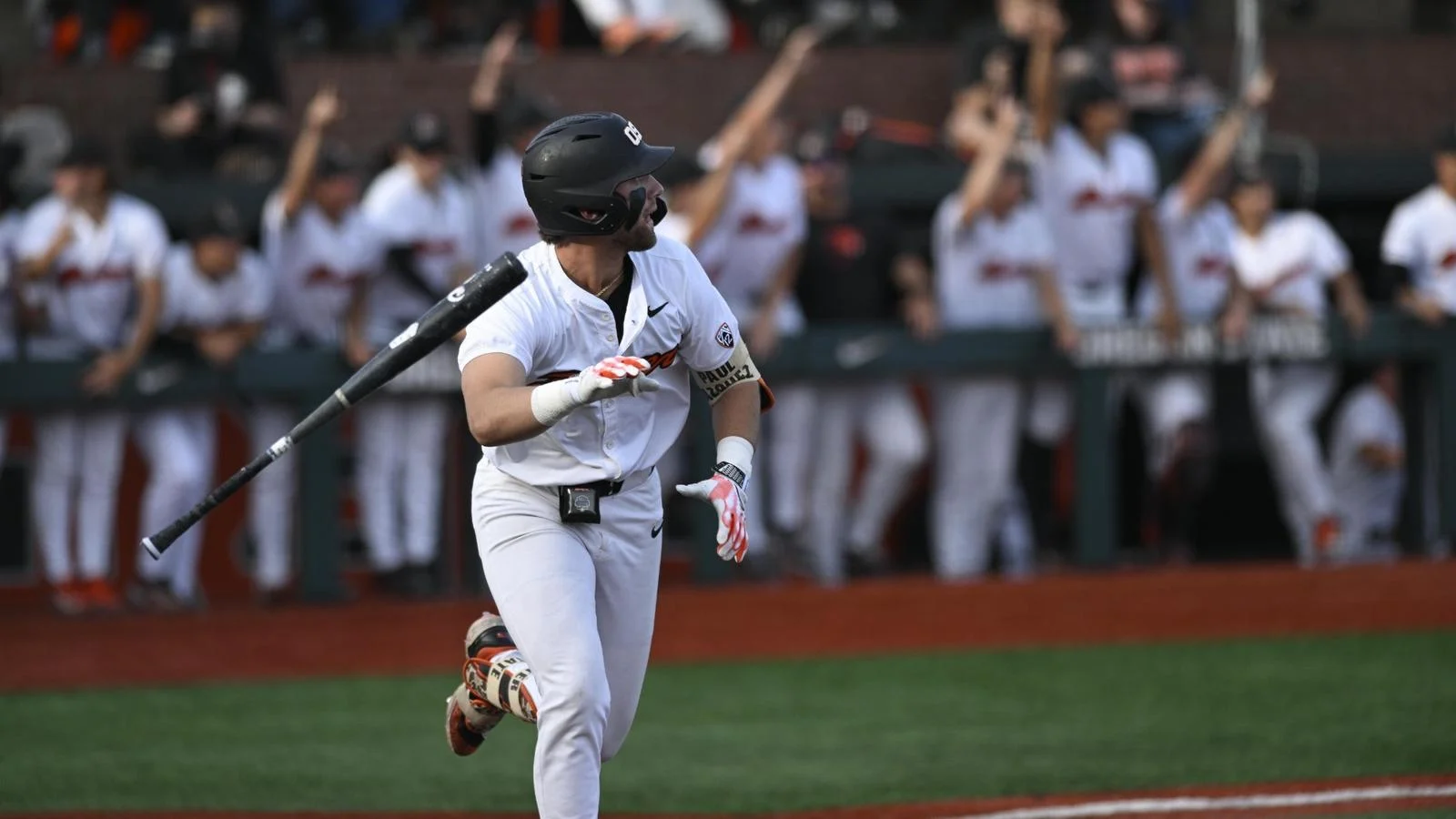
The home crowd is part of that setting, alongside the park and travel. Oregon State's Goss Stadium gallery shows the kind of established home environment a visiting team encounters. A photograph cannot calculate a home-field advantage, but it can illustrate why playing at a campus park is not interchangeable with hosting the same team elsewhere.

There is also no return series within this league format to reverse the venue later in the same spring. A club gets one weekend to solve the opponent's pitching and lineup in that setting. Losing two games after an early rotation problem cannot be answered by another conference visit to the same opponent a month later.
Each completed game represents one eighteenth of the planned league slate, approximately 5.56 percent. In a 36-game version it would be one thirty-sixth, approximately 2.78 percent. That arithmetic describes the smaller sample; it does not prove that one format produces the correct champion. More games provide more observations, while fewer games make each available opportunity a larger part of the conference record.
An alternating home assignment in a future year could address a different kind of balance over time, but the 2027 announcements alone do not establish a guaranteed rotation policy. Assess the published spring on its own terms instead of treating an assumed 2028 return trip as an already announced remedy.
What 24 or 36 conference games would change
The Pac-12 fan discussion raises several concrete alternatives: more rivalry series, a complete home-and-home arrangement and four-game series. These are suggestions from commenters, rather than an announced conference review. They nevertheless identify the choices behind the complaint that six weekends feel insufficient.
Twenty-four games requires a choice about repeat opponents
If the league keeps the current three-game series structure, 24 games means eight series. After playing all six opponents once, a team would need two repeat series. The immediate question becomes which two opponents repeat. Rivalries can make those weekends attractive, but different repeated opponents can also give contenders different levels of difficulty.
For example, imagine two teams fighting for first place. One repeats the eventual strongest and second-strongest opponents; the other repeats the eventual weakest pair. The extra games enlarge the sample, yet the schedules are no longer balanced by opponent frequency. That hypothetical does not establish how the real schools would finish. It shows why adding six games requires a scheduling policy, not merely a larger total.
There is a separate 24-game option: four games against each of six opponents. A commenter explicitly raises four-game series, and that version would not require repeat series. It would instead add a fourth game to every league matchup, changing the demands on rotation depth and the weekend timetable. The alternatives should not be collapsed into one supposedly obvious fix.
A full home-and-home schedule doubles the league commitment
Two three-game series against every opponent produces 36 games across twelve series. That version addresses the one-venue objection directly: each pairing takes place once at each school. Every club would have eighteen home and eighteen road conference games, rather than nine of each.
| Illustrative format | League games | Series per team | Main choice |
|---|---|---|---|
| Current one series per opponent | 18 | 6 | Single venue per pairing |
| Eight three-game series | 24 | 8 | Which two opponents repeat? |
| Full home-and-home | 36 | 12 | More weekends committed to league play |
The price of that symmetry is calendar commitment. Twelve conference series leave fewer weekends for other opponents than six do. Whether that is desirable depends on what those displaced nonconference weekends would have contained. Removing an awkward trip to weak opposition and removing a valuable series against a national contender are different sporting decisions.
Comments attributing the shorter schedule to Oregon State's wishes belong in the opinion category unless an attributable official explanation emerges. A format can offer a school useful flexibility without proving that school dictated it. Fans can debate the merits of 18, 24 or 36 games using the announced structure, without needing an unverified account of the negotiating room.
Fewer league weekends shift work into the nonconference schedule
The freedom left by an 18-game slate has to be used. A school still needs opponents willing to play on suitable dates and terms. An open weekend creates an opportunity to arrange an attractive series, but does not deliver that opponent, the venue or the travel arrangements automatically.
Oregon State's October 21 full-schedule announcement makes the distinction tangible. The Beavers are scheduled for a nonconference series at USC on April 9-11 and a four-game home series against Texas Tech beginning March 11. The latter is also a real example of a four-game weekend arrangement, separate from the Pac-12's three-game league series.
Those choices cannot be understood by looking only at an empty conference calendar. One weekend may become a home attraction; another may take a team to a different region. The value depends on the actual opponent and the rest of the itinerary. A strong nonconference schedule is an accomplishment of scheduling work, not an automatic property of having fewer league games.
Travel is similarly specific. DBU's conference announcement describes Spokane as its longest league road trip and San Marcos as its shortest. Replacing an additional conference series with a nearby opponent could reduce a particular travel burden; replacing it with a distant event could increase it. The word nonconference does not establish either outcome.
A midweek game and a weekend series also solve different problems. A nearby Tuesday opponent can be convenient, yet it does not fill three weekend dates or test the same sequence of starters. The pitching staff has to navigate the resulting rhythm: how deep the previous weekend's starters went, which relievers worked and what is available for the next series. Counting opponents without their dates misses that part of the plan.
This is the substance behind the scheduling-cost complaint in the fan discussion. More games arranged centrally within conference play can provide predictable opponents, while more nonconference freedom puts more of the arrangement on each program. Without published budgets or contract terms, it is not possible to turn that concern into a verified dollar increase for every school. The responsible comparison is between the completed itineraries, rather than between two labels.
An eighteen-game slate cannot guarantee a better RPI
The national-selection argument is the strongest sporting reason to examine what replaces conference games. It is also where the discussion most easily overreaches. A smaller league slate can create room for demanding nonconference opponents; the count alone cannot establish an improved Rating Percentage Index or an NCAA tournament place.
The NCAA's 2025-26 Division I baseball manual describes RPI through a team's Division I winning percentage, its opponents' winning percentages and their opponents' winning percentages, with adjustments. It also describes the index as an additional evaluation tool. That is the most recent manual verified here, rather than a claim that a 2027 selection handbook has already settled every provision.
The replacement opponent and the result both matter
Imagine replacing a second conference series with a road weekend against an outstanding nonconference team. The opponent may provide useful schedule strength, but the club still needs to compete and win games. A difficult assignment that yields three losses is not the same accomplishment as winning that series. The effect cannot be read from the opponent's familiar logo alone.
Now imagine replacing that league weekend with an undemanding home series. The team might improve its raw winning percentage, while the surrounding opponent information tells a different story. Those invented examples do not supply enough data to calculate either team's index. They explain why calling a game nonconference is not, by itself, a metric advantage.
The wider network matters too. An opponent's season can strengthen or weaken after the matchup is arranged. A forecast made when the schedule is released is not the same thing as the final quality of those games. This limits confident October claims that one particular 2027 scheduling choice has already improved a team's eventual position.
Selection is broader than a conference's preferred metric argument. The verified manual includes nonconference performance, road performance, conference results and comparative evidence among the information considered. A short league season therefore has to produce a convincing overall season, not merely a promising explanation of how the schedule was designed. Our rankings and RPI guide explains those distinctions in more detail.
The useful test is specific: which opponents filled the available dates, where were the games played, and what did the team achieve? That can support a serious assessment once results exist. The statement that 18 conference games must improve RPI cannot.
Judge the 2027 plan by its actual series and results
For following the season, keep a series record rather than just an 18-game total. Note the opponent, venue, dates and conference designation, then add the completed results. That lets you distinguish a difficult road series from a home sweep and prevents another meeting between the same schools from being counted as a league game without checking its status.
DBU and Oregon State are scheduled to finish their conference slates against each other in Dallas on May 20-22. The DBU announcement then places the Pac-12 tournament in Corvallis on May 27-30. Those are separate stages of the announced calendar. The regular-season format should not be confused with the tournament's eventual results or treated as a complete explanation of postseason access.
When comparing contenders, ask what happened across the three games. Did the rotation supply competitive starts after Friday? Was a lost series the product of repeated command problems or one difficult inning? Were important relievers already used in a nearby midweek game? Those questions add baseball evidence to a standings comparison without turning one weekend into an excuse to ignore the record.
Use the scores page for completed games and the daily schedule for the date you are following. Keep the displayed season attached to any saved result. An October announcement is a plan for the following spring, and weather or later scheduling changes can alter individual dates. The scheduled eighteen should not be reported as eighteen completed games before they happen.
The debate will become more informative once the actual nonconference series and conference results can be compared. A supporter favoring home-and-home can test the importance of venue balance. A supporter favoring flexibility can point to the opponents secured and the achievements against them. Both arguments need evidence beyond the number of league games. Until then, the firm answer is six three-game series, with the policy's advantages dependent on how the rest of the season is arranged and played.
Join the conversation
Share a question or a thought about college baseball. Comments are reviewed before they appear. Keep it friendly and on topic.
No comments yet. Start the conversation.
Sign in with Google to leave a comment. Your email address is not displayed.