
College baseball’s 2027 ABS experiment gives eligible players a way to challenge a called ball or strike. It does not mean a computer will automatically replace the plate umpire on every pitch, or that every college game will use the system. The published NCAA protocol starts each team with three challenges, retaining successful requests and consuming unsuccessful ones. Actual implementation still depends on the competition.
That last qualification matters. The NCAA’s announcement and its experimental document describe different boundaries for where ABS may be used. A conference announcement can establish a real plan for league games, but a general headline cannot settle every regular-season or postseason question. As of October 31, 2026, those distinctions belong in any useful guide to the coming season.
Here is how to understand the experiment, follow a challenge and assess a player’s decision without importing a different league’s rules.
Where ABS may be used in 2027
ABS is an experimental option, not a nationwide requirement for every 2027 college baseball game. Permission to experiment, a conference’s decision to participate and the actual operation of a particular game are separate steps. A fan needs the last two as well as the national announcement before expecting to see a batter tap his helmet and receive an electronic answer.
There is already a concrete conference example. In its October 2 announcement, the Sun Belt said it would introduce ABS during conference baseball in 2027 through its expanded Trackman relationship. That is an announced league plan. The same release discusses softball tablets, but that separate technology announcement does not turn the baseball commitment into a rule for every sport or every opponent.
Why the NCAA’s public documents need to be read together
The NCAA’s August 25, 2026 news release describes an optional challenge system that could be used in regular-season and postseason games, experimentally across all three NCAA divisions. Its experimental rules document updated August 24, however, limits approved experiments to conference play and explicitly excludes the NCAA postseason. These statements do not establish the same scope.
The safe reading is to keep that discrepancy visible. A difference of one day between publication dates is not enough to declare that one document silently canceled the other. Nor does finding several news reports repeating the announcement resolve the underlying conflict. For an NCAA tournament game, a reader should look for a specific later NCAA clarification rather than assume the broadest wording guarantees ABS.
For the regular season, identify the conference and whether the matchup falls within its announced implementation. A conference weekend and a nonconference midweek game can occur in the same ballpark while raising different authorization questions. Equipment being present does not answer which competition rules apply. Likewise, a schedule listing tells you who plays and when; it does not certify the technology protocol for that contest.
This is a reason to read the actual league announcement, not a reason to dismiss the experiment. The Sun Belt statement gives its fans something definite to anticipate. A school in another league needs its own applicable information. NCAA Division I, II and III also remain distinct from NAIA and junior-college baseball; a national NCAA news item should not be extended automatically to those competitions.
Keep the distinction when sharing preseason news: “the NCAA approved an experimental framework” and “this conference announced that it will use ABS” are both meaningful statements. Neither, by itself, proves that every college park or every stage of the road to Omaha will operate the same way.
How a ball-strike challenge works
The published protocol provides a player-driven correction process. A disputed pitch starts with an on-field decision; an eligible request then brings its location to the electronic zone. It is useful to separate the player’s authority to ask, the timing of the request and the team’s remaining allowance.
Which players can ask for a challenge
The general initiation rule names the pitcher, catcher and batter. They tap their cap or helmet, with a simultaneous verbal request encouraged. Other players and staff cannot signal whether to challenge, and electronic information cannot guide the decision. The ordinary request therefore comes from somebody directly involved in that pitch, rather than a coach waiting for a better replay angle.
That distinction changes what to look for. A hitter reacting unhappily is not necessarily initiating the prescribed request. A dugout argument is not a substitute for the player’s signal. Conversely, a quick tap can be more consequential than a lengthy exchange with the umpire. Follow the action that invokes the procedure rather than judging its validity from the amount of visible emotion.
Why the request must be immediate
The 2027 protocol requires an immediate request, with timeliness decided by the plate umpire. When a runner play or checked-swing appeal follows, the request can come immediately after that action. This is not an invitation to wait for a broadcast analysis.
Imagine a catcher watching a close pitch while a runner attempts to advance. The baseball play still requires his attention. That situation differs from a player standing still, waiting for somebody else to tell him whether the pitch was outside. The timing exception accommodates ensuing action; it does not turn the challenge into a delayed consultation. Do not assume a numerical window from another competition replaces the NCAA wording.
How successful and unsuccessful challenges affect the allowance
Three starting challenges do not mean only three total requests. Successful challenges remain available; an unsuccessful one consumes a challenge. The SEC’s May 2026 tournament explanation documented the same retention concept in that earlier experiment. The 2027 protocol makes it part of the published framework for the coming season.
In a fictional sequence, a team wins its first two requests and still has three challenges. Losing the next leaves two. A later batter is managing the allowance shared with his pitchers and catchers, not a private allocation attached to his own plate appearance. That is why one player’s marginal request can matter to teammates several innings later.
Extra innings provide a limited safeguard: a team entering an extra inning with none receives one for that inning, which cannot be carried forward. It is not an automatic addition to an allowance that remains unused. Starting the tenth with a challenge already available differs from starting it empty. Keep track of what remains before interpreting a late-game request, rather than resetting every team to a new total when regulation ends.
Which strike zone the system judges
A challenge needs a defined zone, not simply a computer’s opinion of whether a pitch looked good. The electronic test combines a fixed location over the plate with vertical limits calculated for the particular hitter. Understanding that geometry helps explain why a slow-motion shot of the catcher’s glove may be persuasive to a viewer without answering the system’s question.
Player height and the plate define the electronic zone
The NCAA protocol specifies a two-dimensional rectangle 19 inches wide, positioned over the middle of home plate. Its upper edge is 56% of the batter’s measured standing height and its lower edge 24%; any part of the ball intersecting that zone makes it a strike. The batter’s crouch does not redefine those limits. The figures appear in the protocol’s final strike-zone section.
Take a fictional player measured at 72 inches. Applying those percentages places the top at 40.32 inches and the bottom at 17.28 inches, a vertical span of 23.04 inches. These are calculations for an invented example, not somebody’s certified measurements. They show why two hitters of different heights do not necessarily face the same vertical rectangle even though the plate’s width stays constant.
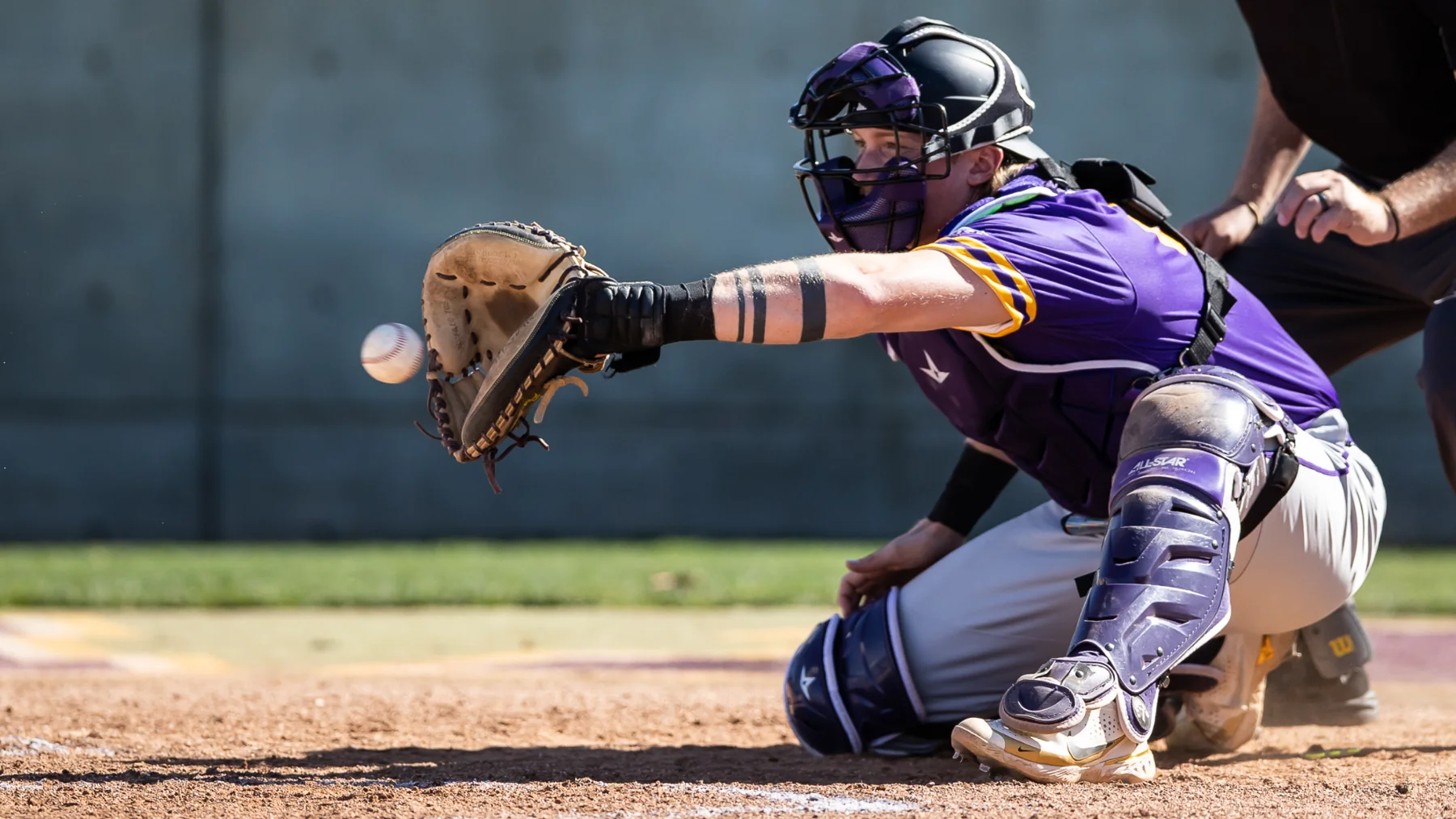
The point of reference is also different from where the catcher ultimately receives the ball. A pitch continues moving after passing the relevant plane. The glove, the batter’s stance and a camera placed to one side can all affect a viewer’s impression. A receiving photograph can explain those perspectives; it cannot supply the tracked coordinates needed to decide a challenge.
Why an MLB graphic or an older proposal can mislead
MLB starts with two challenges; the NCAA protocol starts with three. That simple difference already cautions against treating “ABS” as one universal rulebook. A familiar professional graphic can help a fan understand the idea of a challenge without establishing the exact geometry or allowance in a college experiment.
The date of an explanation matters as well. A preseason proposal, an earlier tournament test and an approved protocol describe different stages of a rule’s development. Use the applicable NCAA measurements rather than combining a boundary from an old story with a challenge total from a professional broadcast. A collection of individually plausible details can still describe a system no college game is using.
For a close pitch, the useful question is whether the ball intersected this hitter’s defined zone at the specified location. It is not whether the catcher moved his glove attractively, whether the hitter stood tall afterward or whether another broadcaster drew a slightly different box. Those observations concern presentation; the challenge needs the applicable electronic measurement.
When a challenge is worth using
The obvious high-stakes situation is a full count. On a taken pitch, changing the decision can separate a walk from a called strikeout. In a fictional game with the tying runner aboard late, that can alter the immediate shape of the inning. But a challenge does not have to concern the final pitch of a plate appearance to matter.
A real earlier example appears in Vanderbilt’s May 20, 2026 SEC Tournament box score. Florida successfully challenged a ball call on a pitch listed at a 1–0 count in Vanderbilt’s second inning. The record then shows Colin Barczi striking out later in that appearance. It demonstrates an early-count correction; it does not prove that one changed call single-handedly caused the strikeout or Florida’s eventual win.
The baseball logic is straightforward. A hitter ahead in the count may be able to narrow the pitch he wants. Adding a strike changes the pressure on his next decision. For the pitcher, avoiding another ball can preserve more options. A correction can therefore have value before two strikes or three balls, even though a terminal pitch makes the consequence easier to see.
The remaining allowance introduces a second question: how confident is the player that the call was wrong? A successful request leaves the opportunity available, but a failed one spends something the whole team may need. A hitter should not confuse his desire to avoid a strike with a strong judgment that the pitch missed. The catcher faces the corresponding distinction between wanting a strike and believing the tracked pitch will support one.
Consider two fictional decisions on equally borderline pitches. Early in the game, a team has all three challenges. Later, it has only one, with several important plate appearances still possible. Spending the final opportunity exposes the team to a different cost if the player is mistaken. That does not create a universal rule to challenge the first pitch and save the last allowance forever. It explains why the same degree of uncertainty can feel different in different situations.
Confidence and game consequence should be considered together. A highly confident correction in an ordinary inning may be more sensible than an emotional, poorly judged request simply because the game has reached the ninth. Conversely, a late pitch with a major consequence deserves attention even when the preceding innings were quiet. There is no defensible fixed success percentage or automatic inning-based answer established here.
For spectators, judge the choice using what was available before the result appeared. A failed challenge can be understandable; a successful one does not prove that every similar-looking pitch should be appealed. Watch the count, runners, outs and remaining allowance together. That produces a more useful discussion of the player’s baseball judgment than celebrating or condemning the request solely after seeing the electronic answer.
How to follow an ABS game from the stands or broadcast
Begin by identifying whether the game actually uses the experiment. Once play starts, keep the original call, the requested correction and the resulting count separate. A television graphic may make the process look seamless, but those are different moments, and each tells you something about what happened.
Separate the original call from the review outcome
After the request, watch the umpire’s announcement and the updated count. The protocol recommends a visual display but allows another available announcement method. It also preserves the field call and challenge when tracking fails. A missing measurement is different from an electronic finding that confirms the original decision.
That distinction helps when the presentation is less elaborate than a familiar major-league broadcast. An arena-style animation is not the rule itself. The information that matters is which call was challenged, whether it changed and what count now applies. A spectator who misses the first announcement should establish that sequence before concluding that the team lost an allowance or the umpire ignored a successful request.
Keep watching any runners as well. A pitch can be followed by baseball action that is separate from its location, and the umpires still have to administer the resulting situation. An electronic strike-zone answer is not a blanket instruction to erase everything else that happened. For a complicated play, wait for the completed ruling rather than reconstructing the bases from one graphic.
Watch the catcher’s work beyond the corrected pitch
A challenge system leaves much of the catcher’s job intact. Receiving the ball, blocking a pitch in the dirt and making a throw against a runner are different skills from recognizing that a called pitch deserves review. Correcting one location judgment does not complete those physical tasks or judge the entire defensive performance.
Imagine a fictional low pitch with a runner at third. The catcher still needs to keep the ball in front of him and respond to the runner’s action. Whether somebody might later ask about the pitch’s location does not make that responsibility disappear. Similarly, a hitter’s actual swing remains relevant: showing that a pitch was outside the electronic rectangle does not turn a swing and miss into a ball.
The experiment also does not justify declaring receiving technique irrelevant. Many pitches will not generate a challenge, and players still operate through an on-field call. It is more useful to watch how the catcher combines receiving, runner control and quick judgment than to reduce his evening to a single successful or unsuccessful tap of the headgear.
Use the college baseball scores page to locate the matchup and the TV schedule to identify listed viewing options. Then follow the conference’s implementation information and the game’s own announcements. A score listing or channel assignment can help you find the baseball; the applicable rules and the actual request explain what an ABS correction means.
Join the conversation
Share a question or a thought about college baseball. Comments are reviewed before they appear. Keep it friendly and on topic.
No comments yet. Start the conversation.
Sign in with Google to leave a comment. Your email address is not displayed.