The best college baseball coach depends on the achievement you value. National championships identify the highest peaks; career victories reward sustained success; repeated trips to the Men's College World Series show a program's ability to keep returning to the final stage. This selective Division I comparison uses those distinctions, with current appointments checked on October 20, 2026, rather than presenting an invented official coach ranking.
Define what a college baseball coach ranking measures
Begin by choosing the question. “Who built the strongest championship dynasty?” is different from “Who won the most games?” A coach can have an exceptional answer to one without leading the other. Combining them into a single number requires value judgments about how much a title, a postseason appearance or an ordinary regular-season win should count.
The NCAA baseball records index separates championship records and coaching categories, while also distinguishing the divisions. Follow that separation. This article concentrates on selected Division I head coaches and their Division I championship achievements. It does not claim that accomplished Division II, Division III, NAIA or junior-college coaches belong below them in a universal ordering.
For a useful comparison, record four things beside the name: the competition being measured, the period covered, the number of opportunities and the result. A completed career and five seasons in a current job are different samples. A program's long history is also different from the years credited to one coach. Give assistants and players their place in the achievement without transferring the school's entire trophy collection to its current head coach.
Three measures are especially useful together. Titles show that a coach finished a championship run. Postseason appearances show how often his teams reached the relevant stage. Career wins show the scale and persistence of the work. Winning percentage adds context to volume, but still needs a minimum sample, schedule context and an explicit rule for which games count.
These measures also leave questions unanswered. They cannot, by themselves, isolate a coach's decisions from recruiting resources, staff expertise or the players already on campus. Use them as evidence for an argument, then explain the argument. A clear statement that championship repetition matters most is more informative than a supposedly objective score whose weights are hidden.
Finally, distinguish the individual-coach discussion from the ABCA divisional coaches polls. Those polls have coaches voting on teams. A team's position in a weekly poll is not that head coach's position among the best coaches in history. The site's college baseball rankings can help you follow teams; the comparison here asks a different question about the people leading programs.
Use championship careers as historical benchmarks
Rod Dedeaux, Skip Bertman and Augie Garrido provide three strong starting points for a championship-centered discussion. Each produced repeated national titles, but the shape of those achievements differs. Read the championship years and the programs together before deciding which argument carries the most weight.
| Coach | Championship benchmark | What the comparison reveals |
|---|---|---|
| Rod Dedeaux, USC | Eleven credited by USC, including the shared 1948 title; five straight in 1970–74 | Exceptional concentration and repetition |
| Skip Bertman, LSU | Five: 1991, 1993, 1996, 1997, 2000 | A championship run within one program |
| Augie Garrido, Cal State Fullerton and Texas | Five: 1979, 1984, 1995, 2002, 2005 | Titles at two schools across four decades |
Rod Dedeaux and the concentrated championship dynasty
Dedeaux's strongest case begins with USC's five consecutive national championships from 1970 through 1974. Repeating the achievement across successive teams is a different test from assembling one outstanding season. It means that departures and new personnel did not prevent the program from continuing to finish at the top.
Be precise about his total. USC's retrospective and year-by-year record credit eleven championships, including 1948, when Sam Barry and Dedeaux were co-head coaches. A list assigning that shared championship to Barry alone can show ten for Dedeaux. Explain the shared credit before treating those totals as a factual disagreement about what USC won.
This is a compelling dynasty argument, but it does not require pretending the championship path was identical in every era. Keep the actual historical achievement intact. Do not describe an early USC title as if Dedeaux had navigated today's tournament stages, and do not convert the absence of that modern structure into an automatic deduction. The comparison needs its context.
Skip Bertman and Augie Garrido offer different paths to five titles
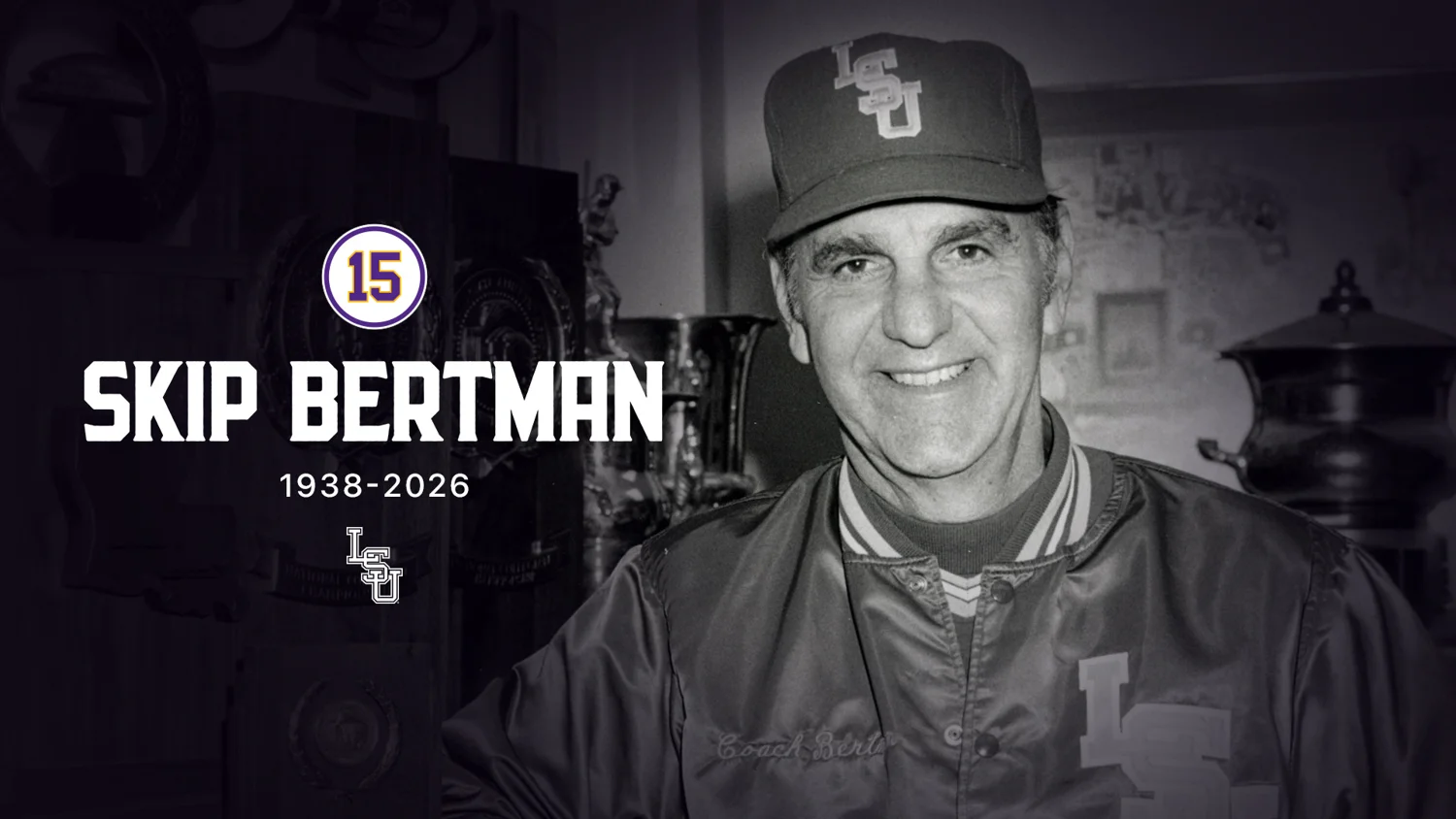
LSU's August 2026 retrospective records Bertman's five championships in 1991, 1993, 1996, 1997 and 2000 during an eighteen-season head-coaching tenure from 1984 to 2001. It also lists eleven College World Series appearances. That combination matters: LSU repeatedly reached the final stage and converted several of those opportunities into titles.
Bertman's case is particularly strong when the question is who established and sustained a championship standard within one program. The title years show a concentrated run rather than one isolated team. They also keep his contribution distinct from LSU championships won under other head coaches. A school's total is the product of several coaching eras, even when one era becomes central to its identity.
Texas's completed-career announcement gives Garrido a different five-title case: Cal State Fullerton in 1979, 1984 and 1995, followed by Texas in 2002 and 2005. Those championships span four decades and two institutions. For a reader who values the ability to build a championship team in more than one setting, that distribution is especially persuasive.
There is no need to force a false precision between Bertman and Garrido. Five championships at one school and five across two schools are the same title count with different supporting arguments. Decide whether concentrated dominance, longevity or success in another institutional setting is the priority, then say why. That produces a defensible comparison without disguising an editorial preference as a universal formula.
Separate career wins from success at the College World Series
Career victories accumulate across a schedule. College World Series victories count only games at the championship's final stage. An appearance counts a trip, regardless of how many games the team subsequently wins there. A national championship counts the completed title run. These are related achievements, but their totals cannot be substituted for one another.
The NCAA CWS coaching records covering 1947–2024 illustrate the distinction. That archive lists Dedeaux with 60 CWS game victories, Cliff Gustafson with 44 and Garrido with 41. Those are final-stage game wins, not national-title totals. The document's stated cutoff matters, particularly when reading rows for coaches whose careers continued beyond 2024.
For the completed careers, the numbers provide another view of repeated success. They show who kept winning after reaching the final field, whereas a career total also includes the much larger body of regular-season and earlier postseason games. Neither number should silently inherit the label or meaning of the other.
What Mike Martin's career tells us about consistency
Martin makes the case for looking beyond championships alone. Florida State's retrospective gives his final head-coaching record as 2,029–736–4 at retirement in 2019, with forty NCAA Tournament appearances and seventeen College World Series trips. These are his completed head-coach figures, rather than the school's later results or appearances made in another role.
The NCBWA's account of the award named for him also records at least forty victories in each of those forty seasons. Keeping a team competitive across that many years is a substantial achievement in its own right. The repeated opportunities show a program that could remain relevant through many changes of personnel.
Martin did not win the national championship. That fact matters in a title-centered comparison and should remain visible. It does not erase the distinction between one good season and four decades of qualifying for the tournament. Conversely, the career win total does not turn into a championship when the comparison changes categories.
A fair discussion can therefore reach different conclusions without changing the facts. A fan prioritizing championship finishes can prefer a multiple-title coach; a fan prioritizing sustained annual competitiveness can place more weight on Martin. State the preference and preserve the evidence. Reducing either argument to a single missing trophy or a single large number leaves out why the career is worth examining.
Date every comparison of current coaches
An active-coach list needs two current facts: what the coach has achieved through the stated season and where he is employed at the time of the comparison. An old biography can preserve useful history while showing an appointment that has changed. Updating the year in a headline does not update either part of that evidence.
The 2026 championship supplies a concrete reason to refresh the field. Oklahoma's June 22 report records Skip Johnson's Sooners winning the national title with a 13–2 victory over North Carolina in the deciding game. A current championship discussion cannot simply reproduce a list assembled before that season and leave the new champion out of the evidence.
A championship record does not establish today's job title
Brian O'Connor's example separates achievement from appointment. Mississippi State's June 2025 hiring announcement identifies the former Virginia coach and his 2015 championship with the Cavaliers. The university's 2027 coaching staff lists him as its head baseball coach. His championship remains part of his personal coaching record, but it does not become a Mississippi State team championship.
Tennessee offers a related warning about staff roles. Its October 25, 2025 appointment notice named Josh Elander head coach after his work on Tony Vitello's staff. Tennessee's current staff list confirms Elander in the job. A historical assessment of the earlier staff can recognize his contribution while still separating assistant and head-coach achievements. An old Tennessee listing for Vitello does not establish who leads the program now.
Use that discipline whenever a familiar name appears in a search result. Read the actual appointment and season, then attach championships to the school and role in which they were earned. This preserves a coach's record while also crediting the correct program and staff.
Compare long tenures with the same statistical cutoff
Tim Corbin and Jay Johnson illustrate why record dates need equal attention. Vanderbilt's Corbin biography explicitly labels its 964–461–1 school record as entering 2026. LSU's updated Johnson biography labels his 220–105 LSU record as entering 2027. Printing those figures together as though both were final 2026 totals would create a misleading comparison.
For a championship comparison through the completed 2026 season, the selected examples can use a common endpoint: Corbin's two Vanderbilt titles in 2014 and 2019; Jay Johnson's two LSU titles in 2023 and 2025; and Skip Johnson's 2026 Oklahoma title. These are examples of different championship records, not a claim that the three names form a complete active-coach leaderboard.
Tenure still matters even when the endpoint matches. Two titles over a longer appointment and two early in a shorter appointment support different questions about repetition and durability. A career record that combines several schools is another category again. Check what the total includes before calling every victory a Division I win.
For a current wins ranking, collect every coach's final record through the same completed season, apply the same competition rules and confirm that each remains in the defined active group. Until those conditions match, keep the dated facts separate. A transparent comparison is more useful than an apparently complete table built from biographies updated in different months.
Choose a comparison that fits the decision
For a historical debate, name the criterion before naming the winner. Dedeaux's repeated championships make the concentrated-dynasty case; Bertman and Garrido let you examine two different five-title careers; Martin makes sustained annual competitiveness impossible to ignore. A useful argument explains which achievement matters most rather than moving between categories whenever a different name comes out ahead.
For following the coming season, begin again with current personnel and the actual team. A school's historical reputation does not identify the pitchers available for next weekend or explain how a new staff will use a changing roster. The college baseball scores and team rankings can help you follow that season's outcomes. They provide context for assessing a program over time, while leaving the longer coaching comparison distinct.
Player development deserves the same care as win totals. A list of professional players can establish that a coach worked with them, but it does not isolate how much each improved because of that coach. Ask what the player was when he arrived, which staff members instructed him and what happened during the period being credited. Celebrating a successful alumnus and demonstrating a repeatable development process are different claims.
For a prospective player, investigate the actual staff and role
A prospective player needs to know who will do the daily teaching. The Tennessee staff directory, for example, separates head coach Josh Elander from assistant coach/pitching Austin Knight, recruiting responsibilities and support positions. Reading those roles is more useful for a pitcher than stopping at the head coach's name. Use the current directory and direct program information to confirm the actual arrangement.
Discuss the development plan in concrete terms. Which coach works with your position? What skills would the staff expect you to improve? How would progress be evaluated? What does the current roster suggest about competition for innings or plate appearances? Ask for the program's explanation instead of treating a trophy count as a personal playing-time promise.
Then investigate the university beyond the field: the academic program you would attend, the support available and how the actual baseball schedule fits those responsibilities. A long coaching tenure or a recent championship is valuable background, but neither answers all of those questions. Coaching appointments can also change, as the recent examples show.
The strongest choice comes from connecting the record to the decision. A fan can defend a historical preference with titles and sustained results. A player needs a current staff, a realistic role discussion and a workable university setting. Keep the evidence attached to that purpose, and a coach comparison becomes something more useful than a list of famous names.
Join the conversation
Share a question or a thought about college baseball. Comments are reviewed before they appear. Keep it friendly and on topic.
No comments yet. Start the conversation.
Sign in with Google to leave a comment. Your email address is not displayed.